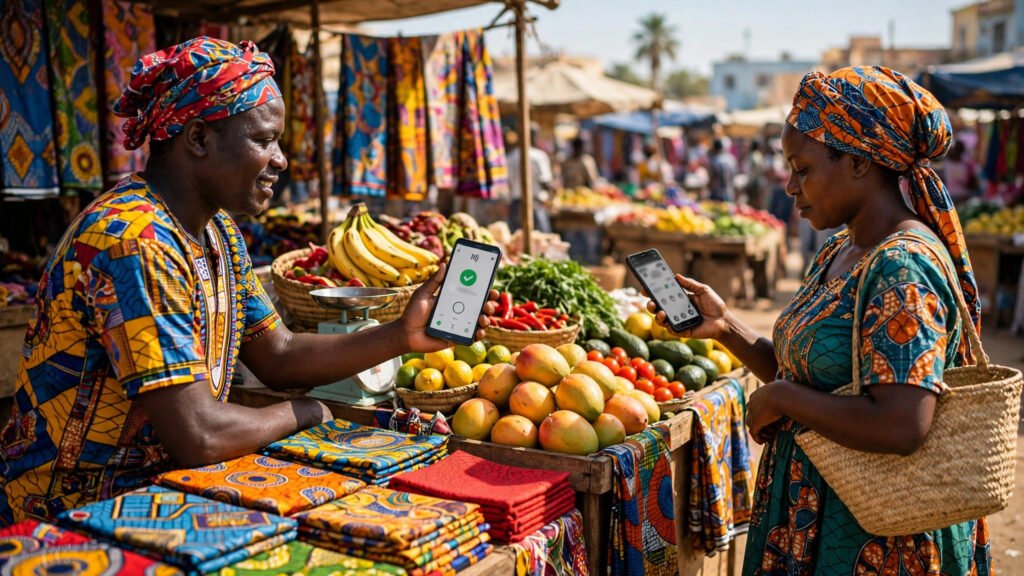
In markets across Dakar, in neighbourhood shops in Thiès, and at roadside stalls far from the capital, a small everyday scene now repeats itself: a customer opens an app, scans a code or types a phone number, and the payment is done in seconds. For many people in Senegal, that app is Wave, and it has quietly changed how daily money moves.
So why do so many Senegalese pay with Wave instead of reaching for cash or a bank card? The answer is not about one feature. It is about what fits daily life: most adults carry a phone, many do not use a traditional bank account for everyday spending, and small payments need to be fast, simple and easy to confirm.
Key Takeaways
- Wave fits daily life in Senegal because it works from a phone number, not a bank branch visit.
- Small, everyday payments — market shopping, transport and bills — are quicker and easier to confirm on a phone.
- Cash still matters, but phone payments remove the need to carry notes, find change or queue at a counter.
Why Cash Became Inconvenient for Everyday Payments
Cash works, but it has friction. Notes get worn, change runs out, and carrying larger sums feels risky. For a market trader, every cash sale also means counting, storing and later depositing money. A phone payment removes several of those steps at once, and both sides can see the result immediately.
That confirmation matters. When a buyer sends money and the seller sees it arrive, there is less doubt and less delay. In a busy market, that speed keeps the queue moving and lets traders serve the next customer sooner.
Why a Bank Card Is Not Always the Default
Bank cards are common in many countries, but in Senegal a card only helps if the buyer has a bank account, the seller has a terminal, and the connection works. In many small shops and open markets, none of those conditions can be taken for granted.
A phone-based wallet changes the requirement. The phone itself becomes the payment tool, and the seller does not need expensive equipment to accept a payment. A printed QR code or a phone number can be enough to receive money, which is why small businesses have adopted phone payments so readily.
A phone payment removes several of those steps at once, and both sides can see the result immediately.
How Wave Fits Senegalese Daily Life
Wave was built around a simple idea: sending money should feel as easy as sending a message. Users generally sign up with a phone number, add money through agents or linked options, and then send, receive or pay from the app. For people who already use their phone for calls, messages and social media, that learning curve is short.
The app also fits how people actually spend. Daily life involves many small transactions rather than a few large ones: breakfast, transport, a top-up, groceries, a bill. Phone payments suit that pattern because they work for small amounts without a trip to a bank or an ATM.
- Payments work from a phone number, so no card terminal is needed at small stalls.
- Both buyer and seller get quick confirmation of a completed payment.
- Money can be sent to family in another town without travelling to deliver it.
- Daily spending, bills and small business sales can all run through the same phone.
The Role of Agents and Everyday Trust
Behind every popular mobile money service is a human network. Agents in shops and kiosks help people add money, withdraw cash and solve problems. That face-to-face help matters, especially for first-time users who want someone nearby to explain a step or confirm a transaction.
Trust also grows through repetition. Once a person has paid a regular trader, a transport operator or a utility bill through the phone several times without trouble, the phone becomes the normal way to pay — not an experiment. Friends and family recommendations speed that process up further.
What About Orange Money and Other Options?
Wave is not the only option in Senegal. Telecom-linked wallets such as Orange Money have long been part of the same landscape, and many people use more than one service depending on who they are paying. Across West Africa, this pattern repeats: in Nigeria, shoppers often reach for OPay and PalmPay instead of bank cards, while in Ghana many people pay with mobile money instead of bank cards, and in Mali Orange Money is a common everyday choice. The services differ, but the reason people choose them is similar: the phone is already in their hand.
Competition between services can also help users, because each provider tries to make sign-up, transfers and payments simpler. For small traders, accepting more than one wallet means fewer lost sales when a customer prefers a different app.
Where Cash Still Has a Place
Phone payments have not replaced cash entirely, and they do not need to. Some sellers still prefer notes, some customers keep cash for small or informal purchases, and a flat battery or a weak signal can interrupt any phone-based payment. In those moments, cash remains the fallback.
The shift is therefore best understood as a change in the default, not a complete replacement. For a growing share of everyday spending, the phone comes first — and cash stays in reserve for the situations where it still works best.
What to Watch Next
The story of Wave in Senegal is, at its core, a story about convenience meeting daily habits. Phone payments won ground because they fit small transactions, small businesses and a phone-first population, and because confirmation is instant for both sides.
What to watch next is whether that same convenience extends further: more bill payments and business tools inside the same app, wider acceptance beyond cities, and smoother ways to move between cash and phone money. Whatever comes next, the habit itself is already clear — for many Senegalese, paying by phone is now simply the easiest way to get through the day.