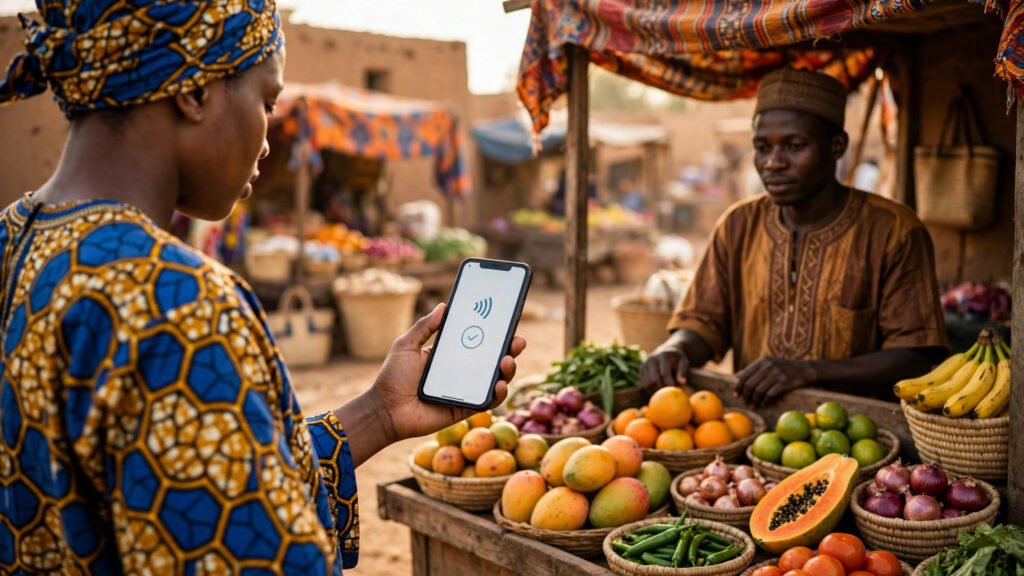
In Mali, a phone is often more useful for paying than a bank card. For many people, especially outside the big bank branches, the quickest way to send money to family, pay a shopkeeper, or top up airtime is Orange Money, the mobile money service linked to a mobile phone number. It does not ask the user to carry a card, visit a bank, or own a particular kind of phone. That simple fit with daily life is the main reason it has become part of how Malians handle small, everyday payments.
The question is not really about one app beating another. It is about what is available, what is trusted, and what works when cash is awkward and a bank account feels distant. In Mali, mobile money answers all three for a large number of people, and Orange Money is one of the names they meet most often.
Key Takeaways
- Orange Money lets Malians pay and send money from a phone number, without needing a bank card.
- It fits daily life because agents, basic phones, and small transfers suit how people actually trade and support family.
- Bank cards still have a place, but access, habit, and everyday convenience keep mobile money ahead for many small payments.
How Orange Money Works in Practice
At its simplest, Orange Money turns a mobile phone account into a wallet. A user loads money into that wallet, usually through an agent or a transfer, and then uses the phone to pay someone else, buy airtime, or settle a bill. The other person receives the money in their own wallet and can spend it, forward it, or withdraw it through an agent.
One reason this works so widely is that it does not depend on a smartphone. Many mobile money services in West Africa can be used with menu codes on a basic phone, so a person does not need mobile data or the newest handset to send money. For a trader, a driver, or a parent sending support to relatives, that low barrier matters more than any extra feature.
Agents are the other half of the system. Small shops and kiosks act as points where cash goes in and out of the digital wallet. That network brings the service close to where people live and work, rather than asking them to travel to a bank branch in a larger town.
Why Bank Cards Are Less Common for Everyday Payments
Bank cards are not absent from Mali, and they are useful for larger purchases, formal shopping, and withdrawals from machines. But for everyday payments, they face practical hurdles. Opening and keeping a bank account can feel formal and time-consuming, and a card is only useful where a shop has a terminal or an ATM is nearby. In many markets and neighbourhoods, neither is a given.
Mobile money flips that problem around. The phone is already in the pocket, the wallet is tied to a number people already use, and the person on the other end is likely to have the same kind of wallet. A payment can therefore happen between two phones in seconds, without extra hardware in the shop. Similar patterns explain why neighbours across West Africa lean on phone wallets too, from Togolese shoppers paying with TMoney and Flooz to Beninese users paying with mobile money.
The phone is already in the pocket, the wallet is tied to a number people already use, and the person on the other end is likely to have the same kind of wallet.
What Malians Actually Use It For
Day-to-day use is refreshingly ordinary. A customer pays a market trader without hunting for change. A family member in Bamako sends money home quickly when a relative needs it. A worker tops up airtime or pays a small bill without queuing. None of these are grand transactions, and that is exactly the point: mobile money earns its place by handling the small, repeated payments that make up most of daily life.
It also helps across distance. Mali is a large country, and moving cash between towns can be slow and risky. Sending money by phone avoids a long trip for a small amount, and the recipient can collect or spend it locally. For families spread between cities and villages, that convenience is hard to give up once it becomes a habit.
- Paying market traders and small shops without needing change or a card terminal.
- Sending money to family in another town or village quickly, without travelling.
- Topping up airtime and paying small bills straight from the phone.
- Withdrawing cash through a nearby agent when notes are actually needed.
Trust, Habit, and the Limits That Remain
Trust grows through repetition. When a payment arrives as expected, time after time, people keep using the same method and recommend it to others. Orange Money benefits from being attached to a mobile network that people already use for calls and messages, so the wallet does not feel like a separate, unfamiliar system. Over time, that familiarity becomes a habit, and habit is one of the strongest forces in how any country pays.
That does not mean mobile money has no limits. A wallet still needs an agent with cash available for withdrawals, a phone with charge and signal, and care around PINs and scam messages. Fees and limits vary by transaction, so a large payment may still be better handled another way. And where a shop or service only accepts cards or cash, the wallet alone is not enough. The honest picture is therefore a mix: mobile money leads for many small payments, while cash and cards still cover the gaps, much as Senegalese users balance Wave with cash and cards depending on the situation.
What to Watch Next
What to watch next is whether mobile money keeps its everyday lead as more shops and services accept it, and whether agents, signal coverage, and simple safeguards keep pace with that growth. For now, the answer to the question is practical rather than technical: Malians pay with Orange Money instead of bank cards because the phone wallet is closer, simpler, and already part of how they trade and support each other, while bank cards remain useful mainly where terminals, branches, and larger purchases make them the easier choice.