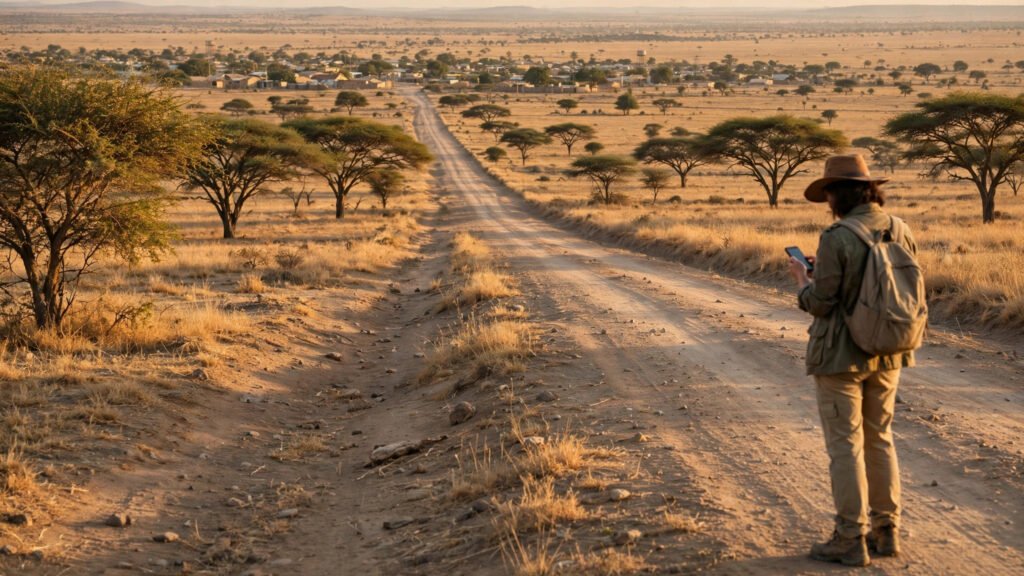
Botswana is a large country with a small, widely spread population. Towns can sit far apart, separated by long stretches of open land, and a trip to the nearest bank branch can take a whole morning or longer. That simple fact of distance explains a great deal about how people in Botswana handle money today: for many, the phone has become the nearest bank, the quickest way to pay, and the easiest way to send help to family far away.
This is not a story about one app or one company. It is a story about geography meeting technology. When the branch is far away but the phone is already in your pocket, banking on the phone stops being a novelty and starts being the practical choice.
Key Takeaways
- Botswana’s long distances make a trip to a bank branch costly in time, so the phone has become the nearest bank for many people.
- Mobile banking and mobile money let people check balances, pay bills, and send money without travelling to a town.
- Phones also help families stay connected across distance, turning a money transfer into a few taps instead of a long journey.
Distance Is the First Reason
In a country where settlements are spread out, everyday errands carry a travel cost. A visit to a bank can mean arranging transport, waiting, and losing hours that could have been spent working, studying, or caring for family. For people living outside the main towns, that cost adds up quickly.
A phone removes most of that journey. A balance check, a bill payment, or a transfer can happen from home, from a workplace, or from a village, without a bus fare or a long wait. The phone does not shorten the road, but it makes the road unnecessary for many routine money tasks.
That convenience matters most for the tasks people repeat often. Paying for electricity, sending money to relatives, or settling a small bill are not special occasions. They are weekly or monthly chores, and doing them on a phone saves time every single time.
Banking Without the Branch
Mobile banking apps and USSD menus — the simple text-based menus that work even on basic phones — let people carry out the core jobs of a bank account. They can check what came in and what went out, move money between accounts, and pay for services, all without standing in a queue.
For small businesses, that matters too. A trader, a farmer, or a shopkeeper can receive payment on the spot and confirm it immediately, rather than waiting for cash to be carried from one place to another. Cash still has its place, but a phone payment leaves a record that both sides can check, which reduces arguments and mistakes.
It is a pattern seen in other wide, sparsely settled places as well. In Mongolia, for example, people also bank on their phones across the steppe, because the distances there make branch banking just as impractical.
Mobile Money Fills the Gaps
Not everyone has a traditional bank account, and not every transaction needs one. Mobile money services, run through phone networks, let people store value on their phone and send it to another phone number. The recipient can then withdraw cash from an agent nearby or spend the balance directly.
This is especially useful for families spread across the country. Someone working in a town can send money home the same day, and the family receiving it does not have to travel to collect it. What used to require a journey, a favour from a traveller, or a long wait can now be settled in minutes.
Similar habits have grown across Africa for the same reason. In Ghana, many people pay with mobile money instead of bank cards, because the phone reaches places where card machines and branches do not.
The phone does not shorten the road, but it makes the road unnecessary for many routine money tasks.
Everyday Payments, One Tap at a Time
Beyond banking and transfers, phones have become a way to pay for the small things of daily life. Utilities, airtime, and services can be settled from the phone, which means fewer trips and fewer pieces of paper to keep track of.
- Balance checks and transfers without travelling to a branch
- Bill and utility payments from home or work
- Money sent to family in another town the same day
- Payments to small traders confirmed on the spot
- A record of each payment that both sides can check
That shift also changes how people plan. When money can move quickly, a family can respond to an urgent need — a medical bill, school costs, or a broken tool — without waiting for someone to travel. Speed is not a luxury here; it is the difference between a problem handled today and a problem left for next week.
Trust Is Built Slowly
None of this happened overnight. People trust a payment method only after it works, again and again, for people they know. Early users showed neighbours and relatives how a transfer worked. Agents in local shops answered questions and helped with first transactions. Over time, what felt new became normal.
Trust also depends on the basics working: network coverage, charged phones, and help when something goes wrong. Where coverage is weak, a phone payment can fail at the worst moment, and that experience sticks. The growth of phone banking in Botswana is therefore tied to the steady spread of mobile networks into rural areas, not just to the apps themselves.
In Zambia, a similar everyday logic applies: people buy electricity units on their phones instead of queuing, because the phone removes a trip for a task that repeats every month.
What the Phone Cannot Replace
Phones have not made branches, cash, or face-to-face help disappear, and they should not. Some transactions still need a person, a signature, or a conversation. Older residents may prefer a branch, and anyone dealing with a large or complicated matter will still want to speak to staff.
The honest picture is a mix: cash for some things, cards for others, and phones for the routine jobs where distance used to be the biggest cost. The phone wins where it saves a journey, and the branch remains where advice or paperwork matters more than speed.
What to Watch Next
Botswana’s phone-banking story will keep following the same logic: wherever distance makes a trip expensive, the phone will keep filling the gap. The next steps to watch are wider network coverage in rural areas, simpler menus for basic phones, and more local agents who can help first-time users.
As those pieces spread, the phone’s role as the nearest bank will only grow — not because branches disappear, but because for many people in Botswana, the shortest route to their money is already the one in their pocket.