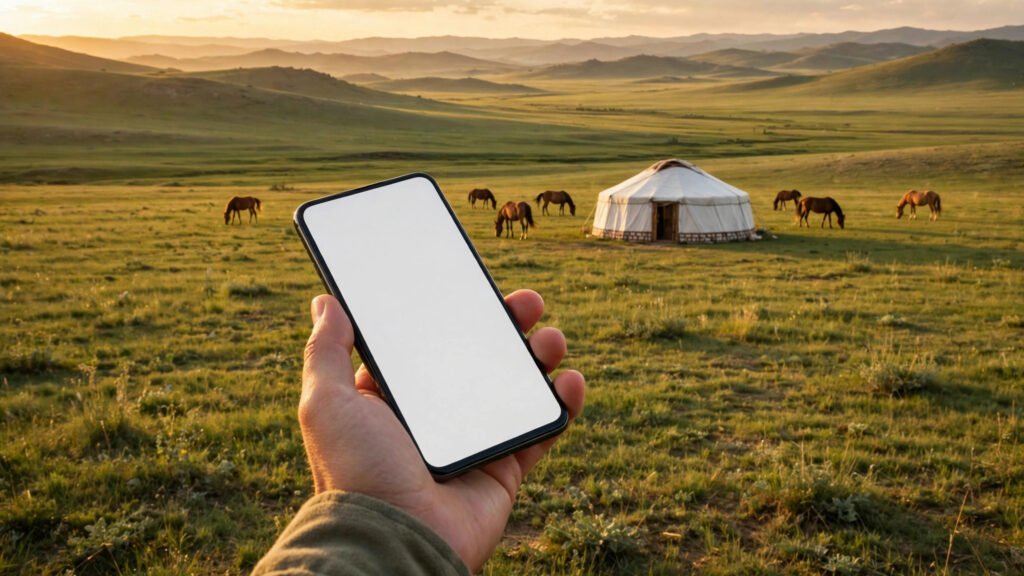
In Mongolia, the nearest bank branch can be a long journey away. Towns are far apart, roads can be rough, and winter weather can make travel slow or difficult. For many Mongolians, that simple fact answers a common question: why do Mongolians bank on their phones across the steppe? A phone can carry the bank in a pocket, so everyday money tasks do not always need a trip to town.
This is not only a city story. In Ulaanbaatar, the capital, phone payments and bank apps fit a fast urban life. Outside the capital, the same tools solve a different problem: distance. A herder family, a small shopkeeper in a soum centre, or a student studying far from home may all need to move money, check a balance, or pay a bill without losing a whole day to travel. The phone does not remove every need for a branch, but it makes many routine tasks possible from wherever a signal reaches.
Key Takeaways
- Distance is the main driver: bank branches can be far away, so phone banking saves long trips across the steppe.
- Phone banking fits both city life in Ulaanbaatar and daily life in rural areas, from bills to transfers between family members.
- Cash and branches still matter, especially where signals are weak or a task needs help in person.
Distance makes the branch hard to reach
Mongolia is a large country with a widely spread population. Outside the capital, settlements can be separated by long stretches of open grassland, and a journey that looks short on a map can take a long time in practice. Weather, road conditions, and the season all affect travel. In winter, cold and snow can make even a planned trip harder, while in other seasons herding work and family duties leave little time for a day spent travelling.
That is why a phone-based option matters so much. Checking a balance, sending money to a relative, or paying a utility bill from home can replace a trip that would otherwise cost time, fuel, and effort. For people who move with the seasons, the advantage is even clearer: the bank does not stay behind in one town. It travels with the phone, as long as there is a connection and the phone is charged.
The point is practical rather than dramatic. Nobody chooses phone banking only because it is modern. People use it because it fits the geography of their lives. When the branch is close, a visit is easy. When it is far, the phone becomes the sensible first choice for routine tasks.
A phone fits a mobile way of life
Many Mongolian families still live with livestock, and herding often means moving between pastures during the year. A home in this setting is not always a fixed address in a town. A ger can be taken down, moved, and set up again where grazing is better. In that kind of life, a service tied to one building is less useful than a service that moves with the person.
Phone banking matches that pattern. A transfer can be sent after animals are sold, a payment can be made before a supply trip, and a family member working in the city can send support home without either side travelling to meet a bank counter. The phone also helps people stay in touch while these tasks happen: a call or message can confirm that money has arrived, which matters when the sender and receiver are far apart.
For students and workers who leave home for the capital or another town, the same logic applies. Their families may still be in the countryside, and their money often needs to move in both directions. A phone makes that flow simpler, whether the amount is for everyday costs, school needs, or help during a hard month.
When the branch is far, the phone becomes the sensible first choice for routine tasks.
QR codes and apps in towns and cities
In Ulaanbaatar and larger towns, the picture looks different but points in the same direction. Shops, cafes, and service providers commonly accept phone payments, and QR codes have become a familiar sight at counters. Scanning a code can be quicker than handling notes and coins, and it leaves a record that both sides can check later. For small businesses, that record can help with keeping track of sales and costs.
Bank apps also bring several tasks together in one place. Instead of visiting different offices or counters, a person can often check accounts, move money between their own accounts, pay a bill, and top up a phone plan from the same device. That convenience is part of why phone banking has become a habit rather than a one-time experiment. Once people learn the steps and trust the process, they tend to keep using it for the tasks it handles well.
This pattern is familiar in other countries too. In Central Asia, neighbours have built their own phone-first habits: Kyrgyzstanis use mobile wallets for everyday payments, while Kazakhstanis pay with QR codes instead of cash and cards. Mongolia’s version is shaped by its own distances and lifestyle, but the underlying idea is similar: the phone turns a routine money task into something that can be done on the spot.
What phone banking cannot replace yet
Phone banking is useful, but it is not a complete answer on its own. A weak signal can delay a payment, a flat battery can stop a task at the wrong moment, and some jobs still need a person at a counter — for example, when documents must be checked, a problem needs explaining, or a customer is setting up an account for the first time. Older users, or anyone less comfortable with apps, may also prefer to ask questions face to face.
Cash has not disappeared either. In small local trade, at markets, or in places where a phone payment is not accepted, notes and coins remain practical. A sensible approach is therefore a mix: use the phone for routine transfers and payments, keep some cash for everyday local needs, and visit a branch when a task truly needs in-person help. That mix is likely to stay for a long time, because no single method fits every place, every season, and every person.
- Long distances and seasonal movement make a trip to a branch costly in time and effort.
- Phone banking lets people check balances, send money, and pay bills from home or on the move.
- QR payments in towns and cities add speed and a clear record for shops and customers.
- Weak signals, flat batteries, and complex tasks still leave a role for cash and branches.
The wider lesson goes beyond banking. Across remote and mountainous regions, phones often fill gaps left by distance. Bhutanese people rely on mobile phones across the Himalayas for similar reasons: when settlements are scattered and travel is hard, a phone can connect people to services, family, and information. Mongolia’s steppe tells the same story in its own landscape.
What to Watch Next
Phone banking in Mongolia will likely keep growing where it already works best: routine payments, transfers between family members, and everyday bills. Its future depends on practical things rather than promises — steadier connections in rural areas, phones that are easy to charge and use, and help for people who are still learning the apps. Branches and cash will still matter for complex tasks and local trade. The balance between the phone, the branch, and cash will keep shifting, but the reason for the phone’s popularity is already clear: in a country of long distances, a bank that fits in a pocket saves the journey.