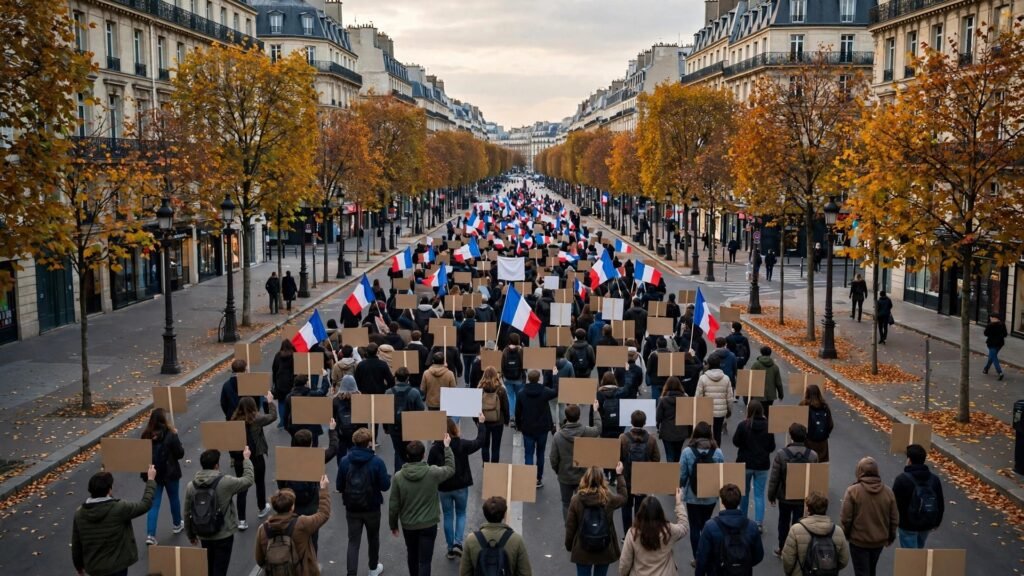
Hundreds of thousands of people, many of them students, took to the streets across France on Saturday, October 31, 2026, for a third consecutive weekend of youth-led protests over the cost of living and the state of the country’s schools. The demonstrations, which began with high school students and later drew in labour unions, have now spread to other European countries, with rallies reported in Germany, Portugal and the Netherlands.
The French government estimated that 320,000 people protested nationwide on Saturday, including 70,000 in Paris. Organisers put the turnout higher, at nearly half a million across France and about 200,000 in the capital. Either way, the turnout was smaller than the two previous weekends: officials counted about 550,000 marchers on October 17, when some of the demonstrations deteriorated into rioting, and 410,000 on October 24.
Key Takeaways
- An estimated 320,000 people marched across France on October 31, the third straight weekend of youth-led protests over living costs and schools.
- About 70,000 police and gendarmes were deployed, and hundreds of arrests were reported as some gatherings in Paris ended in tear gas.
- The movement has spread across Europe, with youth rallies in Germany, Portugal and the Netherlands over housing, education and living costs.
Paris march pushed to the city’s edge
In Paris, the main march was moved to the capital’s eastern edge after a last-minute court battle, following a route along the outer boulevards from Porte de Bagnolet to Porte de Charenton. Police barred people from entering Place de la République and Les Halles, neighbourhoods popular with young people, from 11 p.m. to 6 a.m. on Saturday and Sunday. Unaccompanied minors faced a separate 9 p.m. curfew around the Champs-Élysées, after a Paris court had earlier suspended a previous curfew on minors.
France deployed about 70,000 police and gendarmes across the country. Interior Minister Laurent Nuñez had warned of a “very high risk” of disorder, especially after dark on Halloween. Most gatherings were peaceful, with some protesters in Halloween costumes, but gatherings in Paris and other cities ended in clouds of tear gas and scattered fires set by small groups on the margins. Authorities reported hundreds of arrests nationwide.
Most gatherings were peaceful, with some protesters in Halloween costumes, but gatherings in Paris and other cities ended in clouds of tear gas and scattered fires set by small groups on the margins.
How the movement began
The movement began last month with high school students protesting against neglected school buildings, teacher shortages and a university admissions system seen as unfair to disadvantaged students. It has since broadened into wider anger over living costs, and labour unions have joined the marches. The October 17 protests drew the largest crowds but also saw hundreds of shops looted, while the October 24 demonstrations were largely peaceful even as police made more than 1,300 arrests.
Prime Minister Sébastien Lecornu held several meetings with student unions this week and is looking at measures to ease the cost of living, according to the government. President Emmanuel Macron said on Monday that marches would stay out of city centres to protect shops. The protests are unfolding against a difficult economic backdrop: France’s economy shrank in the third quarter of 2026 while inflation jumped, adding to pressure on household budgets.
- October 17: about 550,000 marchers, with rioting and hundreds of shops looted
- October 24: about 410,000 marchers, largely peaceful, with more than 1,300 arrests
- October 31: about 320,000 marchers by the government estimate, with hundreds of arrests
- 70,000 police and gendarmes deployed nationwide on October 31
Protests spread across Europe
Youth-led demonstrations were also held elsewhere in Europe on Saturday. In Germany, a youth initiative called “Gen Z regelt” — roughly “Gen Z’s got this” — rallied in more than 30 cities for education, health, climate protection and an affordable life, and against any return of military conscription. In Berlin, young protesters gathered at the Brandenburg Gate demanding more investment in education and housing. In Lisbon, thousands of people, including families with young children, gathered peacefully to protest against the housing crisis, while police used water cannon in Cologne and authorities in Spain and Italy raised their alert levels after earlier clashes in Milan, Turin and Bologna.
The French protests are the latest chapter in a month of unrest that began with mass protests and nearly 1,000 arrests in late October, and the government will now be watching whether the movement keeps its momentum into a fourth weekend or fades as turnout falls.
What to Watch Next
What happens next depends on whether turnout keeps falling or stabilises, whether the government announces concrete cost-of-living measures after the prime minister’s meetings with student unions, and whether the youth rallies spreading across Germany, Portugal and the Netherlands grow into a wider European movement. For now, the pattern is clear: smaller crowds than the October 17 peak, but a protest movement that has not gone away.