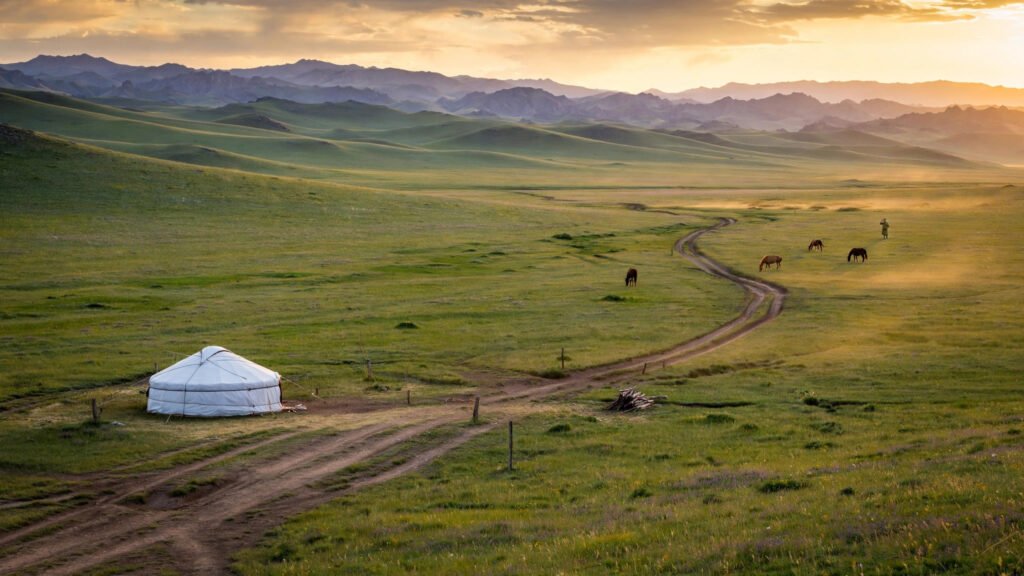
In Mongolia, the phone is not a luxury gadget. It is the thread that holds together a life spread across one of the largest and emptiest landscapes on Earth. Herding families may live far from the nearest town, move with the seasons, and spend long stretches out of sight of any neighbour — yet a single handset keeps them connected to family, markets, weather warnings, and the bank. This is why Mongolians rely on their phones across the steppe, and why the device matters here in ways that city dwellers rarely have to think about.
Key Takeaways
- Distance is the defining fact of steppe life: homes, herds, towns, and services can be far apart, so the phone replaces many long journeys.
- A phone bundles weather forecasts, family contact, market information, and banking into one tool a herder can carry anywhere.
- For families who move seasonally, the phone is the one address that never changes, even when the home does.
Distance Makes the Phone Essential
Mongolia is a vast country with a small population spread thinly across grasslands, deserts, and mountains. A herding family might live a long drive from the nearest district centre, and the road between the two may be little more than wheel tracks across open ground. In such a setting, a trip to town is not a quick errand. It costs time, fuel, and a day away from the animals.
The phone changes that calculation. A call can settle a question that once required a journey: is the vet in town today, has a delivery arrived, is a relative safe after a storm? When every trip is long, the ability to ask first is not a convenience — it is a practical necessity. The same logic applies to people living on scattered islands or in remote valleys elsewhere in the world, where phones bridge the gaps between far-flung communities in much the same way.
A Moving Home Needs a Fixed Point of Contact
Many Mongolian herders still move with their animals through the year, shifting camp to fresh pasture as the seasons change. The traditional ger, the round felt tent, is designed to be taken down, transported, and rebuilt. A postal address, in the usual sense, does not fit this way of life very well.
A phone number, however, moves with its owner. Family members working in the capital or studying in another province can reach a herding camp with a call or a message, no matter where the camp has moved to that month. Friends can coordinate a meeting, share news of a birth or a loss, and stay part of one another’s lives across distances that would otherwise mean long silences. The phone, in this sense, is the family’s fixed address — one that travels with them.
A phone number moves with its owner, so family can reach a herding camp no matter where it has moved to that month.
Weather, Animals, and Safety
On the steppe, weather is not small talk. It decides whether animals can graze, whether a journey is safe, and whether a family needs to prepare for a hard winter. A forecast checked on a phone can change the plan for the whole week: bringing herds closer to shelter, stocking up on supplies, or delaying a move until a storm has passed.
Phones also carry warnings and practical information between neighbours. If a snowstorm is approaching or a water source has run low, word spreads quickly through calls and messages rather than slowly from camp to camp. For people whose livelihoods depend on animals exposed to the open sky, that early warning can matter more than almost anything else a phone can do.
Banking Without a Branch Nearby
For a herder, the nearest bank branch may be hours away in the district town. Paying a bill, receiving money from a relative, or checking whether a payment has arrived would once have meant another long trip. Mobile banking and phone-based payments have quietly removed many of those trips.
This is a pattern seen in other countries where bank branches are scarce and distances are long: phones stand in for bank branches where reaching one in person is difficult. In Mongolia, the same logic applies. Money can move between family members, a herder can pay a supplier, and a small business can receive a payment, all without leaving the camp. The phone becomes a pocket bank as well as a telephone.
Government Services and Everyday Admin
The same distance problem applies to paperwork. Registering a document, checking a public service, or contacting an official office can be a full day’s journey from a remote camp. Where government services are available through a phone, that journey can often be avoided or at least shortened to a single visit with the right information already in hand.
Other countries have followed a similar path, putting public services on the phone so citizens do not have to travel to an office for every task — e-government on phones shows how this works elsewhere. For Mongolians in remote areas, the benefit is obvious: less time travelling for admin, more time with the herds and the family.
Markets, Prices, and Selling Animals
Herding is also a business. Decisions about when to sell animals, what prices buyers are offering, and where demand is strongest are easier when information arrives by phone rather than by rumour at the next market day. A herder can compare offers, arrange transport, and agree a sale before setting out, rather than arriving at market and hoping for the best.
- Calls and messages replace long journeys for everyday questions, from vet visits to deliveries.
- Weather forecasts on a phone help herders protect animals and plan moves around storms.
- Mobile banking brings payments and money transfers to camps far from any bank branch.
- A phone number acts as a permanent contact point for families who move with the seasons.
Staying Connected to a Changing Country
Mongolia is changing. Young people leave for the city to study or work, families split between the steppe and the capital, and new ideas and opportunities arrive through the same small screen. The phone keeps those two worlds in touch. A parent on the steppe can video-call a child in Ulaanbaatar, a student can send photos home, and a herder can follow national news without waiting for someone to bring it.
That connection matters culturally as well as practically. It lets people keep family bonds strong even as lifestyles diverge, and it lets rural voices stay part of national conversations. The phone does not erase the distance of the steppe, but it stops that distance from turning into isolation.
What to Watch Next
The question of why Mongolians rely on their phones across the steppe comes down to distance, movement, and the need to stay safe and connected. As coverage reaches further into remote areas and more services move onto the phone, that reliance is likely to deepen rather than fade. The watch points are simple ones: whether rural coverage keeps improving, whether more everyday services become usable from a camp, and whether the phone continues to serve herding life rather than pulling people away from it. For now, the handset remains the most practical tool on the steppe — a bank, a weather station, a marketplace, and a family line, all in one pocket.