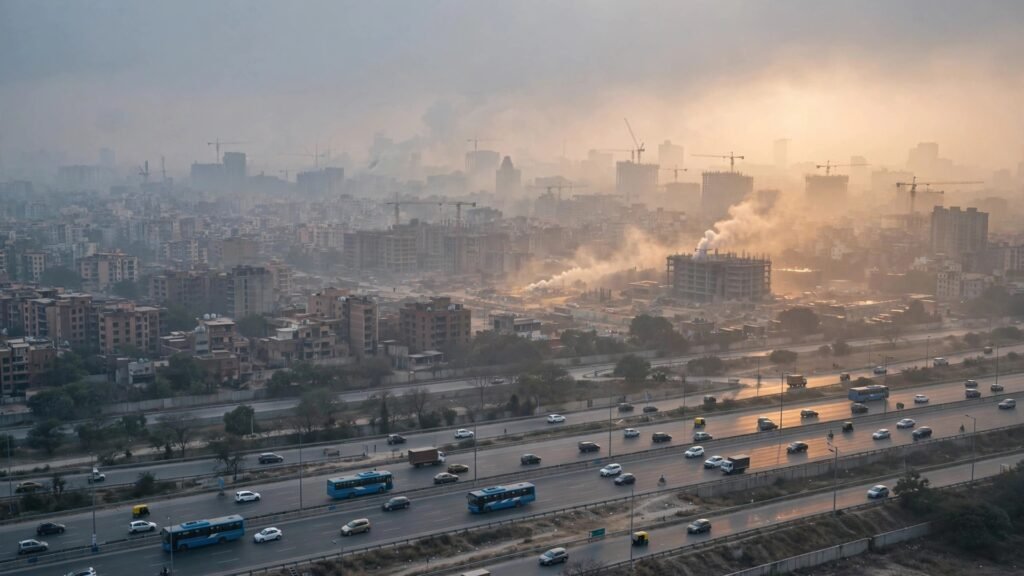
Delhi’s winter pollution rules take effect on Sunday, November 1, 2026, bringing a fixed package of restrictions that will run through January 31, 2027. The measures target the sources that typically drive the capital’s winter smog: older vehicles, construction dust, office commuting and private vehicle use. Unlike emergency steps that switch on and off with daily air quality readings, these are fixed-term rules, set in advance for the whole peak pollution window.
Key Takeaways
- Non-Delhi-registered vehicles below BS-VI emission standards are barred from entering Delhi from November 1, 2026 to January 31, 2027.
- Dust-generating demolition and outdoor construction are banned over the same period, and government and private offices must limit physical attendance to 50 per cent.
- Parking charges at authorised facilities double from November 1 to February 28, and vehicles without a valid pollution certificate will not get fuel at petrol pumps.
The package comes from a gazette notification issued by the Delhi government on June 23, and it goes beyond the usual measures under the Graded Response Action Plan (GRAP), the set of emergency steps that are invoked depending on current or near-future air quality. The measures are fixed in time, not triggered by a single day’s air quality reading, and that is what makes this winter different.
What changes for vehicles
The headline vehicle rule is the entry ban: all non-Delhi-registered vehicles below BS-VI emission norms will not be allowed to ply in the city, with a few exemptions. Electric, CNG, emergency and sovereign duty vehicles are exempt, according to reporting of the notification. Vehicles without a valid Pollution Under Control Certificate (PUCC) will not get fuel at fuel stations, a rule that applies throughout the year under the notification, and the “No PUC, No Fuel” policy is being implemented at Delhi’s petrol pumps from November 1, with 500 pumps equipped with automatic number plate recognition (ANPR) cameras.
Restrictions also apply to non-compliant interstate buses, trucks not destined for Delhi, tractors and jugaad vehicles, and certain vehicles registered outside the capital. Enforcement will rely on special enforcement teams, ANPR cameras and an AI-enabled Integrated Command and Control Centre (ICCC), officials said. For commuters, the practical message is simple: check a vehicle’s emission standard and pollution certificate before travelling into Delhi, and follow the Delhi Traffic Police advisory, which lists the categories allowed to ply.
The vehicle rules land after a mixed October for the capital’s air. Delhi’s October air quality was reported as the city’s lowest October average in eight years, yet the winter months remain the hardest test, when cooler air, slower winds and seasonal burning trap pollutants close to the ground.
Construction, offices and parking
On construction, all dust-generating demolition and outdoor civil construction activities are banned from November 1 to January 31, while essential public infrastructure projects are exempt. A complete ban on construction and demolition, including indoor activities, will be enforced from December 20 to January 20, officials said. Indoor finishing, plumbing and electrical work can proceed outside that window, provided required dust-control measures are followed.
The measures are fixed in time, not triggered by a single day’s air quality reading, and that is what makes this winter different.
Offices face two changes. Government and private offices must implement a mandatory 50 per cent work-from-home rule from November 1 to January 31, with only half of staff physically present and the rest working from home; essential and emergency services are exempt. Office timings are also staggered to spread peak traffic: Municipal Corporation of Delhi offices will function from 8:30 am to 5 pm, while Delhi government offices will operate from 10 am to 6:30 pm, from November 1 to February 28.
Parking is the other lever aimed at private vehicle use. Existing parking charges at authorised facilities will double from November 1 to February 28, a step intended to discourage private vehicle trips into congested areas.
- Vehicle entry ban: non-Delhi-registered vehicles below BS-VI barred, November 1 to January 31, with electric, CNG, emergency and exempt vehicles allowed.
- Construction ban: dust-generating demolition and outdoor work banned to January 31; a full ban including indoor work runs December 20 to January 20.
- Offices: 50 per cent work from home to January 31; staggered timings to February 28, with essential services exempt.
- Parking and fuel: parking fees doubled to February 28; no fuel without a valid pollution certificate from November 1.
- Enforcement: special teams, ANPR cameras and an AI-enabled command centre, with a possible relaxation of enforcement until Deepavali.
How strict will enforcement be at first?
There could be some relaxation in the enforcement of the rules until Deepavali, Environment Minister Manjinder Singh Sirsa told The Hindu, adding: “We will try not to inconvenience people as much as possible till Deepavali.” That is a statement about enforcement approach, not a change to the rules themselves, and residents should not treat it as an exemption. The Chief Minister’s Office said on October 31 that the Environment Department had made all necessary preparations for effective implementation.
October closed on an unusual note for Delhi weather, with the capital’s wettest October day in four years on October 30, but rain does not remove the winter pollution problem. As temperatures fall and the air turns still, the same pollutants that disperse more easily in wet, windy weather tend to linger, which is why the fixed winter measures are timed to the season rather than to a single weather event.
What to Watch Next
What to watch next is only what this article has already set out: whether enforcement holds at the stated level once the initial Deepavali period passes, whether the vehicle entry ban and the fuel rule change traffic at Delhi’s borders and pumps, whether the construction and work-from-home rules ease dust and peak-hour congestion, and whether parking charges and staggered office timings shift commuters toward public transport. The fixed dates give the first checkpoints: January 31 for the vehicle, construction and work-from-home measures, and February 28 for doubled parking and staggered timings.