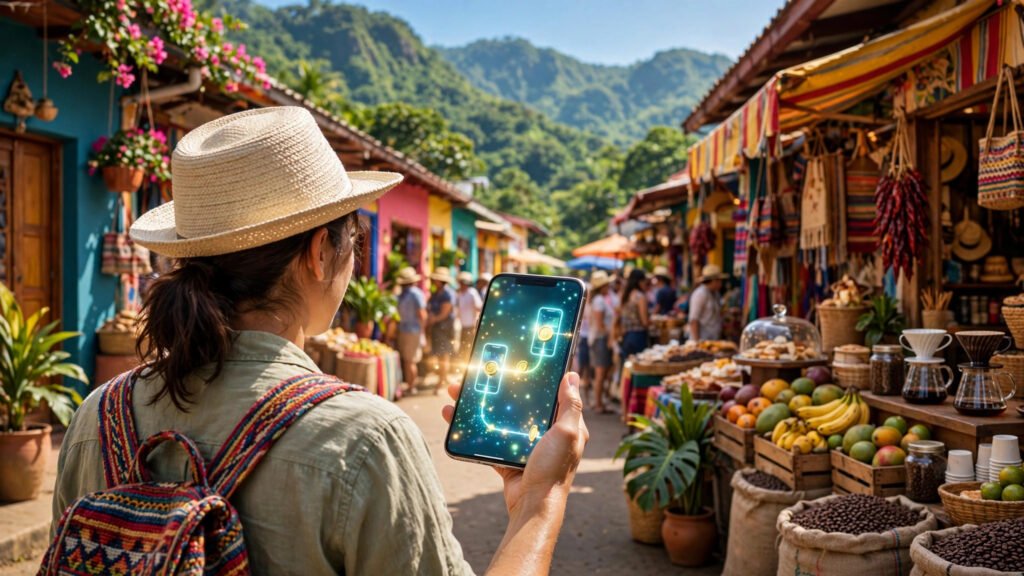
In Costa Rica, paying a friend back for lunch, settling up with a market vendor, or sending money to family often starts with a phone number rather than a wallet. Instead of handing over banknotes or asking for a long account number, many Costa Ricans open their bank’s mobile service and send the money through SINPE Móvil, the country’s phone-number-based transfer system. For visitors, it can look surprisingly casual: a few taps, a confirmation, and the payment is done.
The habit is not really about a single app. It is about a system that connects banks through one shared network, so money can move from one person’s bank account to another person’s account at a different bank, using only a mobile number as the address. That simplicity is the whole point, and it explains why the system has become part of everyday life.
Key Takeaways
- SINPE Móvil lets people send money between bank accounts using just the recipient’s mobile phone number.
- It works across different banks, so splitting bills and paying small sellers does not need cash or long account numbers.
- Cash has not disappeared, but phone transfers are now a normal everyday option for many Costa Ricans.
What Is SINPE Móvil?
SINPE Móvil is the mobile part of Costa Rica’s national electronic payment system, known as SINPE. In practice, a person links their mobile phone number to their bank account through their own bank. Once that link is set up, other people can send money to that number, and the money lands in the linked account.
The important detail is that the sender does not need to know which bank the recipient uses, and does not need to type in a long account number. The phone number does the job of identifying where the money should go, while the banks and the shared system handle the transfer behind the scenes.
The phone number does the job of identifying where the money should go, while the banks and the shared system handle the transfer behind the scenes.
Why a Phone Number Is Enough
Phone numbers are easy to remember, easy to share, and almost everyone already has one. That makes them a natural shortcut for payments between people who know each other. Asking a friend for their account number feels formal and fiddly; asking for their number feels normal.
This is the same reason phone-based payments have caught on in other countries too. In Ghana, mobile money grew because a phone number could act as a simple way to send value, and in Peru, apps like Yape and Plin made phone-to-phone payments part of daily shopping. Costa Rica’s version is bank-based rather than wallet-based, but the appeal is similar: less friction, fewer details to get wrong.
- A mobile number replaces a long bank account number for everyday transfers.
- Transfers work between different banks through the shared SINPE network.
- Both sender and receiver get a record of the payment in their bank account.
- No cash changes hands, so there is no need to find exact change.
Where People Use It Every Day
SINPE Móvil fits the small, everyday payments that cash used to dominate. Splitting a restaurant bill is the classic example: one person pays the restaurant, and everyone else sends their share by phone before leaving the table. The same pattern works for shared taxi rides, group gifts, and money sent between family members.
Small sellers benefit as well. A vendor at a farmers’ market, a neighbourhood hairdresser, or someone selling homemade food can accept a payment without a card terminal. As long as the seller has linked a phone number to an account, a customer can pay on the spot. That lowers the barrier for small businesses that might otherwise deal only in cash.
It also helps with payments that are awkward in cash, such as sending money to someone in another town. Instead of meeting in person or arranging a bank deposit, the sender transfers the amount from wherever they are, and the recipient sees it in their account.
Why Not Just Cash or Cards?
Cash still has its place in Costa Rica, especially for very small purchases and in places where mobile coverage or banking access is limited. Cards are also widely used, particularly in larger shops, hotels, and restaurants. SINPE Móvil does not replace either of them entirely; it fills the gap between them.
Compared with cash, a phone transfer leaves a clear record, which helps both sides remember what was paid and when. Compared with cards, it works for person-to-person payments where there is no shop terminal at all. And compared with a traditional bank transfer, it removes the step of exchanging account details, which is where many people used to give up and just pay cash instead.
There are practical limits, of course. Each bank sets its own conditions for the service, and transfers depend on having a bank account and a working mobile connection. For people without either, cash remains essential. But for the large number of Costa Ricans who bank by phone, the system removes just enough friction to become the default for everyday transfers.
What to Watch Next
SINPE Móvil shows how a simple idea — using a phone number instead of an account number — can change daily payment habits when banks share one system. Cash has not disappeared, and cards remain common in larger shops, but phone transfers now sit comfortably alongside both. As more small sellers accept phone payments and more people link their numbers to their accounts, the question for Costa Rica is less whether phone transfers will survive, and more how far into everyday life they will reach.