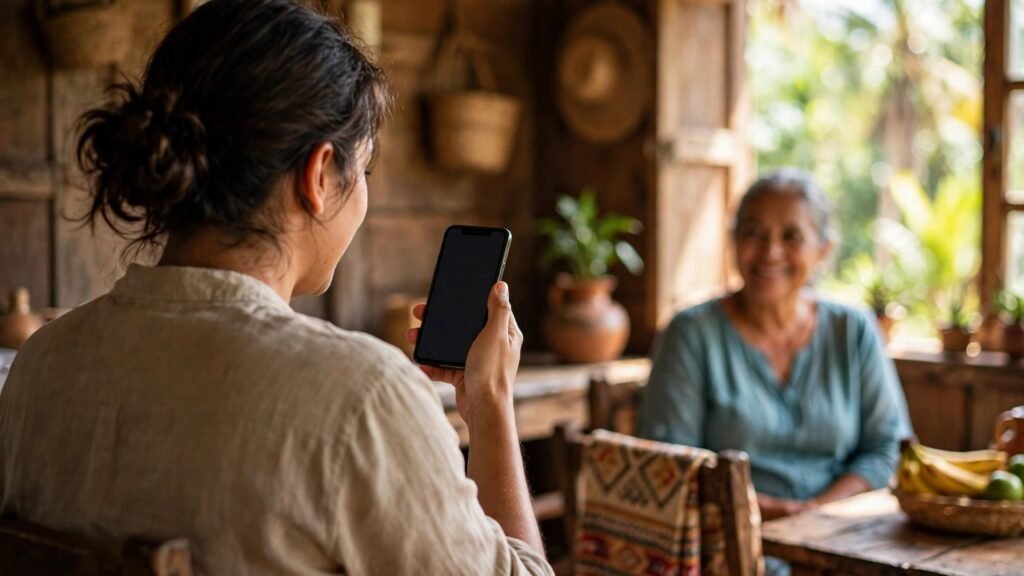
For many Honduran families, the most important message of the month does not arrive by letter or in person. It arrives on a phone: a notification, a short call, or a code that means a relative working abroad has sent money home. That small moment connects kitchens in Tegucigalpa, San Pedro Sula, La Ceiba and small towns across the country with jobs and lives far away, often in the United States, Mexico, Spain and elsewhere in Central America.
The question is a natural one: why has the phone become the centre of this whole process? The answer is not only about technology. It is about distance, trust, timing and the everyday habits of families who already use their phones for almost everything else.
Key Takeaways
- Many Honduran families rely on money sent by relatives working abroad, and the phone is now where that support is first confirmed.
- Phones shorten the wait: a transfer can be checked, confirmed and collected much faster than through older, paper-based routes.
- Care still matters, because a transfer code or message should only ever be shared with a trusted collection point, never with a stranger.
Why So Many Families Depend on Money From Abroad
Honduras has a long history of migration. Parents, children, siblings and cousins often live and work in different countries while still supporting one household back home. Money sent from abroad helps pay for food, school costs, medicine, rent, home repairs and small businesses. For some families it is a regular monthly help; for others it arrives when there is an emergency or a special occasion.
That is why the arrival of the money matters so much. A delay can mean a bill paid late or a trip to town postponed. A quick, clear confirmation on a phone removes much of that uncertainty. Instead of wondering for days whether a transfer has arrived, a family member can see a message and plan around it.
Similar patterns can be seen elsewhere in the region. In neighbouring Guatemala, for example, families also receive money from abroad on their phones, using messages and apps to stay in touch with relatives who send support home.
How the Phone Changed the Wait
Before phones were everywhere, receiving money often meant more waiting and more travelling. A relative would send funds, and the recipient might need to visit a bank or an agent, ask in person whether the transfer had arrived, and return another day if it had not. Each trip cost time and bus fare, and the answer was not always ready.
Phones changed that rhythm in a few simple ways. A sender can now tell the recipient straight away that money is on its way. A bank app or a money-transfer service can send a notification when the transfer is ready. A short call on WhatsApp or an ordinary voice call can confirm the details in seconds. The journey to collect the money still happens, but it usually happens once, at the right time.
For many families, the phone is not just a device for chatting; it is the place where help from abroad first arrives. That single sentence explains why the phone feels so central: it is the first proof that support is coming.
For many families, the phone is not just a device for chatting; it is the place where help from abroad first arrives.
The Usual Journey of a Transfer
Although the exact steps depend on the service used, the journey often follows a familiar pattern. A relative abroad sends money through a bank, a transfer company or an app. The recipient in Honduras gets a message with a reference number or a notification from their own bank or wallet. The recipient then goes to a bank branch, an agent or a partner shop, shows identification, and collects the money in cash or has it placed into an account.
Some recipients prefer cash because it can be spent anywhere, including at small shops and markets that do not take cards. Others prefer to keep the money in a bank account or a mobile wallet, where it can be used for bills, transfers to other family members, or saving for a larger expense. The phone supports both choices: it carries the confirmation, and in many cases it also holds the account itself.
- A message or notification usually confirms that a transfer is ready before anyone travels to collect it.
- Identification and a reference code are normally needed at the collection point, so those details must be kept private.
- Cash remains useful in places where cards are not accepted, while accounts and wallets suit bills and saving.
- Families often combine both: collect in cash for daily spending and keep part of the money aside for school or health costs.
Why Phones Fit Everyday Life in Honduras
Another reason phones took over this role is that they were already part of daily life. People use them to call family, follow the news, check prices, pay for a top-up and run small businesses. Adding money transfers to a device that is already in the pocket felt natural, not like learning a completely new system.
Phones also suit the way Honduran families are spread out. A mother in a rural town, a son working abroad and a daughter studying in a city can all be part of the same conversation. When money is sent, everyone involved can be told quickly, and questions can be answered without another long journey. That shared awareness reduces worry, especially when the amount is needed for something urgent.
The same everyday-phone habit shapes other routines in the region. In the Dominican Republic, for instance, people top up their phones at the local colmado, showing how a small neighbourhood shop and a phone together keep families connected.
What Still Needs Care
None of this means the system is free of problems. Phone signal can be weak in some areas, and an older phone or a low battery can make a confirmation hard to read. Some people still feel more comfortable collecting money in person, with paper and a familiar face at the counter, rather than trusting an app alone. And because transfers involve money, they attract scams.
The most important safety habit is simple: a transfer code, a password or a one-time message should never be shared with a stranger who calls or messages asking for it. A genuine collection point asks for identification in person or through its own official channel; it does not need a family member to forward a private code to an unknown number. When a message looks suspicious, the safest step is to stop, check with the sender through a known number, and ask at the bank or agent directly.
Families also learn to plan around fees and exchange rates, which vary by service and by day. Comparing options before sending, rather than rushing, can leave more of the money in the hands of the person it was meant for. In Guatemala, remittance apps and local agents each have their own strengths, and Honduran families face similar choices between convenience, cost and a nearby collection point.
What to Watch Next
The phone is likely to stay at the centre of how Honduran families receive money from abroad, because it already shortens the wait, confirms the arrival and keeps scattered families in the same conversation. What will matter next is whether services become easier to use in areas with weaker signal, whether more collection points open closer to rural homes, and whether families keep the simple safety habit of sharing codes only with trusted collection points. For now, the pattern is clear: when help comes from abroad, the phone is usually the first place a Honduran family hears about it.