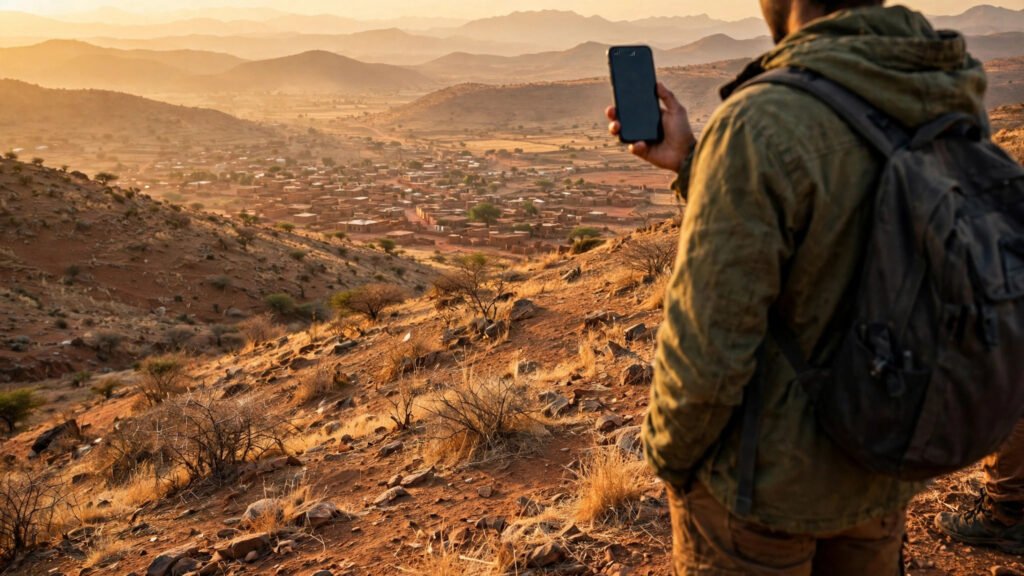
For most people around the world, mobile internet is something you barely think about. You open your phone, and the news, the map, the message and the video are simply there. In Eritrea, a country on the Red Sea coast in the Horn of Africa, that everyday experience looks very different. Mobile internet exists, but it is limited, slower and harder to rely on than in most neighbouring countries. So why is mobile internet in Eritrea so limited?
The short answer is that several forces point in the same direction: a tightly controlled telecom sector, difficult geography, limited infrastructure, and costs that put regular data use out of reach for many households. None of these factors alone explains the whole picture, but together they shape how Eritreans connect, work, study and keep in touch.
Key Takeaways
- Mobile internet in Eritrea is limited by a controlled telecom sector, difficult geography and high relative costs, not by a lack of interest in phones.
- Where connections are weak or expensive, people lean on calls, text messages, radio and face-to-face contact instead of data-heavy apps.
- Any wider change would need more infrastructure, more affordable access and more open routes to the wider internet, and that change would be gradual rather than overnight.
What Limited Access Looks Like in Everyday Life
In a place with limited mobile internet, the phone itself does not disappear. People still call, still send text messages and still use their handsets every day. What changes is what the phone can do. A video call may freeze, a large file may take a long time to arrive, and an app that updates constantly in the background can quietly eat through a data allowance.
That matters more than it sounds. Today, a phone is not only a telephone. It is a classroom, a market stall, a bank counter and a family living room. When data is scarce, students cannot easily stream a lesson, small traders cannot easily share photos of their goods, and families living far apart cannot easily see each other on a call. The limitation is not about one app. It is about how much of modern life now runs through a connection.
It is also worth remembering that Eritrea is not alone in facing a connectivity gap. In mountain areas of Nepal, mobile internet matters precisely because roads and services are far away, and the same logic applies in remote parts of Eritrea, where distance makes a working connection even more valuable.
A Tightly Controlled Telecom Landscape
One of the biggest reasons for limited mobile internet in Eritrea is how the telecom sector is organised. The country has a single state-run telecom operator, and there is no open, competitive mobile market of the kind found in many other countries, where several networks compete on price, coverage and speed.
Competition matters for internet access. When several operators compete, they tend to build more towers, offer cheaper bundles and upgrade their networks faster, because each one wants to win customers. Without that competition, there is less pressure to expand quickly or to cut prices. Investment decisions are centralised, and upgrades can move slowly.
Control also shapes what kind of access is offered. In Eritrea, internet access has historically been treated as something to be managed carefully rather than opened up as widely as possible. That approach affects everything from how easily people can get online to which services feel normal and everyday. For visitors and residents alike, the result is the same: getting online takes more planning than it does in most other places.
When data is scarce, students cannot easily stream a lesson, small traders cannot easily share photos of their goods, and families living far apart cannot easily see each other on a call.
Geography, Infrastructure and the Cost of Building a Network
Eritrea’s geography adds a second layer of difficulty. The country stretches from a long Red Sea coastline through hot lowlands to highland plateaus, with towns and villages spread across rugged terrain. Building and maintaining mobile towers, power supplies and backhaul links across that landscape is expensive and technically demanding, especially where roads and reliable electricity are themselves limited.
A mobile network is only as strong as the links behind it. Towers need power, fibre or microwave links to carry traffic, and international connections to carry that traffic to the rest of the world. Where any part of that chain is thin, the whole service feels slower and less reliable. In Eritrea, that chain has grown more slowly than in countries that opened their markets earlier and attracted more private investment.
Neighbouring Ethiopia shows a different path, where mobile money and wider digital services have grown alongside network expansion. Ethiopians paying with Telebirr instead of cash and cards is a reminder that when a network reaches enough people, everyday habits can change quickly. In Eritrea, that wider digital shift has had less room to take hold.
Cost, Devices and the Price of Being Online
Even where a signal is available, cost can be the real barrier. Mobile data, handsets and regular top-ups all cost money, and in a country where many households live on modest incomes, a data bundle can feel like a luxury rather than a basic utility. People make choices: a call to a relative may come first, a data bundle second, and a video stream may not make the list at all.
Devices matter too. An older handset with a small battery and limited storage handles modern apps poorly, and replacing it is not always easy. When the phone itself struggles, people naturally use it for the basics — calls and texts — rather than for the data-heavy services that define smartphone life elsewhere.
- Limited competition means less pressure to expand coverage, cut prices or upgrade networks quickly.
- Rugged terrain and thin infrastructure make every new tower and link more expensive to build and maintain.
- High relative costs push many people towards calls and texts instead of data-heavy apps.
- Where data is scarce, radio, in-person contact and word of mouth stay central to daily life.
What People Do Instead
Limited internet does not mean limited communication. Eritreans, like people everywhere, adapt. Radio remains important. Face-to-face conversation, community gatherings and market days carry news and information. Phone calls and text messages handle the urgent things. And for many families, especially those with relatives abroad, a short call can matter far more than a social media feed.
This is a useful corrective to the idea that a country without fast internet is somehow cut off from the world. Eritrea has a large diaspora, and families stay in close contact across continents. The tools are simply different: more voice, less video; more planned contact, less constant scrolling. The human need to stay connected is the same, even when the technology is thinner.
Cost and speed problems are not unique to Eritrea, either. Mobile internet in Lebanon is slow and expensive for different reasons, and comparing the two shows how the same frustration — a page that will not load, a call that drops — can come from very different causes.
Could Mobile Internet in Eritrea Open Up?
Change, if it comes, is likely to be gradual. Wider access would need several things to move together: more investment in towers and links, more affordable data and devices, reliable power for the network, and a policy approach that treats wider internet access as a normal part of daily life rather than an exception.
None of that happens by flipping a switch. Networks take years to build, and habits take time to change. But the direction of travel in most of the world is clear: as costs fall and coverage grows, more people come online, and the services they use — from education to trade to health information — grow with them. For Eritrea, the question is less whether people want to be online, and more how quickly the infrastructure and the market around it can catch up with that demand.
What to Watch Next
What to watch next is whether coverage, affordability and everyday use move together. If new infrastructure reaches more towns, if data becomes easier to afford, and if handsets become easier to replace, then mobile internet in Eritrea could slowly become a more everyday tool rather than a limited one. Until then, calls, texts, radio and face-to-face contact will remain the backbone of how most Eritreans communicate, and the phone will stay a device for essentials first and data second. The story of mobile internet in Eritrea, in other words, is still being written — one tower, one bundle and one connection at a time.