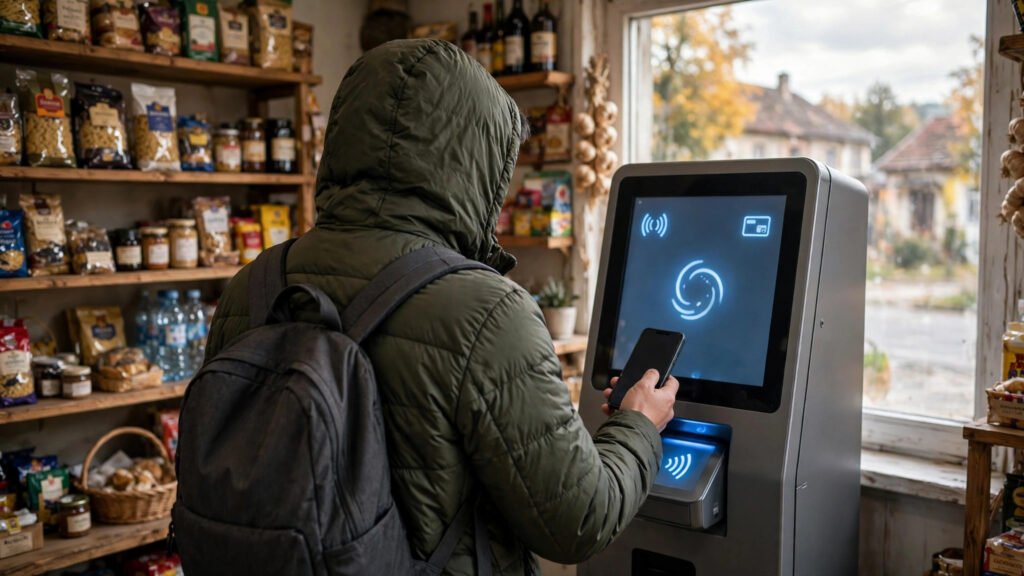
In many Moldovan towns and villages, paying a bill does not start with an app. It starts with a walk to a familiar machine. Standalone payment terminals sit in shops, kiosks and shopping centres, and for a large number of people they are the normal way to top up a phone, pay for utilities and settle everyday bills. The habit looks old-fashioned from the outside, but it survives because it fits how people in Moldova actually handle money.
Moldova is a country where cash still plays a large role in daily life, where many people live outside the biggest cities, and where family members working abroad send money home to relatives. In that setting, a machine that accepts cash and turns it into phone credit or a paid bill is not a curiosity. It is a practical bridge between cash in hand and services that live on a screen.
What a payment terminal actually does
A payment terminal is a self-service machine with a touchscreen. The visitor chooses a service, types in a phone number or an account number, feeds in banknotes, and receives a receipt. The most common jobs are topping up mobile credit and paying for utilities such as electricity, gas, water and internet. Some machines also handle other everyday payments, and the list of services on the screen is usually long.
The appeal is simple. There is no need to own a bank card, no need to remember an online password, and no need to wait for a bank branch to open. The machine works in the evening and at weekends, it gives a printed receipt straight away, and the person paying can see each step before confirming. For someone who is not comfortable with online banking, that visible, step-by-step process matters more than speed.
Why cash still leads the way
Cash remains the default for many Moldovans for reasons that have little to do with technology. Wages, pensions and money sent by relatives are often received in cash. Small shops and markets still run largely on cash. And for older residents in particular, cash is something they can count, hold and control in a way that a balance on a screen is not.
That is why the terminal fits so well. It does not ask people to give up cash. It lets them use cash to reach digital services. A grandmother in a village can hand over banknotes at a terminal and know that her grandson’s phone has credit, without ever opening a banking app. A worker can pay the electricity bill on the way home from a shift, without taking time off to visit an office.
The same cash habit shapes payment culture elsewhere in the region. In Albania, for example, many people still pay cash for everyday purchases even as cards spread, and in Bosnia and Herzegovina cash remains the everyday choice in small shops and cafes. Moldova’s terminals are a local answer to the same question: how do you pay for modern services when cash is still king?
The village problem terminals solve
Outside Chisinau, Moldova’s capital, bank branches and service offices are thinner on the ground. A trip to pay a bill in person can mean a bus ride and a queue. A terminal placed in a local shop removes that trip. The shop is already part of the daily routine, the machine is always there, and the payment takes a couple of minutes.
Terminals also help people who share a phone or a household account. One person can top up several numbers at the same machine, paying for children, parents or relatives in one visit. The receipt gives everyone a record of what was paid, which matters in households where bills are split and money is watched carefully.
Trust plays a part too. A machine that prints a receipt feels accountable in a way that an invisible online transfer does not. If something goes wrong, the receipt shows the time, the amount and the number that was topped up. That paper trail is reassuring for people who have learned to keep proof of every payment.
Why online payment has not replaced the terminal
Online banking and mobile wallets do exist in Moldova, and younger, city-based users rely on them more and more. But replacing the terminal entirely would mean asking a large part of the population to change several habits at once: to hold money in a bank account rather than in cash, to trust an app with bill payments, and to be comfortable fixing problems through a call centre or a chat window instead of with a person or a receipt.
That shift is happening gradually, not suddenly. Many people use both systems side by side. They may receive money through a bank app but still top up a relative’s phone at a terminal. They may pay one bill online and another in cash at the shop. The terminal survives because it does not demand a choice. It works alongside newer options rather than competing with them.
Neighbouring Romania shows how fast the picture can change when connectivity improves, with fast and cheap mobile internet reshaping everyday habits there. Moldova’s own internet is widely available too, which suggests the terminal’s staying power is less about connection and more about cash, habit and trust.
Key Takeaways
- Payment terminals in Moldova let people use cash to top up phones and pay utility bills without a bank card or an online account.
- They fit village life especially well, saving a trip to a distant office and giving a printed receipt as proof of payment.
- Online banking is growing, but terminals survive because they match how many Moldovans still earn, receive and handle money.
A machine that accepts cash and turns it into phone credit or a paid bill is not a curiosity. It is a practical bridge between cash in hand and services that live on a screen.
Who uses terminals most
The heaviest users tend to be people at the edges of the banking system rather than at its centre. Older residents, people in rural areas, workers paid in cash, and relatives topping up phones for family members all find the terminal easier than an app. Parents paying for a child’s phone, children topping up a parent’s phone, and migrants’ families managing bills back home are all familiar scenes at these machines.
Shopkeepers benefit as well. A terminal brings footfall into a shop, and a customer who comes in to pay a bill often buys something else at the same time. That is one reason terminals are found in so many small stores rather than only in banks or shopping malls. The machine and the shop support each other.
- Terminals accept cash, so no bank card or online account is needed to pay.
- They print a receipt immediately, giving a clear record of every payment.
- They sit in shops people already visit, saving a separate trip to an office.
- One visit can top up several phone numbers for the whole household.
- They work in the evening and at weekends, outside office hours.
What could change the habit
Several slow forces are pushing against the terminal. Younger Moldovans grow up with smartphones and bank apps. Employers increasingly pay wages into accounts rather than in cash. And as more services offer simple, reliable online payment, the extra step of walking to a machine becomes harder to justify for city residents.
But none of these forces removes the terminal overnight. As long as cash wages, cash remittances and rural distances remain part of Moldovan life, there will be people for whom a machine in the local shop is the easiest way to pay. The terminal may shrink in importance over time, yet it is unlikely to disappear while it still solves a real problem better than the alternatives.
What to Watch Next
Watch whether younger Moldovans keep using terminals for family top-ups even as they pay their own bills online, and whether banks and mobile operators make their apps as simple and receipt-friendly as the machines they compete with. The future of the terminal will be decided not by technology alone, but by whether cash, village distances and the need for a printed receipt still shape how Moldovans pay. Until those things change, the familiar machine in the corner of the shop is likely to stay busy.