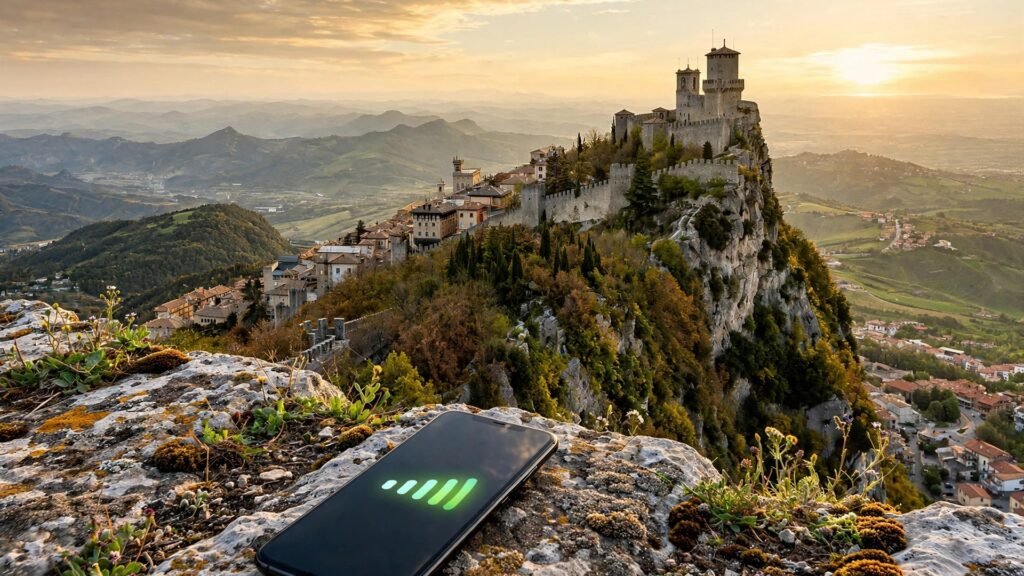
Stand on a hilltop in San Marino, look at your phone, and you may notice something odd: the network name on the screen often looks Italian. For a country with its own government, its own flag and its own long history, that can feel surprising. The explanation is mostly geography, and it is simpler than it first seems.
San Marino is a tiny republic completely surrounded by Italy. There is no coastline, no neighbouring country on the other side, and no long border with anywhere else. When a place is that small and that closely wrapped inside another country, its phone signals live in the same landscape as its neighbour’s signals. That closeness shapes what your phone finds, which network it joins, and sometimes what a call or a data session costs.
Key Takeaways
- San Marino sits entirely inside Italy, so Italian mobile signals naturally reach across its borders.
- A phone usually joins the strongest available signal, which is often an Italian network rather than a local one.
- Visitors should check the network name on their phone before making calls or using data, because roaming rules can differ from those at home.
A Country Inside Another Country
San Marino is one of the world’s smallest and oldest republics, perched on the slopes of Mount Titano in the Italian peninsula. Its towns, roads and hilltop towers sit within a short distance of Italian towns in every direction. Everyday life reflects that closeness: people cross into Italy for work, shopping, healthcare and travel, and Italian is the language of daily life.
Mobile networks follow the same pattern. Radio signals do not stop at a border post. A mast built to serve an Italian town a few kilometres away can easily cover homes, roads and viewpoints just across the line in San Marino. In the same way, a mast inside San Marino can reach Italian streets nearby. From the phone’s point of view, there is no neat line on the ground — there is only signal strength, and the phone joins whichever network it can use best at that moment.
That is why the network name on a visitor’s screen can change during a short walk. One street may show a local connection, while the next hilltop viewpoint may show an Italian operator. The phone is not confused. It is simply doing what phones are designed to do: searching for a usable signal and holding on to the strongest one it is allowed to join.
Why Italian Networks Reach So Far
Building a mobile network is a large job for any country, and it is a particularly large job for a very small one. Towers, spectrum, backhaul links and maintenance all have to be paid for, and the number of people using the network is small. Italy, by contrast, has large national operators with dense networks in the regions that surround San Marino. Their coverage spills over the border naturally, just as a radio station from one town can be heard in the next.
Agreements between operators also matter. Mobile operators routinely sign roaming and interconnection deals so that their customers stay connected when they travel. In a place as intertwined with Italy as San Marino, those arrangements are part of everyday connectivity. A phone from elsewhere in Europe, or from further afield, may therefore connect through an Italian network while its owner is standing in San Marino, even if the owner never set foot in Italy on that trip.
A phone from elsewhere may connect through an Italian network while its owner is standing in San Marino, even if the owner never set foot in Italy on that trip.
The same border effect shapes other tiny places in Europe. Travellers in Andorra often notice that roaming works differently there than in the rest of Europe, and phones in Monaco switch networks often because French and Italian signals are always close by. San Marino belongs in that same group: small territory, powerful neighbours, and signals that ignore the map.
What This Means for Visitors
For most visitors, the practical effect is small. Calls go through, messages arrive, and maps load. The thing to watch is not coverage but cost. San Marino is not a member of the European Union, so the roaming rules that apply inside the EU do not automatically apply in the same way there. Depending on your home operator and your plan, a day in San Marino can be treated differently from a day in neighbouring Italy, even though the two places are only minutes apart.
That is why the network name at the top of the screen matters. If your phone has jumped to a network you did not expect, your plan may treat that connection as roaming. Checking before a long call, a video upload or a large download can save an unpleasant surprise later. Many travellers simply use Wi-Fi at their hotel or café for heavy data, keep mobile data for maps and messages, and check their operator’s travel guidance before they arrive.
- Check the network name on your phone when you arrive in San Marino.
- Use Wi-Fi for large downloads and video calls where it is available.
- Ask your home operator how San Marino is treated on your plan before you travel.
- Keep automatic network selection in mind: your phone may switch networks on its own near the border.
What About People Who Live There?
For residents, the Italian connection is simply part of life. People in San Marino live, work and travel across the Italian border every day, so a phone that works smoothly on both sides of the line is more useful than one that stops at it. Local services exist, but the wider Italian network around them is impossible to ignore — it is the network of the towns, workplaces and transport routes that surround the republic.
The same closeness has shaped San Marino’s wider digital life. Like Malta, which became a home for online and digital companies partly through language, location and clear rules, San Marino benefits from sitting inside a much larger market. Its small size is not a barrier to being connected. In many ways, being surrounded by Italy is what keeps it so well connected.
Tips Before You Go
A little preparation makes the phone question disappear into the background, where it belongs. Before a trip, look up how your operator treats San Marino on your plan. On arrival, glance at the network name and note whether your phone is on a network you recognise. If you plan to use a lot of data, download offline maps for the area in advance, so navigation keeps working even if the signal changes on a hilltop road.
If you cross back into Italy during the same trip, expect the phone to switch again without any action from you. That switching is normal in border country. The phone is following signal strength, not politics, and in a republic entirely surrounded by Italy, the strongest signal will very often be Italian.
What to Watch Next
The short answer remains geography: San Marino is a small republic inside Italy, Italian signals cross its borders freely, and phones join the strongest network they can use. Visitors should check the network name and their plan’s roaming treatment, residents live with the Italian connection as an everyday fact, and the phone’s habit of switching networks near the border is a normal part of travelling in such a closely intertwined place. The next time your screen shows an Italian operator on a San Marino hilltop, you will know it is not a mistake — it is the map, working exactly as the airwaves do.