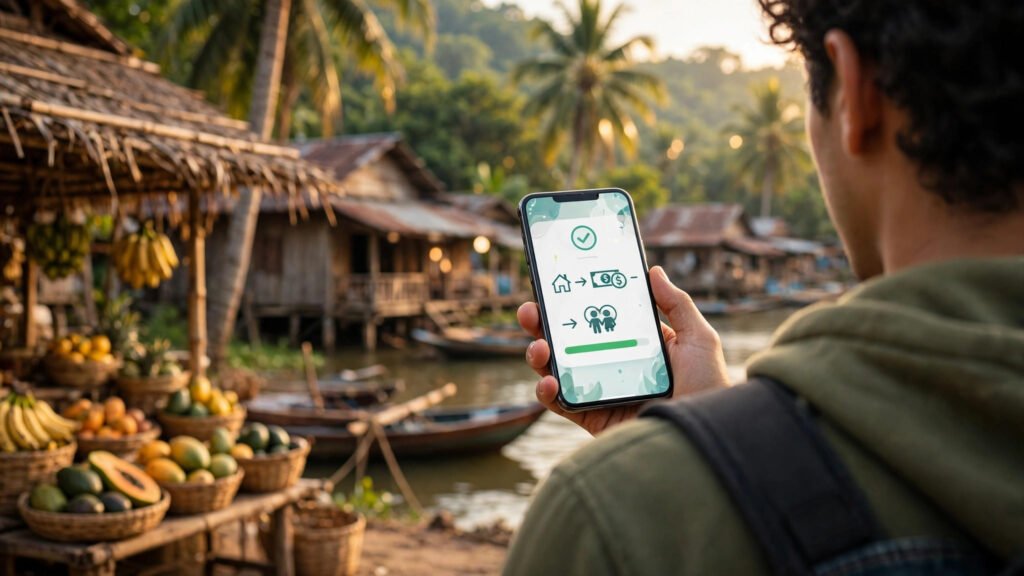
For many Surinamese families, sending money home does not start at a bank counter. It starts with a phone. A relative working abroad, a parent in Paramaribo, or a sibling in a smaller town can move money with a few taps, and the person receiving it often gets it the same day. That simple change matters in a country where towns can be far apart, rivers and rainforest separate communities, and a trip to a bank can take far more time than the transfer itself.
The question is not whether Surinamese people trust banks. Many do use them. The question is why the phone has become the first choice for so many everyday transfers. The answer lies in distance, timing, and family life: money sent home usually pays for food, school costs, medicine, or help for an older relative, and waiting days for it is not always an option.
Key Takeaways
- Phones let Surinamese families send and receive money without a long trip to a bank branch.
- Transfers from relatives abroad often cover everyday needs such as food, school costs, and medicine.
- Cash agents, bank apps, and transfer services fill the gaps where branches are scarce, but fees, access, and trust still shape every choice.
Why Banks Are Hard to Reach for Many Families
Suriname’s population is concentrated along the coast, especially around Paramaribo, while many smaller communities sit further inland, along rivers, or in areas reached by boat and unpaved road. Bank branches tend to cluster where business is busiest, so a family living outside the main towns may face a long journey just to collect money. That journey costs time, transport money, and sometimes a full day away from work.
A phone changes that calculation. If the receiver can collect the money from a nearby agent, a shop, or a mobile wallet, the trip shrinks from hours to minutes. For older relatives or people without easy transport, that difference alone can decide how money moves. It also matters when a transfer is urgent: a medical expense or a school fee cannot always wait for the next planned trip to town.
None of this means banks have disappeared from the picture. Many transfers still pass through the banking system behind the scenes, and many receivers later keep part of the money in an account. The phone is often the front door, not a replacement for the whole system.
How a Phone Transfer Works in Practice
The usual pattern is straightforward. The sender, often a relative living abroad, uses a bank app or a money-transfer service to send an amount to a family member in Suriname. The receiver gets a message or a notification, then collects the money through an agent, a partner location, or a mobile wallet, depending on the service used. Some families prefer cash in hand; others leave the money in an account and spend it gradually.
Families also use phones to coordinate before and after the transfer. A quick call or message confirms the amount, the collection point, and who should pick it up. That coordination reduces mistakes, such as money sitting uncollected or a relative travelling to the wrong place. In households where several people share one phone, the message itself becomes part of the family routine.
Similar habits appear in other countries where receiving money from abroad is part of daily life. Readers who want a comparison can see how Gambians receive money from abroad by phone instead of visiting a bank, and how people in Lesotho rely on mobile money to receive money from South Africa.
Why Families Abroad Prefer Phones
Many Surinamese live abroad, and the Netherlands in particular is home to a large Surinamese community with close family ties back home. For these senders, a phone transfer is practical: it can be made in the evening after work, without visiting an office, and the family at home does not have to plan a bank trip around it. The sender can also send smaller amounts more often, matching payday or a specific need, rather than saving up for one large transfer.
That flexibility shapes how families budget. Instead of one big sum arriving once in a while, smaller, regular transfers help cover weekly shopping, transport, or school expenses as they come up. It also lets the sender respond quickly when something unexpected happens, such as a repair bill or a health cost.
For older relatives or people without easy transport, that difference alone can decide how money moves.
What Phones Still Cannot Replace
Phones solve distance, but they do not solve everything. A receiver still needs a charged phone, mobile signal, and a nearby collection point. In remote areas, signal can be patchy, and an agent may be closed or out of cash when the family arrives. Fees also matter: a small fee on a small transfer feels larger, and families compare services carefully before choosing one.
Trust matters just as much. First-time receivers may prefer to collect money with a relative, or to use a service a neighbour already trusts. Scams and mistaken transfers are a real worry wherever money moves by phone, so families often double-check names, amounts, and collection details before confirming anything. A service that is fast but confusing will lose to one that is slower but clear.
Phones also assume a level of digital comfort that not everyone has. Younger family members often help older relatives read messages, confirm amounts, and keep records. That help is part of why the system works: the phone may be personal, but the transfer is usually a family effort.
- Distance is the main reason phones win: a nearby agent beats a long trip to a branch.
- Small, regular transfers from relatives abroad help families cover everyday costs as they arise.
- Signal, agent availability, fees, and trust still decide which service a family actually uses.
- Phones work best when combined with banks and agents, not as a complete replacement for them.
Elsewhere, phones have become the centre of daily life in different ways, as shown by how Sri Lankans run daily life from their phones. In Suriname, the story is narrower and more personal: the phone is, above all, a way for a family spread across countries to look after one another.
What to Watch Next
What happens next in Suriname will depend on the same factors this article describes: whether collection points reach further into smaller communities, whether fees stay manageable for small transfers, and whether services stay simple enough for older receivers to use with confidence. If access improves, phones will likely handle even more of the everyday money families send home. If agents stay scarce or signal stays patchy in remote areas, the bank trip will remain part of life for many households. Either way, the family need behind the transfer will not change: money sent home is meant to arrive quickly, safely, and close to the people who need it.