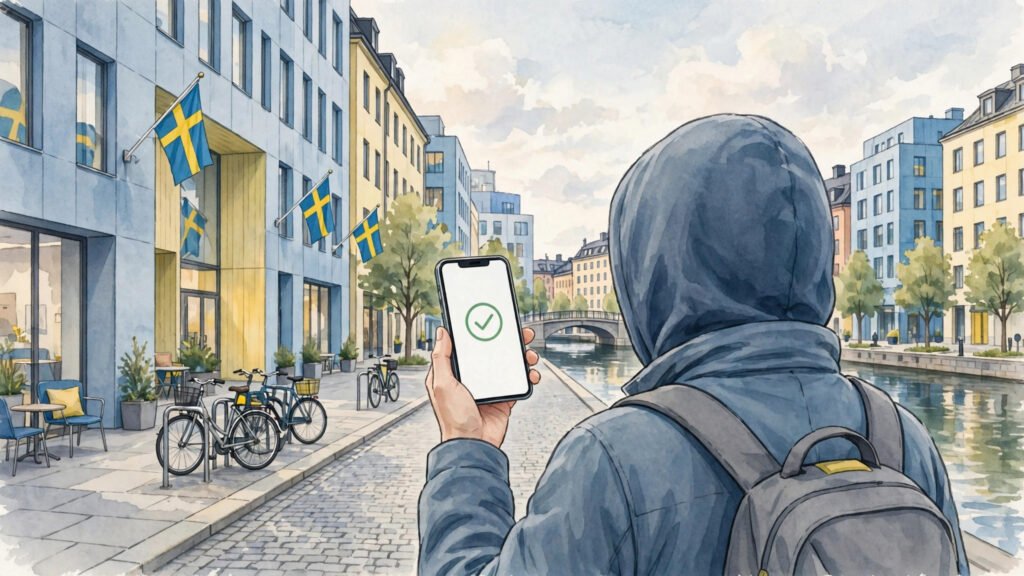
In Sweden, the phone is not just a phone. For many everyday tasks, it is also the key that proves who you are. Open a bank app, sign in to a public service, approve a payment or sign a document, and the same step often appears: confirm with BankID. Visitors sometimes ask why one app seems to sit behind almost everything. The short answer is that Sweden built its digital life around a shared way of proving identity, and BankID became the everyday form of it.
Key Takeaways
- BankID is Sweden’s widely used electronic identification, issued through banks and used to log in, approve payments and sign documents.
- It works across banks, public services and many private services, so one familiar check replaces many separate passwords and paper steps.
- Its strength is convenience and trust, but it also means life without it — for newcomers and visitors — can feel much harder.
What BankID Actually Is
BankID is an electronic identification, often called an e-ID, that people in Sweden use on a phone or computer. In its mobile form, it usually lives as an app linked to a person’s bank. When a service needs to know who you are, it asks BankID to confirm your identity. You then approve the request, often with a code, a fingerprint or face recognition, depending on the device.
The important part is what BankID does not do. It is not a social media login and it is not a single account that holds all your data. It is a way of saying, in a trusted way, “this is me.” The service you are using then decides what you are allowed to see or do. That separation is part of why banks, authorities and companies have been willing to accept the same identification in so many different places.
For most Swedes, BankID is simply part of getting a bank account and a phone set up. Once it is in place, it quietly becomes part of the daily routine, in the same way a bank card once did.
Where Swedes Use It Every Day
The list of places where BankID appears is long because it covers the ordinary business of life. People use it to log in to their bank, check balances and approve transfers. They use it for public services, from tax matters to health services and official messages. They use it to sign agreements and documents without printing, posting or visiting an office.
It also sits behind payments. Sweden is known for paying by phone and card rather than cash, and the country’s popular mobile payment service, Swish, which Swedes use instead of cash and cards, relies on BankID to confirm who is sending money. That link matters: when the identity check is quick and familiar, paying a friend or a small business feels as easy as sending a message.
The same habit shows up in the wider move away from cash, as explored in our look at why Swedes barely use cash anymore. Cash has not disappeared, but for many daily payments the phone has taken its place — and BankID is often the step that makes the phone trustworthy enough to use.
In Sweden, BankID is not a separate chore. It is the quiet step that lets the phone stand in for a signature, a visit and a queue.
Why One Identity Caught On
Sweden’s answer did not come from one company alone. Banks worked together on a shared identification system, and public services and businesses then adopted it, so people did not need a different login for every service. That network effect is powerful: the more places accept BankID, the more useful it becomes, and the more useful it becomes, the more places accept it.
Trust also plays a part. Because BankID is issued through banks, with the checks that come with opening a bank account, services can treat it as a strong form of identification. Users, in turn, learn one process and repeat it. There is no new password to remember for every authority, no paper form to fill in for every signature, and no need to prove the same identity from scratch each time.
Sweden’s high level of digital access helped too. When most people carry a smartphone and are used to handling banking and public services online, a phone-based identity fits naturally into daily life rather than feeling like an extra burden.
The Other Side: Life Without BankID
The same system that makes life smooth for residents can make it awkward for everyone else. A newcomer who has not yet opened a Swedish bank account may not have BankID, and that can slow down simple tasks that residents finish in seconds. A visitor may find that some services assume a Swedish personal identity number and a BankID, even when an alternative exists in theory.
That gap is worth understanding before judging the system. BankID works so well in Sweden precisely because it is widely shared. The trade-off is that anyone outside that circle — a tourist, a new arrival, or someone without a smartphone — may need extra help, extra time, or a different route to the same service.
Other countries have faced the same question and answered it differently. Denmark, for example, built its own widely used digital identity, as explained in our piece on why Danes use MitID for almost everything. The details differ, but the idea is similar: one trusted digital identity that many services agree to accept.
What BankID Means for Everyday Life
For people living in Sweden, BankID changes the shape of ordinary errands. A document can be signed from home. A service can be reached late at night. A payment can be approved without a card reader or a trip to a branch. None of that removes the need for care — approving a BankID request should always be done deliberately, and only for a request you expected — but it does remove a lot of waiting and paperwork.
- One familiar identity check works across banks, public services and many businesses.
- Payments, logins and signatures can all happen on the phone, without paper forms.
- The system depends on trust in banks and on most people having a smartphone and a bank account.
- Visitors and newcomers may need alternative routes, because the system assumes a Swedish banking identity.
That combination — convenience for insiders, friction for outsiders — is the real story of BankID. It is not magic, and it is not compulsory in every single situation, but it has become the default way Sweden proves who someone is online.
What to Watch Next
BankID will keep sitting at the centre of Sweden’s digital life as long as banks, public services and businesses keep accepting the same identity check. The interesting part is how the system handles the people it currently leaves out — whether newcomers and visitors get smoother alternatives, whether the identity check stays as quick and familiar as it is now, and whether other countries keep moving towards a similar shared identity. In Sweden, the question is no longer whether a phone can prove who you are. It already can, every day, with BankID.