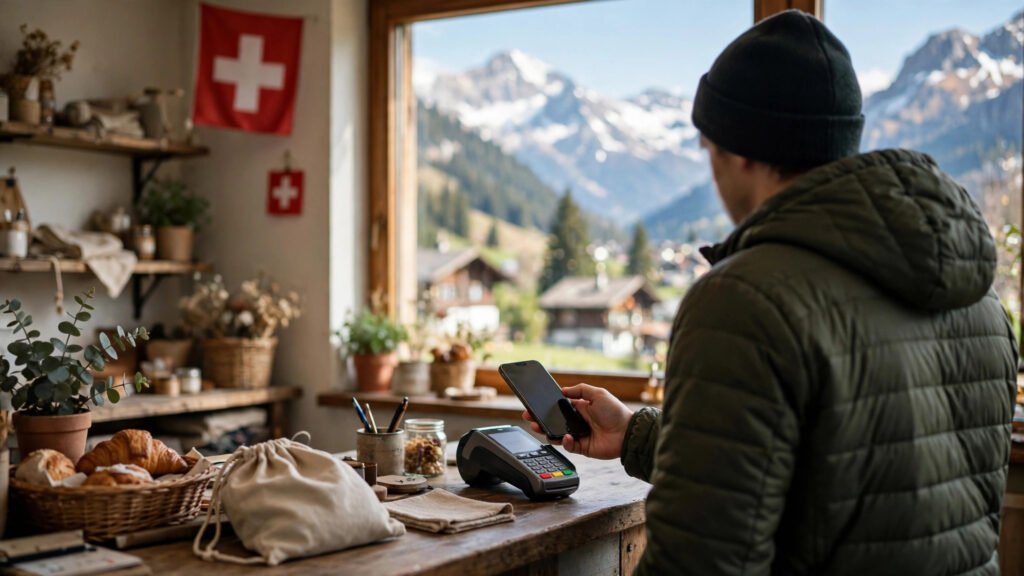
Walk into a bakery in Zurich, a farm shop in the mountains, or a market stall in Bern, and you may notice something that surprises visitors: many Swiss shoppers reach for their phone instead of a card. The app they open is usually TWINT, Switzerland’s own mobile payment system. It is not a foreign wallet that happened to catch on here. It was built for Swiss banks, Swiss shops, and Swiss everyday life, and that local fit explains a large part of its appeal.
So why do so many people in Switzerland pay with TWINT instead of cards? The short answer is convenience layered on trust. TWINT connects directly to a Swiss bank account, works for small everyday payments as well as transfers between friends, and is accepted in a wide range of places where people actually spend money. Cards still work fine in Switzerland, but for many daily moments, TWINT simply feels one step simpler.
Key Takeaways
- TWINT is Switzerland’s own mobile payment system, linked to a Swiss bank account rather than a separate card network.
- It covers everyday life in one place: shops, markets, parking, online orders, and money sent between friends.
- Its appeal comes from local fit and trust, not from replacing cards entirely — cards remain widely used alongside it.
What TWINT Actually Is
TWINT is a mobile payment app used across Switzerland. In simple terms, it lets a person pay with a phone instead of cash or a card. The app is linked to a bank account, so money moves directly from the account when a payment is made. There is no need to top up a separate wallet first in the usual setup, and no need to carry a physical card for that payment.
Payments work in a few familiar ways. At a shop counter, the customer scans a QR code or confirms the amount shown on a terminal. Online, TWINT appears as a payment option at checkout. Between friends, one person sends money to another person’s phone number, which is handy for splitting a restaurant bill, sharing the cost of a gift, or paying back a small loan without a trip to a cash machine.
Because TWINT grew out of the Swiss banking world, it feels familiar to people who already bank in Switzerland. The app sits alongside the bank account they already use, rather than asking them to join an entirely new financial system. That familiarity matters in a country where people tend to be careful about where their money goes.
Why It Fits Switzerland So Well
Switzerland is a country of small businesses, local markets, and regional habits. A payment method that works for a large supermarket but not for a village bakery or a market stall would leave gaps in daily life. TWINT spread into exactly those everyday places: bakeries, farm shops, restaurants, parking meters, vending machines, and small retailers. When the same app works at the corner shop and the train station, people stop thinking about which payment method to use and simply use the one that is already in their hand.
Language and local identity play a quiet role too. Switzerland has several official languages and strong regional identities, and a home-grown system can speak to that landscape in a way an imported app cannot. TWINT is Swiss in branding, banking partnerships, and everyday presence, which gives it a sense of belonging that global wallets struggle to match. People often trust what was made for their own market, especially when money is involved.
There is also a practical point about small amounts. Daily life is full of small payments: a coffee, a bread roll, a parking fee, a ticket. For these, opening an app and confirming with a quick step can feel faster than finding a card, and it avoids carrying coins. Over time, those small repeated moments add up into a habit, and habits are what turn an app into a default.
When the same app works at the corner shop and the train station, people stop thinking about which payment method to use and simply use the one that is already in their hand.
Why Not Just Use Cards?
Cards are not going away in Switzerland, and this is not a story of one payment method defeating another. Cards remain widely accepted and widely used, especially for larger purchases, travel, and online shopping from international stores. Many Swiss shoppers use both: a card for some situations, TWINT for others.
Where TWINT has an edge is in the spaces cards handle less neatly. Sending money to a friend is the clearest example. A card cannot easily move a few francs from one person to another, but a phone app can do it in seconds. The same goes for small sellers who may not want a full card terminal, and for situations like parking or a market stall where a QR code is simpler to set up than card hardware.
This pattern is not unique to Switzerland. Across Europe, countries have built their own local payment habits around what fits daily life there, from mobile wallets in Norway to phone payments in Denmark and bank-based payments in the Netherlands. In each case, the local system won trust by fitting local routines, and Switzerland follows the same logic.
What Visitors Should Know
For visitors, the main thing to know is that TWINT is designed for people with a Swiss bank account, so a short-term tourist generally cannot simply download it and start paying. Cards and cash remain the practical options for visitors, and both are widely accepted. If a shop sign says TWINT only for a particular offer or machine, a card or cash alternative is usually available nearby, and it is always fine to ask.
For residents, the choice between TWINT and a card usually comes down to the moment: TWINT for quick everyday payments and transfers between people, a card for larger or international spending. Neither choice is wrong, and most people mix the two without thinking about it much.
- TWINT links to a Swiss bank account and pays by phone, with no separate card needed for that payment.
- It works for shops, markets, parking, online checkout, and sending money to friends.
- Cards stay important in Switzerland, especially for larger and international purchases.
- Visitors generally pay by card or cash, since TWINT is built around Swiss bank accounts.
What to Watch Next
The question is no longer whether mobile payment fits Switzerland, because for everyday moments it clearly does. What to watch next is how far that habit spreads: whether more small businesses, public services, and online shops keep adding TWINT alongside cards, and whether the mix of phone payments and card payments settles into a stable everyday balance. For now, the Swiss answer to paying is practical rather than dramatic. People use the phone when it is simplest, the card when it suits the purchase, and cash when the moment calls for it, and TWINT has earned its place in that mix by fitting Swiss daily life so well.