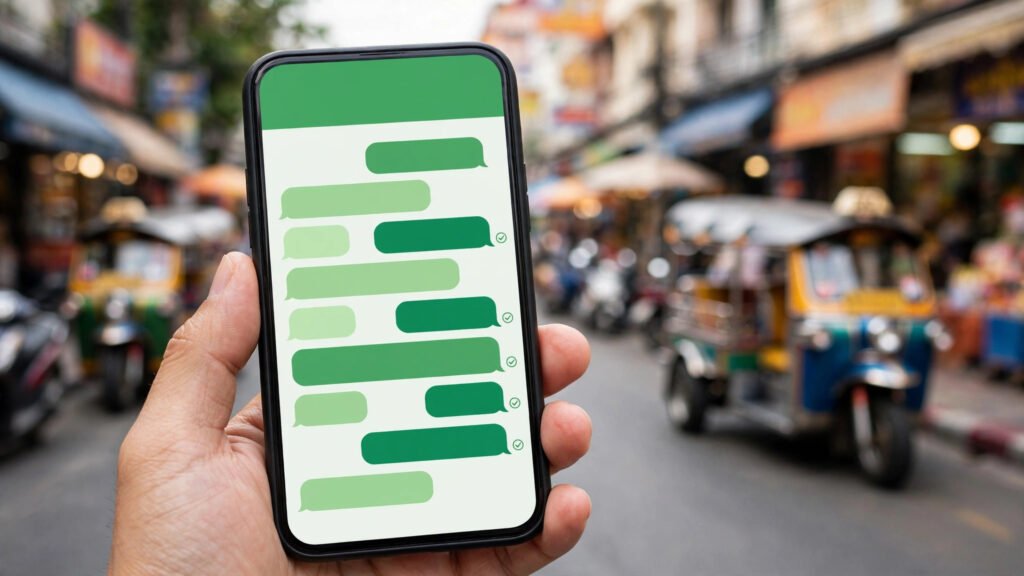
In Thailand, LINE is not just an app you open; it is the place where daily life happens. Friends chat there, families share photos there, and shops, schools, clinics and delivery riders all seem to run on it too. For a visitor, it can look surprising that one green messaging app carries so much of a country’s daily communication. For most Thais, it simply feels normal, because LINE grew into that role step by step, one everyday use at a time.
The short answer is that LINE arrived at the right moment, stayed easy to use, and then kept adding the things people needed next. It started as a simple way to message and call over the internet, without paying for every text or every minute of a call. As smartphones spread, LINE was already on people’s phones, already full of their contacts, and already familiar. Once everyone you know is in one place, there is very little reason to move somewhere else.
Key Takeaways
- LINE became Thailand’s everyday messaging app because it was simple, free to message over the internet, and already full of people’s contacts.
- Stickers, group chats and official accounts turned it from a chat app into a tool for shops, schools, services and daily errands.
- Its strength is the network effect: switching is hard when family, friends, work and businesses all expect to reach you there.
More Than a Chat App
At its core, LINE does what any messaging app does: text messages, voice calls, video calls, photos and group chats. What made it stick in Thailand is how far beyond chatting it reaches. A restaurant can run an official account and send its menu or opening hours. A school can share announcements with parents in a group. A small shop can answer a customer, confirm an order and arrange delivery without ever picking up a telephone or building a website.
That everyday usefulness connects closely with how Thailand pays and shops by phone. Many people already move between chatting, ordering and paying on the same device, as explained in our guide to paying by phone in Thailand. LINE fits that same habit: one phone, one app, and the next step is only a tap away.
Stickers, Groups and Everyday Thai Communication
One feature deserves special attention, because it shaped how Thais actually talk on LINE: stickers. A sticker can say thank you, sorry, good morning or good luck faster and more warmly than a typed sentence, and it crosses age gaps in a way long text sometimes does not. Grandparents, teenagers and office workers can all use the same sticker set, and that shared visual language makes the app feel friendly rather than technical.
Group chats matter just as much. Family groups, class groups, office groups, neighbourhood groups and hobby groups all live side by side. A single morning can start with a family greeting, a work update, a school notice and a joke from friends, all inside the same app. That density is the point. LINE is not one conversation; it is dozens of small circles of daily life, kept in one place.
In Thailand, LINE is not just an app you open; it is the place where daily life happens.
- Free internet messaging and calls made LINE cheap and easy to adopt as smartphones spread.
- Stickers gave Thai users a warm, visual way to communicate across ages and formalities.
- Group chats keep family, school, work and neighbourhood life in one familiar place.
- Official accounts let shops and services share news, answer customers and take orders directly.
- Once contacts, groups and services all live in one app, moving elsewhere feels like starting over.
Why Businesses and Services Live on LINE
For a small business, LINE removes friction. Setting up an official account is far simpler than building an app or a website, and customers are already there. A customer can ask a question, see a reply, and place an order in the same thread where they chatted yesterday. That closeness builds trust, especially for local shops, clinics, tutors and food sellers whose customers value a quick, human reply over a formal booking system.
Thailand is not alone in this pattern. Across Asia, messaging apps that do more than chat have become daily tools, much like the way Vietnamese users rely on Zalo for far more than messages. The details differ from country to country, but the logic is the same: people stay where their contacts, services and daily routines already are.
The same habit appears in other parts of the world too, where one messaging app covers almost everything in Spain. In each case, the winning app is rarely the one with the most features on paper. It is the one that friends, family and businesses all agreed to use first, and then never had a strong reason to leave.
Why Switching Is So Hard
This is the quiet force behind LINE in Thailand: the network effect. A messaging app is only useful if the people you need are on it. Moving to a different app would mean rebuilding every group, re-adding every contact, and persuading shops and schools to follow you. Most people will not do that work when the current app already works, even if a rival app looks slightly better.
Habit plays a role as well. Years of chats, photos, stickers and group history live inside LINE. People know where every button is, how notifications behave, and how to find an old conversation. A new app would have to be dramatically better, not just a little different, to be worth that disruption. For most users, it is not.
There is also a social cost to leaving. If your family group, your office group and your child’s school group are all on LINE, stepping away means missing news or asking everyone to repeat it elsewhere. In practice, people keep LINE even if they also try other apps, because LINE is where they can be reached.
What to Watch Next
LINE’s place in Thailand rests on the same strengths described above: simple messaging, stickers and groups that suit everyday communication, official accounts that bring businesses close to customers, and a network of contacts that is hard to rebuild elsewhere. If any of those pillars weaken, for example if a new habit pulls younger users elsewhere, or if businesses find a better way to reach customers, the balance could slowly shift.
For now, though, the pattern looks stable. LINE remains the default meeting place for Thai daily life, not because it does one thing perfectly, but because it does so many ordinary things in one familiar place. That is why Thais use it for almost everything, and why a visitor who wants to understand daily life in Thailand will keep meeting it, again and again.