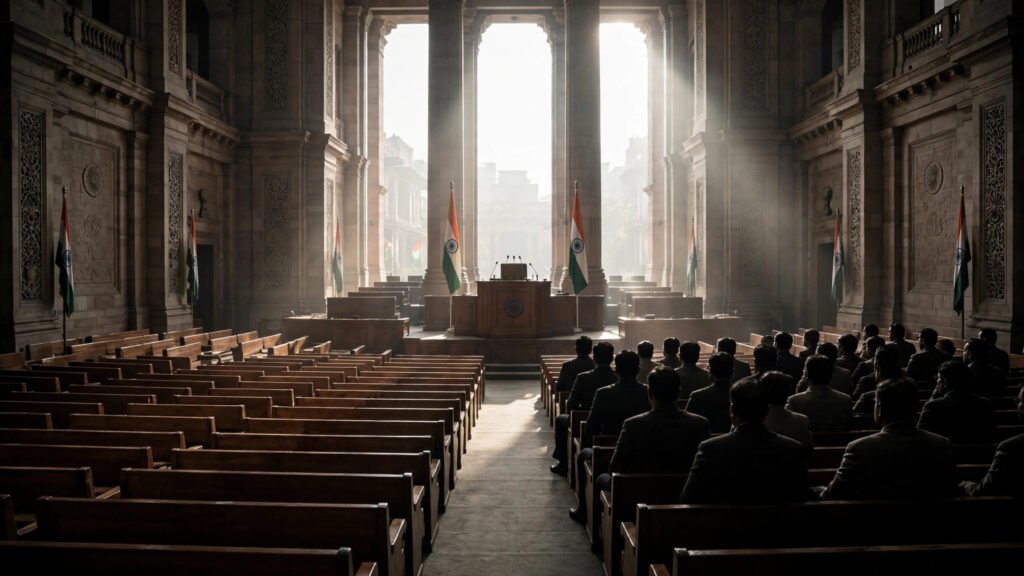
India’s opposition INDIA bloc staged a symbolic “public impeachment” of Chief Election Commissioner Gyanesh Kumar in New Delhi on Saturday, October 31, 2026, turning a dispute over electoral rolls into a piece of parliamentary-style theatre at the home of Congress president Mallikarjun Kharge. The exercise was modelled on proceedings in Parliament, but it was not a formal impeachment and it does not remove anyone from office — a distinction the organisers themselves framed as the point, arguing that the formal route had already been closed to them.
Key Takeaways
- The INDIA bloc held a symbolic “public impeachment” of Chief Election Commissioner Gyanesh Kumar in New Delhi on Saturday, October 31.
- Former Lok Sabha Speaker Meira Kumar presided, Kharge moved the motion, and Rahul Gandhi was scheduled to deliver the concluding remarks.
- The programme is a precursor to the bloc’s November 1 march and rally at Ramlila Maidan over the Special Intensive Revision of electoral rolls.
The programme was held at 10, Rajaji Marg, Kharge’s residence in the capital, after being postponed by a day. It had originally been planned for Friday, but heavy rain in New Delhi forced a reschedule, with Leader of the Opposition in the Lok Sabha Rahul Gandhi saying the decision was taken by consensus so that senior leaders would not have to sit in the rain. Reports said the venue had changed more than once before settling on Kharge’s residence, after plans involving a hotel and Ramlila Maidan ran into permission-related hurdles.
A Parliament in Miniature, Without the Government Benches
The format deliberately copied Parliament. Meira Kumar, a former Lok Sabha Speaker, presided over the proceedings. Kharge, who is also Leader of the Opposition in the Rajya Sabha, moved the motion seeking Kumar’s impeachment, and leaders from different opposition parties spoke in turn. Gandhi was scheduled to deliver the concluding remarks before the motion was put to a vote.
Reports put participation at around 19 to 21 opposition parties, including the Congress, the Samajwadi Party and the Trinamool Congress, along with Left parties. Civil society representatives and voters said to have been affected by the Special Intensive Revision, or SIR, of electoral rolls were also expected to attend, according to live reporting of the event. In a symbolic touch reported from the venue, the government benches were left empty — the opposition’s way of saying the government was defending the Chief Election Commissioner without answering its concerns. Security was tightened outside Kharge’s residence ahead of the programme, and posters describing the event as the public impeachment of Gyanesh Kumar were put up outside.
The exercise does not remove anyone from office, but it is designed to put the Election Commission itself on public trial.
Why the Opposition Is Targeting the Election Commission
The immediate trigger is the SIR of electoral rolls and the opposition’s allegation of “vote chori”, or vote theft — claims that the revision process has wrongly removed genuine voters. The bloc has been demanding Kumar’s resignation over the exercise and alleged electoral irregularities, and it has framed the November 1 rally as the next step in that campaign.
The opposition’s case for staging its own proceeding rests on what happened to its formal impeachment notices. Congress MP Shashi Tharoor said on Saturday that the bloc had been left with no option but to hold the mock parliament because the notices against Kumar had not been admitted by the presiding officers of the Lok Sabha and the Rajya Sabha. Congress leader Pawan Khera made a similar point in describing the event, saying it was not a mock parliament but a public impeachment of the Chief Election Commissioner. The Election Commission has not been reported in the day’s coverage as accepting the opposition’s characterisation of the rolls revision, and the programme itself is best read as a political charge sheet rather than a legal verdict: it records the opposition’s allegations in public, but it carries no power to dismiss a Chief Election Commissioner.
- The programme was held on Saturday, October 31, at Congress president Mallikarjun Kharge’s residence at 10, Rajaji Marg, New Delhi.
- Former Lok Sabha Speaker Meira Kumar presided; Kharge moved the motion and Rahul Gandhi was to give the concluding remarks.
- Around 19 to 21 opposition parties were reported to be taking part.
- The event was postponed from Friday because of rain in the national capital.
- The bloc says its formal impeachment notices were not admitted by the presiding officers of either House.
- The next step is a November 1 march and rally at Ramlila Maidan in Delhi.
A Busy Political Day in the Capital
The impeachment programme took place on a crowded political day in Delhi. October 31 also marked the 151st birth anniversary of Sardar Vallabhbhai Patel, commemorated in the capital, as reported in tributes paid to Patel on Saturday. Against that backdrop, the opposition used its own event to set the terms of the next 24 hours: not a debate about history, but a direct challenge to the institution that runs India’s elections.
What to Watch Next
What to watch next is what happens on November 1, when the INDIA bloc plans its “Chalo Dilli” march from the Minto Road–Connaught Place junction in central Delhi to Ramlila Maidan, followed by a rally against alleged vote theft through the SIR of electoral rolls and pressing for the Chief Election Commissioner’s resignation. The other question is whether the symbolic impeachment changes anything beyond the rally itself: whether it sharpens public attention on the rolls revision, whether the government or the Election Commission responds to the specific allegations aired at Kharge’s residence, and whether the bloc can turn a one-day proceeding into a sustained campaign. Until then, Saturday’s event stands as a protest in parliamentary dress — a motion moved, arguments heard, and a verdict delivered by the opposition alone.