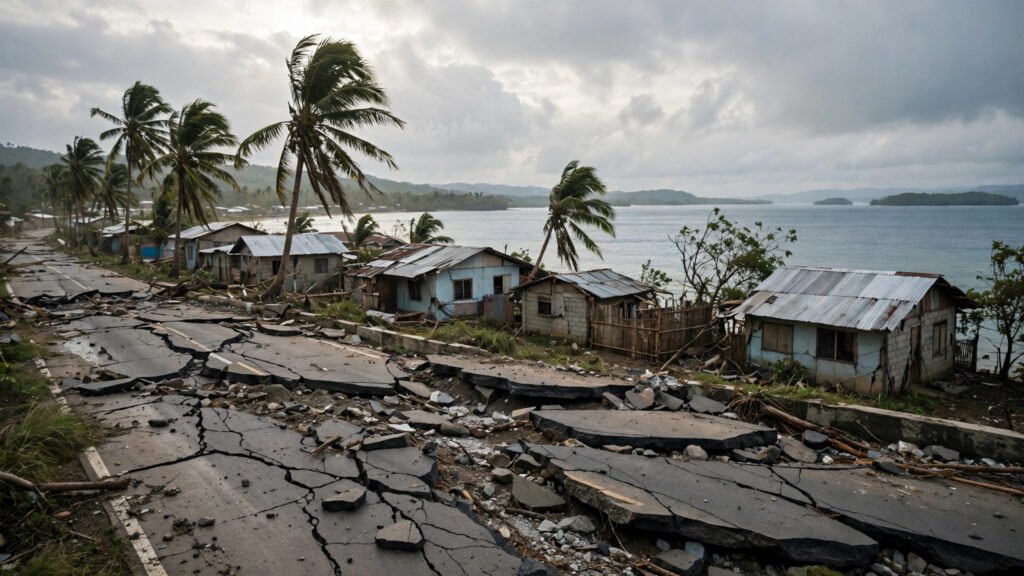
Two earthquakes struck off the coast of Sarangani in Davao Occidental on Wednesday morning, October 28, 2026, shaking towns across the southern Philippines and prompting local officials to suspend work and classes while safety checks were carried out.
The first tremor was reported at 7:43 a.m., followed by a second quake later in the morning. Both were centred near Balut Island, off Sarangani town, according to data from the Philippine Institute of Volcanology and Seismology (PHIVOLCS) reported by Philippine news outlets.
The morning brought two separate jolts to the same coastal area within less than two hours.
Key Takeaways
- Two earthquakes struck near Balut Island, off Sarangani in Davao Occidental, on the morning of October 28, 2026.
- Shaking was felt across Davao Occidental and neighbouring provinces, with the strongest reported intensities in Sarangani town and Alabel.
- Work in government offices and in-person classes were suspended in Sarangani province so safety inspections and damage assessments could take place.
What happened on Wednesday morning
PHIVOLCS data reported by the Cebu Daily News put the first earthquake at magnitude 5.5, striking at 7:43 a.m. nine kilometres southwest of Balut Island at a depth of 10 kilometres. A second earthquake, reported at magnitude 5.4, followed at 9:11 a.m., centred 11 kilometres west of Balut Island, also at a depth of 10 kilometres.
Both quakes were described as tectonic in origin. Early reporting showed some variation in the first quake’s initial magnitude and location estimates, which is common as seismological agencies refine their measurements, but the reported sequence was consistent: two morning tremors in the same offshore area.
The morning brought two separate jolts to the same coastal area within less than two hours.
Where the shaking was felt
PHIVOLCS recorded Intensity IV shaking in Sarangani town in Davao Occidental and in Alabel in Sarangani province. Intensity III was reported in General Santos City, as well as in Malungon and Malapatan in Sarangani and Tupi in South Cotabato.
Lower intensities were reported across a wider area, including Intensity II in several towns in Davao Occidental, Sarangani, South Cotabato and Davao del Sur, and Intensity I in Koronadal City and Surallah in South Cotabato, among other places. The broad spread of felt reports underlined how widely the offshore tremors were noticed, even in towns some distance from the epicentres.
- First quake: magnitude 5.5 at 7:43 a.m. near Balut Island, off Sarangani
- Second quake: magnitude 5.4 at 9:11 a.m. in the same offshore area
- Strongest shaking: Intensity IV in Sarangani town and Alabel
- Local response: work and in-person classes suspended in Sarangani province for inspections
Why work and classes were suspended
The provincial government of Sarangani suspended work in government offices and in-person classes at all levels on Wednesday. In an advisory reported by NewsWatch Plus, Sarangani Governor Rogelio Pacquiao said the suspension was intended to allow post-earthquake safety inspections and damage assessments to ensure the safety of learners, personnel and the public.
The decision reflected a precautionary approach: after two tremors in quick succession, officials moved to check buildings and public facilities before normal activity resumed, rather than waiting for damage reports to emerge on their own.
Aftershocks of June’s larger quakes
PHIVOLCS said the tremors were aftershocks of much larger earthquakes that struck offshore in June 2026, including a magnitude 7.8 earthquake off Sarangani on June 8 and a magnitude 6.5 earthquake off Davao Occidental. Aftershocks can continue for weeks or months after a major earthquake as the earth’s crust adjusts, and they are a familiar pattern in this seismically active part of the Philippines.
The region sits in a tectonically active zone, and communities in Davao Occidental and neighbouring provinces have experience of both large offshore quakes and the smaller tremors that follow them. Wednesday’s sequence fits that pattern: two moderate aftershocks, widely felt, but centred offshore rather than beneath a town.
As with other recent seismic events in the region, including an earthquake in Afghanistan’s Hindu Kush and an earthquake off Vanuatu, the first priority after Wednesday’s tremors was checking people and buildings for safety, not speculating about what might follow.
What to Watch Next
Attention now turns to the safety inspections and damage assessments under way in Sarangani province, and to whether work and classes resume once those checks are complete. PHIVOLCS will continue to monitor the area for further aftershocks, and local officials will update residents if conditions change. For now, the story of October 28 in Davao Occidental is one of two morning tremors, widely felt shaking, and a precautionary pause while the province checks that its schools and offices are safe.