Prime Minister Narendra Modi inaugurated the Emerging Science, Technology and Innovation Conclave 2026 at Bharat Mandapam in New Delhi on Tuesday, October 27, opening a three-day national gathering devoted to where Indian science and technology go next. The conclave runs from October 27 to 29 and brings together scientists, researchers, academics, policymakers, industry leaders, startups and international experts for discussions on emerging technologies and on India’s science, technology and innovation priorities.
The event is a national platform organised by the Council of Scientific and Industrial Research, under the guidance of the Office of the Principal Scientific Adviser to the Government. Its stated aim is to strengthen India’s science, technology and innovation ecosystem in support of the vision of Viksit Bharat 2047, the long-term goal of a developed India by the centenary of independence.
Key Takeaways
- Modi inaugurated the Emerging Science, Technology and Innovation Conclave 2026 at Bharat Mandapam in New Delhi on October 27.
- The three-day conclave runs to October 29 and covers 12 thematic areas, from artificial intelligence and biotechnology to energy and ocean research.
- Around 150 deep-tech startups are exhibiting, and a new Global Connect event brings together more than 300 participants from academia, research and industry.
Twelve Themes, One Question
Deliberations at the conclave cover 12 key thematic areas, including artificial intelligence, biotechnology, advanced materials, manufacturing, healthcare, energy, climate science and ocean research. The breadth of that list is itself the point: the conclave is not a single-sector trade show, but an attempt to set research priorities across the fields that will shape India’s economy, health system and environment in the coming decades.
Discussions centre on three practical questions: what research should be prioritised, how national capabilities in science and technology can be strengthened, and how breakthroughs made in laboratories can be turned into practical, real-world solutions. That last step, from discovery to application, is often the hardest part of an innovation system, and it is a recurring theme of the conclave’s programme.
For India, the timing matters. The country has large research institutions, a growing startup sector and major public science programmes, but turning research strength into products, jobs and public services requires coordination between universities, laboratories, companies and government. A conclave that puts those groups in the same rooms, around the same themes, is designed to make that coordination easier.
Discussions centre on setting research priorities, strengthening national capabilities, and converting scientific breakthroughs into practical, real-world solutions.
An Exhibition, Not Just a Conference
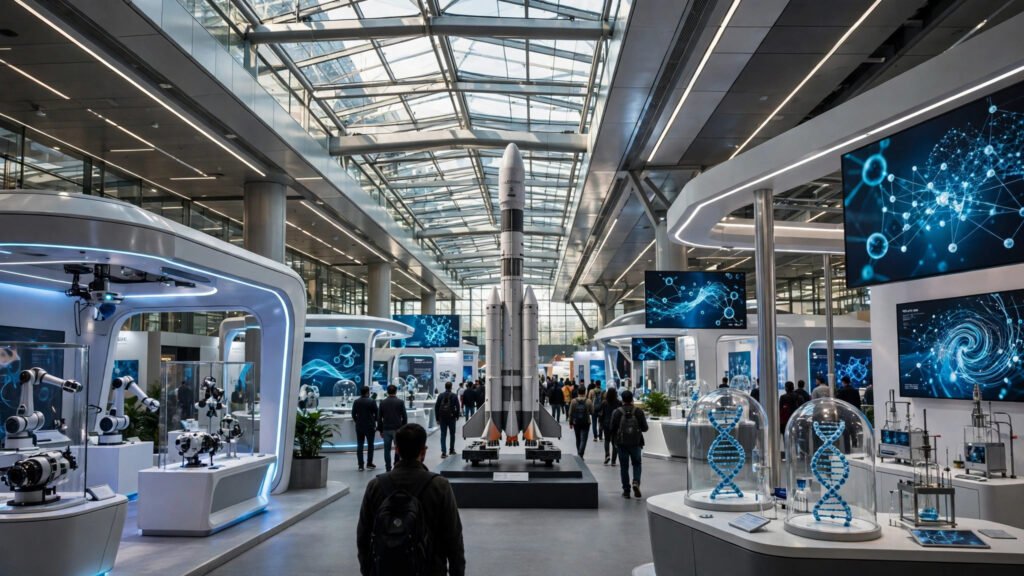
Alongside the talks, the conclave hosts a large-scale technology and innovation exhibition showcasing indigenous scientific achievements and emerging technologies. Around 150 deep-tech startups are taking part through dedicated stalls, demonstrating new ideas and explaining how they could be applied across a wide range of sectors.
For startups, an exhibition of this kind offers something a pitch meeting cannot: direct contact with researchers, policymakers and potential partners, and a chance to test whether a technology built for one problem can solve another. For visitors, it offers a visible picture of what Indian deep-tech looks like today, beyond headlines about individual companies or funding rounds.
A new initiative, the Global Connect Networking Event, brings together more than 300 invited participants from academia, research institutions and industry in India and abroad. Its purpose is to open up international research partnerships, encourage collaboration between industry and academia, and create pathways for moving innovations from laboratories to markets.
- The conclave runs from October 27 to 29 at Bharat Mandapam in New Delhi.
- It is organised by the Council of Scientific and Industrial Research, under the guidance of the Office of the Principal Scientific Adviser.
- Deliberations cover 12 themes, including artificial intelligence, biotechnology, advanced materials, manufacturing, healthcare, energy, climate science and ocean research.
- Around 150 deep-tech startups are exhibiting their work.
- The Global Connect event brings together more than 300 participants from India and abroad.
- ISRO is showcasing a model of a proposed next-generation heavy-lift launch vehicle able to place payloads of over 30,000 kg into low Earth orbit.
Space Takes Centre Stage
ISRO is also showcasing emerging technologies as part of the conclave. The space agency’s exhibition includes the model of a proposed next-generation heavy-lift launch vehicle that can place payloads weighing over 30,000 kg to low Earth orbit, according to the agency’s chairman, V Narayanan, speaking at a curtain-raiser event.
The event also showcases the Chandrayaan-4 and Chandrayaan-5 missions, keeping India’s lunar programme visible alongside the wider science agenda. Space has become one of the most public faces of Indian science, and its presence at the conclave links the long-term research programme with the startups and researchers working on the ground.
That connection matters for the conclave’s wider goal. Heavy-lift launch capability, advanced materials, biotechnology and artificial intelligence are not separate stories: they draw on similar research skills, similar manufacturing capacity and similar questions about how public investment in science returns value to society. A conclave that treats them together reflects how modern technology actually works.
What to Watch Next
What to watch next is what the article has already set out: how the discussions over the three days, from October 27 to 29, shape research priorities across the 12 themes; whether the Global Connect event leads to new international research partnerships and industry-academia collaboration; what the around 150 exhibiting deep-tech startups demonstrate about the state of Indian innovation; and how the technologies on show, including ISRO’s proposed heavy-lift launch vehicle model and the Chandrayaan-4 and Chandrayaan-5 missions, are received. The test of the conclave will be whether the priorities, partnerships and pathways discussed in New Delhi turn into practical solutions after the exhibition halls close.