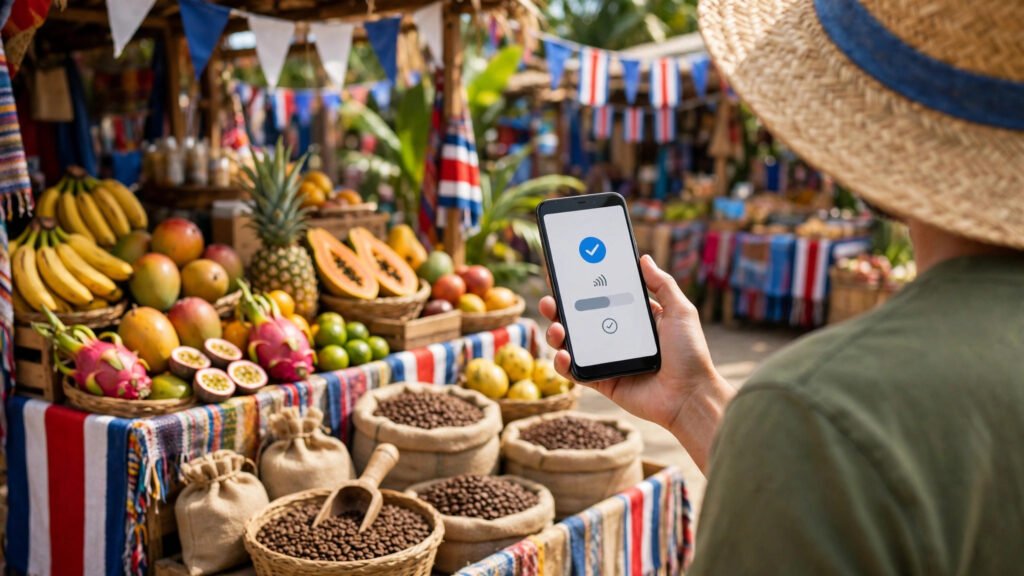
In a busy Costa Rican market, a shopper picks up fruit and coffee, holds up a phone, and pays without reaching for a wallet. No card machine appears, no notes change hands, and the seller simply checks a phone to confirm the money has arrived. For many people in Costa Rica, this is now an ordinary moment, and the system behind it is called SINPE Móvil.
So why do so many Costa Ricans pay with SINPE Móvil instead of cash and cards? The short answer is that it fits daily life unusually well: it uses a phone number instead of long bank details, it works for small everyday payments, and it sits inside the banking apps many people already use.
Key Takeaways
- SINPE Móvil lets people send money using a mobile phone number, without sharing full bank account details.
- It suits small, everyday payments at markets, small shops and between friends and family.
- Cash and cards still have a place, especially where phone signal is weak or a business prefers traditional payment.
What SINPE Móvil Actually Is
SINPE Móvil is a mobile payment service connected to Costa Rica’s national electronic payment system, SINPE. In practice, a person links a mobile phone number to a bank account, and then money can be sent to another person’s phone number. The receiver does not need to hand over account numbers, and the sender does not need to carry cash or a card for that payment.
Most major banks in Costa Rica offer SINPE Móvil through their own mobile banking apps. That matters because it means people do not usually need a separate wallet app or a new account. If they already bank on their phone, the option is often already there, waiting in the same app they use to check a balance.
For the person paying, the steps feel simple: open the banking app, choose the SINPE Móvil option, enter the other person’s phone number and the amount, and confirm. For the person receiving, the money lands in their bank account, and they can check it on their own phone. That simplicity is a large part of the appeal.
Why a Phone Number Beats a Bank Account Number
Traditional bank transfers ask for details that most people do not carry in their heads: account numbers, bank names and sometimes branch information. A phone number is different. Almost everyone knows their own number, and contacts already store the numbers of friends, family and regular customers.
That difference matters most in informal, everyday situations. Splitting a restaurant bill, paying a neighbour for a lift, sending money to a family member in another town, or paying a market seller all become quicker when the only detail needed is a phone number. There is less room for a mistyped account number, and less awkwardness in asking for banking details from someone you barely know.
Small businesses benefit in the same way. A market stall, a coffee seller or a home-based baker can accept a payment without renting a card terminal or handling large amounts of cash. A phone is often the only equipment needed, which keeps costs down for businesses that work on thin margins.
For many Costa Ricans, the phone number has quietly become the easiest address for money.
Why It Suits Small Payments So Well
Cash still works for small payments, but it brings its own friction: finding change, carrying coins, and keeping notes safe. Cards solve some of that, but not every small seller has a terminal, and some customers prefer not to use a card for a very small purchase.
SINPE Móvil sits in the middle. It handles the small amounts that make up much of daily spending — a coffee, a bus fare contribution, fruit from a market stall, a payment to a local tradesperson — without needing change or a terminal. The payment is recorded in both people’s banking apps, which also makes it easier to keep track of spending than cash.
- A phone number replaces long bank details for everyday transfers.
- Small sellers can accept payments with just a phone, no card terminal needed.
- Payments leave a record in the banking app, unlike cash.
- It works best for people who already have a bank account and a mobile phone.
Why Cash and Cards Have Not Disappeared
None of this means cash is gone in Costa Rica, or that cards are unwanted. Cash remains important for people without a bank account, for visitors, and in places where mobile signal is unreliable. Some sellers still prefer cash because it is immediate and familiar, and some buyers like the control of paying with notes and coins.
Cards also remain the natural choice for larger purchases, online shopping and travel, where buyer protections and spending limits matter more. SINPE Móvil is strongest in the everyday, person-to-person and small-business payments where speed and simplicity matter most, and weaker where a formal card payment makes more sense.
The pattern is similar in other countries that have built everyday life around a local phone-based system. In Mexico, many people top up their phones at corner shops because that is where daily routines already happen. In Argentina, QR-code wallets grew for a similar reason: they fitted how people already shopped. And in Sri Lanka, scanning a national QR code made small payments simpler without new hardware.
What Still Gets in the Way
SINPE Móvil is not a solution for everyone. It requires a bank account and a mobile phone, so people outside the banking system cannot use it. It also depends on mobile connectivity, which can be patchy in remote areas. And as with any phone-based payment, a lost or stolen phone needs to be secured quickly, just as a lost wallet would.
There is also a learning curve. Older users, or people who have always paid in cash, may need help the first time they link a number or confirm a payment. Banks and family members often fill that gap, walking a new user through the first transfer until it feels routine.
What to Watch Next
SINPE Móvil is likely to stay central to everyday payments in Costa Rica because it matches how people already live: phones in hand, small daily purchases, and trust in a phone number as the simplest way to reach someone. Cash and cards will keep their roles for larger purchases, visitors and places with weak signal, while phone-number payments keep handling the small, frequent transfers in between. The next thing to watch is how far that habit spreads — whether more small businesses, rural sellers and older users make the phone-number payment their default, and how smoothly the system works as even more daily life moves onto the phone.