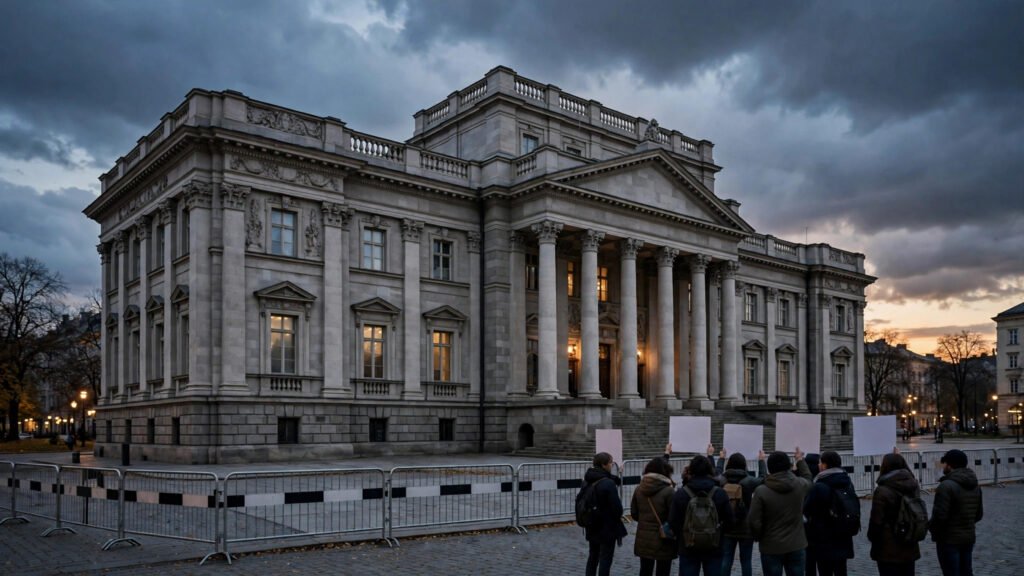
Poland’s Constitutional Tribunal became the centre of a political and judicial standoff on Friday, October 30, after the suspension of the court’s president and deputy president triggered protests outside the building in Warsaw, three detentions by police, and the return home of President Karol Nawrocki from an official trip to Senegal.
Police secured the tribunal as dozens of protesters gathered to oppose the suspension of court president Bogdan Święczkowski. Officers said they detained three people after some protesters breached the tribunal’s fence and others threw objects at officers. Police stressed that officers were acting to maintain public order and security, but had not entered the courthouse itself.
Key Takeaways
- Poland’s Constitutional Tribunal president Bogdan Święczkowski and deputy president Bartłomiej Sochański were suspended for one month, according to reports of the tribunal’s announcement.
- Police detained three protesters outside the tribunal in Warsaw after a fence breach and objects thrown at officers.
- President Karol Nawrocki cut short a trip to Senegal, returned to Warsaw, and called an urgent meeting of parliamentary group heads for Saturday.
What Happened Outside the Court
The suspension was published on the Constitutional Tribunal’s website at around 6 p.m. local time on Friday, according to multiple reports. Shortly afterwards, protesters began rallying outside the building, including Law and Justice (PiS) leader Jarosław Kaczyński and other opposition politicians. Warsaw police deployed a large presence around the court after a tribunal judge, Anna Korwin-Piotrowska, issued an urgent warning of a real threat to the lives of judges and court employees, as well as a serious risk of public disorder.
Korwin-Piotrowska announced that she was taking charge of the court after ordering Święczkowski and Sochański to be suspended for a month, on grounds reported as obstructing the court’s work. The tribunal’s leadership disputed the suspension, issuing a statement saying that Święczkowski “remains president of the Constitutional Tribunal.” The dispute is no longer only about two judges; it is about who controls Poland’s highest court.
The dispute is no longer only about two judges; it is about who controls Poland’s highest court.
How the Standoff Unfolded
President Nawrocki, who opposes the pro-European government of Prime Minister Donald Tusk, turned back his plane during a flight to Senegal on Friday evening and returned home over the situation. After returning to Poland, he made his way to the Constitutional Tribunal and said he helped the suspended court president to also enter the building.
On Saturday morning, Nawrocki said a “breach of Poland’s constitutional order” had taken place and called parliamentary group heads for an urgent meeting on Saturday. Kaczyński accused Tusk of staging a “coup” against the institution, while the government says Święczkowski repeatedly broke the law and jeopardised the tribunal’s work. Justice Minister Waldemar Żurek said he had requested that the legal immunity of the two senior judges be lifted to allow criminal proceedings against them, according to reports.
The confrontation also sits alongside wider European tensions this week. Poland has been active in diplomacy over Black Sea ceasefire and grain shipments, and Warsaw has just been welcomed as a full G20 participant in Atlanta. At the same time, protests elsewhere in Europe show how quickly street demonstrations can become part of a broader political moment.
Why the Court Matters
Poland’s top judicial bodies, including the Constitutional Tribunal, have been a major bone of contention between the current pro-European government and PiS, the national-conservative party that governed for eight years before the 2023 election. During its time in power, PiS appointed judges to the tribunal, including Święczkowski and his deputy, and the court became a central point of conflict between Poland and the European Union over judicial independence and the rule of law.
The tribunal has the power to strike down legislation, and under the previous PiS government it helped impose an almost total ban on abortion and challenged the supremacy of EU law. The latest confrontation marks a fresh escalation in Tusk’s efforts to reverse judicial reforms introduced by the former PiS government, and it sharpens the contention between the government and its opponents ahead of future elections.
For now, the verified facts are narrow but serious: two senior judges suspended, a competing claim about who leads the court, three people detained outside it, and a president who cut short a foreign trip to intervene. What is contested is the legitimacy of the suspension itself, and that question is now being argued in public, in parliament, and outside the court building at the same time.
- Suspension of the tribunal president and deputy president announced Friday evening, reported as lasting one month
- Anna Korwin-Piotrowska announced she was taking charge of the court; the tribunal leadership disputed the suspension
- Three protesters detained after a fence breach and objects thrown at police officers
- President Nawrocki returned from Senegal and called an urgent Saturday meeting of parliamentary group heads
- Justice minister sought lifting of the two judges’ legal immunity for criminal proceedings, according to reports
What to Watch Next
What to watch next is only what this article has already set out: whether Saturday’s urgent meeting of parliamentary group heads produces any agreed way forward, whether the competing claims over who leads the Constitutional Tribunal are resolved, and whether the requested lifting of legal immunity leads to criminal proceedings against the two suspended judges. Until then, the standoff remains what Friday’s events made it — a dispute over two judges that has become a dispute over who controls Poland’s highest court.