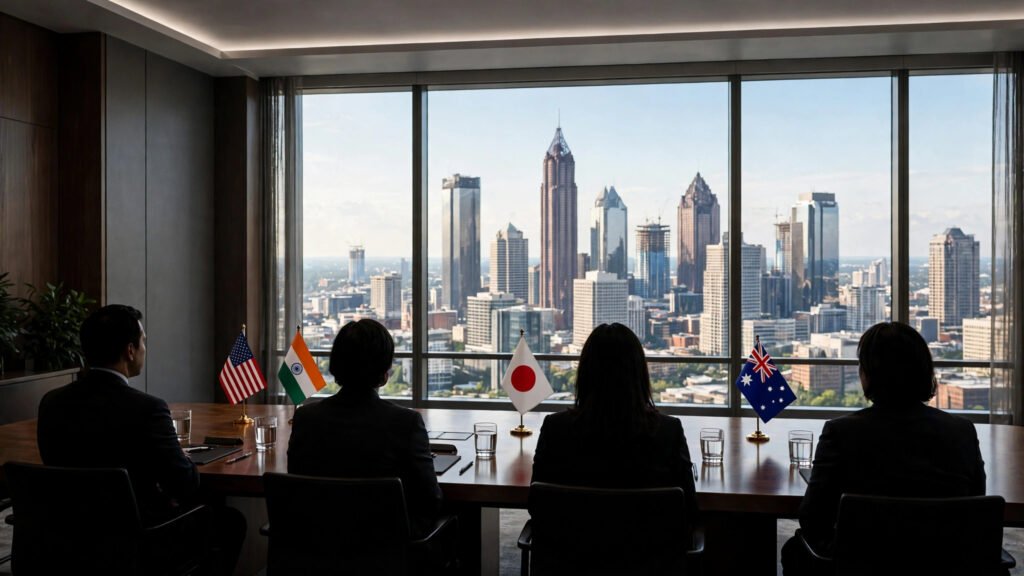
The foreign ministers of India, the United States, Japan and Australia met in Atlanta on Saturday, October 31, 2026, for the third Quad ministerial meeting of the year, reviewing progress on turning shared priorities into practical benefits for the Indo-Pacific region.
The meeting was hosted by United States Secretary of State Marco Rubio on the sidelines of the G20 Foreign Ministers’ Meeting in Atlanta. It brought together Rubio, India’s External Affairs Minister S. Jaishankar, Japan’s Foreign Minister Toshimitsu Motegi and Australia’s Foreign Minister Penny Wong.
According to reports of the meeting, the four ministers reviewed progress on building secure supply chains, securing critical minerals, strengthening maritime cooperation and advancing next-generation technologies. Those themes have run through the Quad’s work in 2026, as member countries try to reduce dependence on single suppliers and keep sea lanes open and safe.
- The Quad foreign ministers met in Atlanta on October 31, 2026, for their third ministerial meeting of the year.
- The talks reviewed supply chains, critical minerals, maritime cooperation and next-generation technologies.
- The ministers used the meeting to prepare the ground for a Quad leaders’ summit planned for Manila next month.
A third ministerial in a busy year
Earlier ministerial meetings this year were held in New Delhi in May and in Manila in July, making Atlanta the third gathering at foreign-minister level in 2026. The pace reflects how often the four countries are now meeting to coordinate, rather than relying on a single annual summit.
Rubio said after the meeting that he was pleased to meet his Quad counterparts in Atlanta and discuss the real progress made in turning shared priorities into real benefits for the Indo-Pacific. In a post on X, he pointed to open supply chains, increased maritime cooperation and secured critical minerals as areas where the group continues to build.
The meeting was the third Quad ministerial of the year, and the ministers used it to prepare the ground for a leaders’ summit planned for Manila next month.
Why supply chains and minerals topped the agenda
Supply chains and critical minerals have become central to the Quad’s economic agenda because they underpin everything from electronics and electric vehicles to defence equipment. When supplies are concentrated in a small number of countries, disruptions can quickly spread across industries and regions.
The Atlanta discussion therefore focused on practical cooperation: how the four countries can build more resilient supply chains, diversify sources of critical minerals and work together on technology standards. Maritime cooperation was also on the agenda, reflecting the group’s long-standing interest in a free and open Indo-Pacific and in keeping trade routes secure.
- Secure supply chains were a central theme of the Atlanta talks.
- Critical minerals featured alongside maritime cooperation and new technologies.
- The meeting took place on the sidelines of the G20 foreign ministers’ gathering in Atlanta.
- A Quad leaders’ summit is planned for Manila next month.
India-US ties in focus
The meeting came amid strains in India-US ties, and analysts quoted in coverage of the talks said the Atlanta session would test the group’s cohesion as well as lay the groundwork for the leaders’ summit. Jaishankar’s visit to Atlanta also included bilateral engagements on the sidelines of the G20 meeting, including meetings reported with counterparts from Argentina, Canada, Mexico, Brazil and Germany.
India’s foreign ministry had announced ahead of the visit that Jaishankar would participate in the Quad meeting and hold several bilateral engagements. After Atlanta, Jaishankar was scheduled to travel to Antigua and Barbuda for the Commonwealth Heads of Government Meeting from November 1 to 4.
The Quad meeting also came a week after Rubio’s visit to India, a sequence that underlines how closely the two countries’ diplomatic calendars are now linked. As with other recent alliance efforts, including the Canada-EU alliance agreed in Montreal, the Atlanta talks showed established partners looking to deepen cooperation rather than act alone.
What to Watch Next
The next step to watch is the planned Quad leaders’ summit in Manila next month, where leaders are expected to take up the work reviewed by their foreign ministers in Atlanta. Whether that summit produces concrete announcements on supply chains, critical minerals and maritime cooperation will show how far the Atlanta discussion has moved from shared priorities to delivered results. Observers will also watch whether the ministers’ focus on economic resilience translates into joint projects that businesses and governments in the Indo-Pacific can actually use.