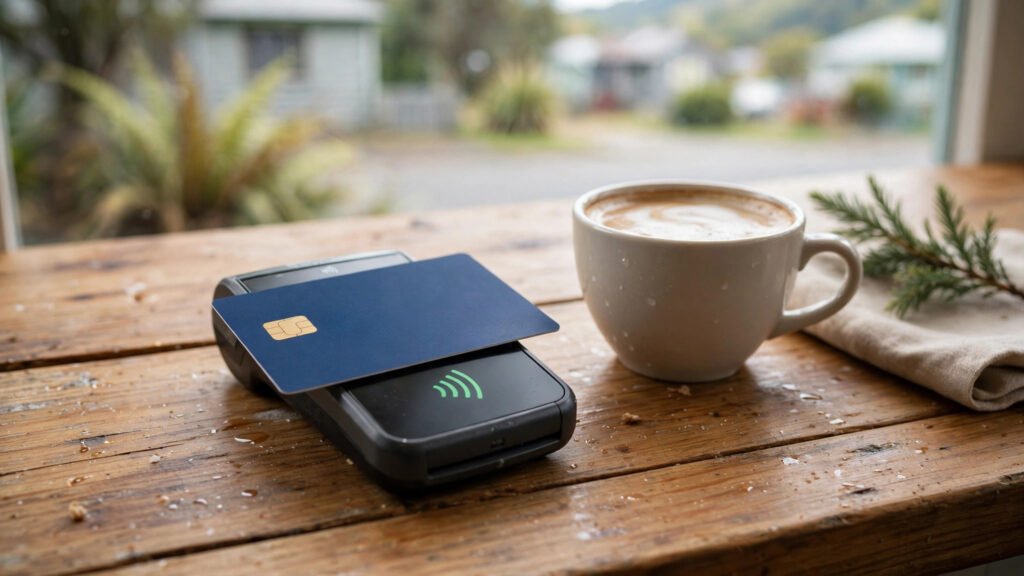
Walk into almost any café, dairy or petrol station in New Zealand and pay for a flat white, and the word you will hear at the counter is often not “card” but “EFTPOS”. Visitors sometimes wonder whether it is a brand, a bank or a special kind of card. It is, in fact, the everyday name New Zealanders give to paying straight from a bank account at the till — and it has stuck around long after newer ways to pay arrived.
So why do so many New Zealanders still pay with EFTPOS instead of reaching for a credit card or a phone wallet first? The answer is a mix of history, habit and simple practicality: a system that arrived early, worked everywhere, and never gave people a strong reason to leave it behind.
Key Takeaways
- EFTPOS in New Zealand means paying directly from a bank account at the till, rather than borrowing on credit.
- It spread early and widely, so paying this way became a shared habit in shops, cafés and small businesses across the country.
- Credit cards, phones and bank apps now sit alongside EFTPOS, but for many everyday purchases the old habit still wins.
What EFTPOS Actually Means in New Zealand
EFTPOS stands for electronic funds transfer at point of sale. In plain terms, when a New Zealander pays by EFTPOS, the money moves from their own bank account to the shop’s account, usually straight away. There is no credit involved and no bill arriving at the end of the month for that coffee.
That distinction matters to a lot of people. A credit card lets you spend money you have not yet earned, and pay it back later, sometimes with interest. EFTPOS spends money you already have. For shoppers who like to keep a clear view of what is in their account, that directness is the whole appeal.
The word itself has also become part of everyday language. New Zealanders say “I’ll EFTPOS it” the way people elsewhere say “I’ll card it”. The system is so familiar that the name covers the whole act of paying at a terminal, whatever card is in the wallet.
Why It Took Hold So Early
New Zealand was an early adopter of electronic payments at the till. Long before paying by phone or watch became normal, Kiwi shops already had terminals on their counters, and bank cards that worked in them were common. When a payment method is available in the corner dairy as well as the city department store, people build their routines around it.
Small businesses played a big part too. For a café owner or a market stallholder, taking a straightforward bank-account payment at the counter is simple: no cash to count at closing time, no change to find, and a sale completed in seconds. Once both sides of the counter were comfortable with it, there was little reason for either to change.
Habit then did the rest. Most of us pay the way we have always paid, unless something clearly better comes along. For a two-dollar top-up or a lunchtime pie, EFTPOS was already fast enough, so the habit held firm year after year.
The Flat White Test
Nothing explains EFTPOS better than the daily coffee run. A New Zealander orders a flat white, taps or inserts a card, and walks out. The payment comes straight out of the account, the café gets paid, and nobody thinks about it again.
This is where EFTPOS beats more complicated options for many people: there is nothing to set up, no app to open, and no extra step at the counter. The card is already in the wallet, the terminal is already waiting, and the whole exchange takes a few seconds.
Compare that with payment habits elsewhere. In Norway, many people reach for Vipps on their phone instead of a card, and in Denmark the equivalent habit is paying with MobilePay. New Zealand never needed a single app to take over, because the card terminal habit was already doing the same job.
For a two-dollar top-up or a lunchtime pie, EFTPOS was already fast enough, so the habit held firm year after year.
Where Credit Cards and Phones Fit In
EFTPOS has not stood still, and neither have New Zealanders. Contactless payments are now normal, many bank cards work in phone wallets, and credit cards are widely used for bigger purchases, travel and online shopping, where credit or extra buyer protections can be useful.
But for everyday spending, the old logic still applies. If the money is in the account, paying from it directly feels simpler than borrowing and repaying later. Phones have changed the device people tap with, but for many shoppers the money is still coming from the same place it always did.
The Dutch experience shows a similar pattern: the Netherlands built its own bank-to-bank habit with iDEAL rather than defaulting to international card schemes. Every country keeps the payment method that arrived first and worked well, and in New Zealand that method is EFTPOS.
What Could Change the Habit
Habits do shift, slowly. Younger shoppers who grew up with phones may be more open to paying from an app, and businesses that sell mainly online have less use for a counter terminal at all. If a future payment method becomes clearly faster, cheaper or more useful for everyday buys, some EFTPOS users will move.
- EFTPOS pays from money already in the account, not from credit.
- It works at counters all over New Zealand, from city stores to small-town cafés.
- Contactless cards and phone wallets now carry the same habit in a newer form.
- Bigger or online purchases are where credit cards still make the most sense for many people.
For now, though, there is no obvious gap for a rival to fill. EFTPOS already does the everyday job, and New Zealanders tend to keep a system that works until something plainly better replaces it.
What to Watch Next
EFTPOS endures in New Zealand because it is simple, familiar and tied to money people already have. It arrived early, spread everywhere, and became part of the language of paying. Credit cards and phone payments have joined it rather than replaced it, and the daily coffee run still runs on the same straightforward idea: pay from your account, and move on. Whether a future app or device eventually loosens that habit is the question to watch — but for now, at counters across the country, EFTPOS is still the default answer.