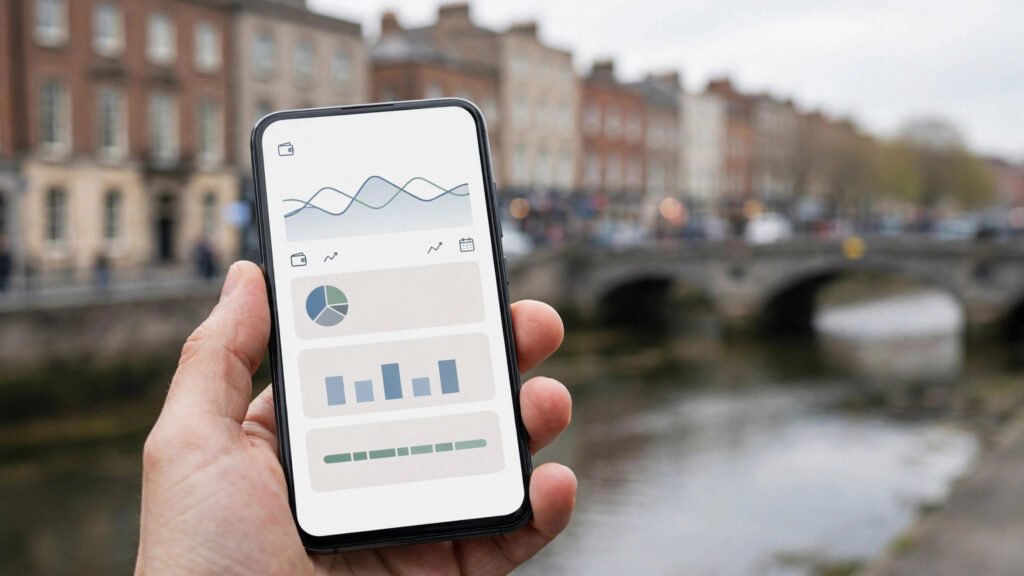
Walk through any Irish town today and you will see the same small ritual again and again: a phone tapped at a café counter, a notification lighting up a second later, a balance checked while waiting for a bus. For a growing number of people in Ireland, that phone is not just a way to reach their bank. It is the bank. So why have so many Irish people turned to Revolut instead of the traditional banks they grew up with?
The short answer is convenience. The longer answer is a mix of timing, technology and changing habits — and it says a lot about how banking itself has changed in Ireland over the past decade.
Key Takeaways
- Revolut reached Irish users as an app-first service, with signup and everyday banking handled on the phone rather than in a branch.
- Instant notifications, spending insights and easy money transfers between friends match how many people already manage their daily lives.
- Traditional banks still matter for mortgages, branches and long-term relationships, so many people use both rather than switching entirely.
Banking That Starts With the Phone
Traditional banking in Ireland was built around branches, paper forms and opening hours. Opening an account once meant a visit, documents and waiting. Revolut arrived with the opposite pitch: download an app, verify your identity from your phone, and start using an account quickly. For younger users especially, that difference mattered. A generation that already books travel, orders food and messages friends from a phone saw little reason why banking should demand a trip into town.
The app-first model also fits how people actually spend. Salaries arrive, bills go out, and small everyday payments pile up — coffee, lunch, a taxi home. Seeing each transaction the moment it happens, with an instant notification, gives people a feeling of control that a monthly statement never did. Spending categories and simple budgeting views turn an abstract balance into something people can follow day by day.
Splitting Bills and Sending Money to Friends
One of the quiet reasons app-based banking caught on in Ireland is social. Splitting a dinner bill, sharing the cost of a holiday rental, or sending money to a friend used to mean cash, bank transfers with delays, or awkward IOUs. Inside an app, sending money to another user can be as quick as sending a message. That social ease helped Revolut spread by word of mouth: one friend using it made it more useful for the next friend, and the next.
Similar patterns explain the rise of local payment apps elsewhere in Europe. In Portugal, many people reach for MB WAY for everyday payments, as covered in our explainer on why Portuguese shoppers pay with MB WAY. In Norway, Vipps plays a comparable role, as described in our look at why Norwegians pay with Vipps. Ireland’s version of that story simply runs through a global app rather than a home-grown one.
For many Irish users, the phone is no longer just a way to check a balance — it is the bank itself.
Travel, Holidays and Spending Abroad
Ireland is a country of travellers. Family live abroad, holidays in Spain and Portugal are routine, and work trips across Europe are common. Traditional banks historically made spending abroad feel expensive and opaque, with charges that only became clear later. An app that shows a conversion at the time of payment, and lets people hold and exchange currencies in advance, removes much of that uncertainty. For frequent travellers, that transparency alone is a strong reason to keep a second account for trips.
It is worth being clear-eyed here: currency features come with their own terms, limits and weekend or fair-usage conditions, and rates move with the market. The appeal is not that travel money becomes free, but that people can see what is happening with their money while they are standing at a foreign till, rather than finding out weeks later.
Timing: Branches Closed and Habits Changed
Revolut’s rise in Ireland also coincided with a shrinking branch network. In recent years, some high-street banks scaled back their branches or left the Irish market altogether, and everyday banking moved further online. When the nearest branch closes, the argument for an app that never closes gets stronger. The pandemic years accelerated that shift everywhere: people who had never banked on a phone learned to do so, and many never went back.
At the same time, Irish consumers grew comfortable paying by phone and card. Contactless payments, phone wallets and tap-to-pay became normal in shops, pubs and buses. An app-based account slots naturally into that world, while a bank that still expects branch visits can feel like it belongs to another era.
What Traditional Banks Still Offer
None of this means traditional banks have disappeared from Irish life. Mortgages, business lending, joint accounts for couples buying a home, and face-to-face advice for complex decisions remain areas where established banks are strong. Many Irish people keep a traditional current account for salary and bills, and use an app-based account alongside it for spending, saving and travel. The real story is less a clean switch than a split: one account for the serious stuff, another for daily life.
Trust plays a part too. Some savers prefer to keep larger balances with a long-established institution, and value being able to walk in and speak to someone when something goes wrong. An app can answer a chat message quickly, but it cannot replace a branch conversation for everyone.
- App-first signup removes the branch visit for everyday banking.
- Instant notifications and spending insights make daily money visible.
- Easy transfers between friends helped the app spread by word of mouth.
- Currency tools suit Ireland’s frequent travellers and families abroad.
- Traditional banks remain important for mortgages, lending and in-person advice.
What to Watch Next
The Irish banking landscape will keep shifting. Traditional banks are investing heavily in their own apps, trying to match the instant notifications and clean design that drew people to app-first rivals. Meanwhile, digital services are adding more features once reserved for high-street banks. The likely future for most Irish users is not one winner, but a mix: a traditional account for the big decisions, and an app in the pocket for everything else. The question is no longer whether Irish people bank on their phones — it is how many of their banking needs the phone will eventually cover.