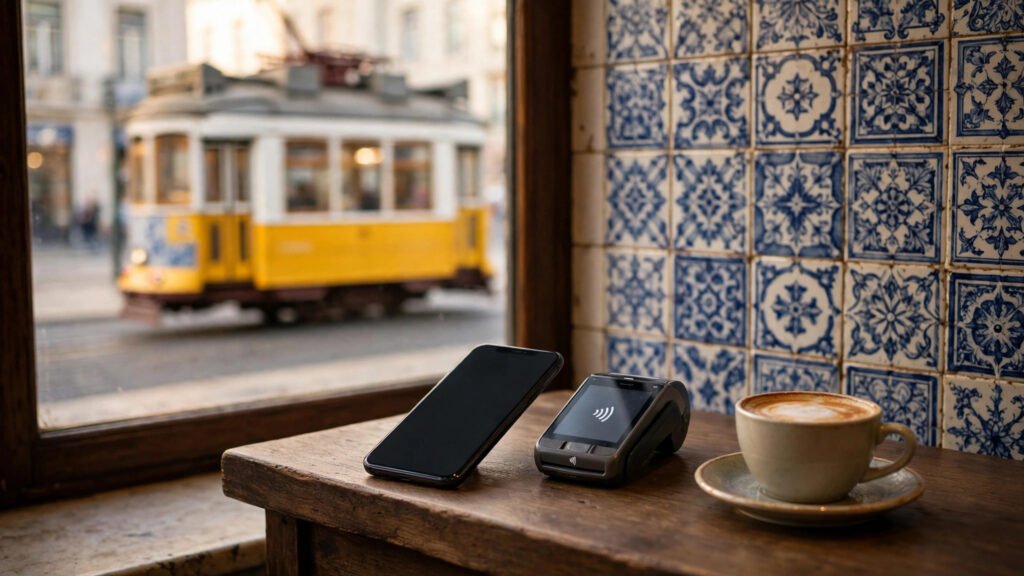
In a small Lisbon café, the payment moment is often over in seconds. The customer opens an app on a phone, confirms the amount, and the coffee is paid for — no card pulled from a wallet, no long number typed in, no change counted out. For many people in Portugal, that app is MB WAY, and it has quietly become one of the country’s most familiar ways to pay.
Visitors sometimes wonder why a separate payment app took hold in a country where bank cards already work well. The answer is not that cards failed in Portugal. It is that MB WAY fits habits Portugal already had, solves small everyday frictions, and grew up inside a banking system people already trusted.
Key Takeaways
- MB WAY lets people pay and send money using a phone number instead of a card number.
- It grew out of Portugal’s long habit of using the Multibanco network for everyday banking.
- Its strength is everyday convenience — small shops, shared bills and online checkouts — while cards still have their place.
What MB WAY Actually Is
MB WAY is a mobile payment service from SIBS, the company behind Portugal’s Multibanco network. A user links a bank account or a card to the app, and can then pay in shops, pay online, send money to other people, and in many cases withdraw cash without a physical card.
The detail that matters most is the phone number. Instead of asking for a card number, an account number or a long reference, MB WAY often needs only the other person’s mobile number. For many people in Portugal, the phone number has become the easiest way to say who should be paid.
Why a Phone Number Beats a Card Number
Think about the two most common small payments in daily life: paying a friend back, and paying a small shop. A card is excellent at a till, but it is awkward between friends. Nobody wants to read out a card number over a message, and nobody wants to carry a card reader to split a lunch bill.
MB WAY removes that awkward step. If you know someone’s phone number, you can send them money. If a shop shows a code or a payment request, you can confirm it on your phone. The payment feels closer to sending a message than to filling in a form, and that feeling matters when the amounts are small and the moments are frequent.
That convenience also helps small businesses. A market stall, a neighbourhood café or a tradesperson does not always want the cost and hardware of a traditional card terminal for every sale. A phone-based payment that the customer already carries can be a simpler fit, especially for businesses that move between locations or work from a small counter.
Portugal’s Multibanco Habit Paved the Way
MB WAY did not arrive in a vacuum. Portugal has one of Europe’s most deeply used ATM and payment networks in Multibanco, and Portuguese people have long been comfortable paying bills, topping up phones and handling everyday banking through machines and electronic references rather than only through cash or cheques.
That history matters because new payment tools succeed fastest when they feel like a next step, not a leap. MB WAY felt like Multibanco in a pocket: the same trusted network behind it, the same idea of paying by reference rather than by handling notes and coins, but now on the phone people already carry everywhere.
It is a pattern seen elsewhere in Europe, where local phone-based payment habits grew out of local banking systems. In Norway, Vipps plays a similar role, and Denmark has its own familiar phone payment habit in MobilePay. The names and banks differ, but the idea is the same: people adopt the tool that matches how they already live.
Where People Use It Every Day
The strongest case for MB WAY is not a single dramatic purchase. It is the accumulation of small moments. Splitting a restaurant bill after a group dinner. Paying a friend for a train ticket bought on someone else’s phone. Settling up for groceries, a coffee, or a ride without hunting for exact change.
Online shopping is another natural home for it. Checking out with a phone confirmation can feel faster than typing card details into a form, especially on a small screen. In the same way, the Dutch habit of paying through iDEAL shows how a familiar local method can become the default online choice simply because it removes steps at checkout.
For many people in Portugal, the phone number has become the easiest way to say who should be paid.
- Pay with a phone number instead of a card number
- Send money to friends and family quickly
- Pay in shops and online without carrying a card
- Built on Portugal’s trusted Multibanco network
What Still Makes Cards Useful
None of this means cards have disappeared in Portugal. Cards remain widely accepted, easy for visitors, and useful for larger purchases, travel and situations where a phone battery is low or a shop does not offer a phone payment option. Many people use both, choosing whichever is quicker in the moment.
That mix is the real story. MB WAY did not win by replacing everything else. It won a large share of everyday payments by being the least effortful option in the situations people meet most often: small amounts, familiar people, and quick decisions.
What to Watch Next
The question for the years ahead is not whether phone payments stay, but how far their everyday role extends. If more shops, services and online checkouts keep offering phone-number payments as a normal option, MB WAY’s place in Portuguese daily life is likely to stay strong. If new payment methods arrive, they will have to beat the same simple test MB WAY already passes: can a person pay a friend, a café or a shop with less effort than before? For now, in Portugal, the phone number remains a remarkably persuasive answer.