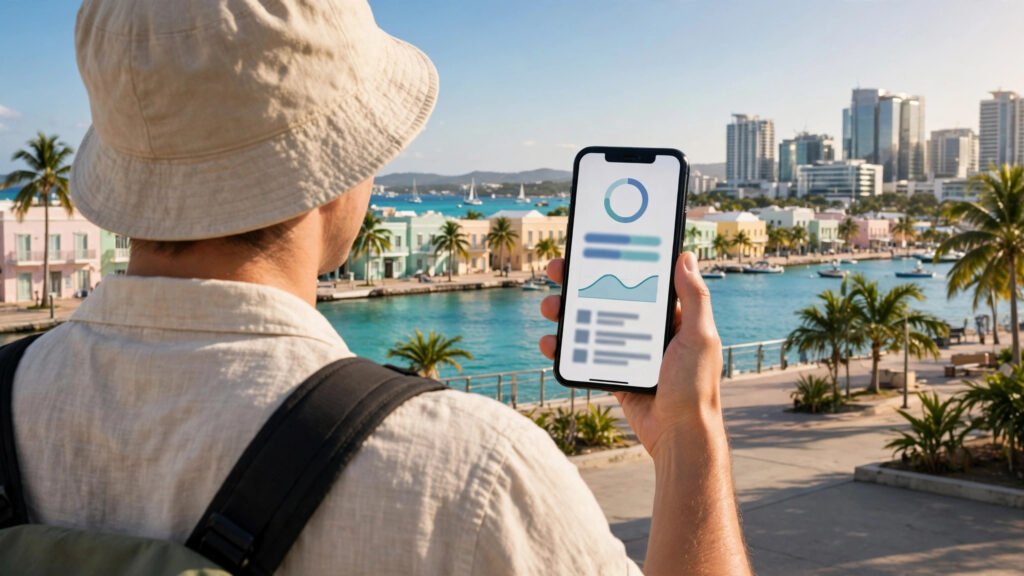
Why the phone became the branch
For many people in the Cayman Islands, banking starts with the phone in their hand, not with a trip into town. Balances are checked over breakfast, bills are paid from the sofa, and money is moved between accounts while waiting for a bus or a boat. The branch still exists, but for everyday banking it is no longer the first stop.
This is not really a story about loving technology for its own sake. It is a story about geography. The Cayman Islands are three small islands in the western Caribbean, and daily life is spread across them. Bank branches are concentrated in and around George Town, the capital on Grand Cayman, while many people live and work elsewhere on the island or on the Sister Islands, Cayman Brac and Little Cayman. When the branch is a drive away, or a journey across water, the phone quietly wins.
Key Takeaways
- Bank branches are concentrated around George Town, so for many Caymanians a branch visit means real travel time.
- Phone banking covers the everyday jobs — checking balances, paying bills and moving money — without that trip.
- Branches still matter for the bigger, rarer jobs, so the phone has replaced the routine visit rather than the bank itself.
Three islands, one busy capital
Grand Cayman is home to most of the population, and George Town is where much of the financial and government activity sits. That concentration makes sense for banks, but it creates a simple friction for everyone else: a routine errand can eat up a large part of the day. Traffic, parking, opening hours and work schedules all stack up against a short task that takes minutes on a phone.
On the Sister Islands the same logic applies even more strongly. Cayman Brac and Little Cayman are quieter, smaller communities, and a banking errand there can mean planning around travel rather than simply walking in. When the alternative is an app that is already in your pocket, most people choose the pocket.
Visitors notice a version of the same pattern. The islands welcome large numbers of tourists and short-stay workers, and many of them arrive already used to banking on their phones at home. The local habit and the visitor habit point in the same direction, which keeps phone banking normal rather than novel.
What phone banking actually replaces
The jobs that moved to the phone first were the boring, frequent ones. Checking a balance before a purchase. Moving money between a current account and a savings account. Paying a utility bill or a phone bill. Sending money to a family member. None of these needs a counter, a form or a queue, and all of them are easier when they can be done at any hour.
That matters in a place where the working day is busy and varied. Many Caymanians work in tourism, finance, construction or public services, and shifts do not always line up with branch opening hours. A payment that can be made in the evening, after work, is simply more useful than one that requires time off during the day.
- Balances, transfers and bill payments are the everyday jobs that moved to the phone first.
- Evening and weekend banking fits shift work far better than branch opening hours.
- Two currencies in daily life — Cayman dollars and widely accepted US dollars — make checking balances on the spot especially handy.
- Island travel turns a short branch errand into a long one, which is the real reason the phone wins.
Why the branch trip costs more than time
It is tempting to describe this as laziness, but that misses the point. A branch visit in the Cayman Islands can involve a car, fuel, parking and waiting, and for some people it can involve a flight or a ferry between islands. The cost is not just minutes; it is planning, transport and a break in the day. The phone removes all of that for routine jobs.
There is also a weather factor that islanders understand well. The Cayman Islands sit in hurricane territory, and heavy rain or storm warnings can disrupt travel at short notice. A banking task that can be finished from home does not depend on the roads being clear. That resilience is part of why phone banking feels less like a convenience and more like common sense.
A banking task that can be finished from home does not depend on the roads being clear.
Trust, security and everyday habits
None of this works without trust, and trust was earned gradually. Early mobile banking felt new and uncertain to many people, especially for larger sums. Over time, familiar habits built confidence: checking a balance and seeing the right number, paying a bill and getting a confirmation, sending money and having it arrive. Each small success made the next phone transaction feel ordinary.
Security habits grew alongside. People learned to guard their phones with passcodes and fingerprints, to be wary of unexpected messages asking for login details, and to check transactions soon after making them. Banks, for their part, built their apps around confirmations and alerts, so customers could see what had happened rather than wondering. The result is a routine that feels controlled, not risky.
That routine also fits how money already moves in the region. Across the Caribbean, islanders have been shifting everyday payments onto phones for years — the Bahamas built its own digital currency, the Sand Dollar, for island-wide use, and the Bahamas launched the Sand Dollar as a digital currency designed for life spread across many islands. Jamaica went a similar way with Jamaica’s JAM-DEX digital dollar, while in Trinidad and Tobago many people still reach for LINX cards instead of credit cards for everyday spending. The Cayman version of the same shift is quieter — ordinary phone banking, used often, for ordinary jobs.
What still needs a branch
The phone has not replaced everything, and nobody serious claims it has. Opening certain accounts, signing important documents, sorting out a complex problem or discussing a large loan are jobs where many people still want a person across a desk. Branches also remain important for visitors and newcomers who need guidance, and for anyone whose phone is lost, broken or out of charge.
That split is the real picture. The branch has become the place for the rare and the complicated, while the phone has become the place for the frequent and the simple. Because the frequent jobs happen every week and the complicated ones happen a few times in a lifetime, the phone looks like it has taken over — when really it has just taken over the routine.
What to Watch Next
The direction of travel is clear: routine banking will keep moving to the phone, and branches will keep focusing on the bigger, rarer jobs that need a conversation. The open question is how far the phone habit spreads into the tasks that still feel branch-shaped today, and how banks make those tasks feel as straightforward on a small screen as checking a balance already does. For Caymanians, the answer will probably be decided the same way the current habit was — not by grand announcements, but by whichever option saves a trip across the island on a busy day.