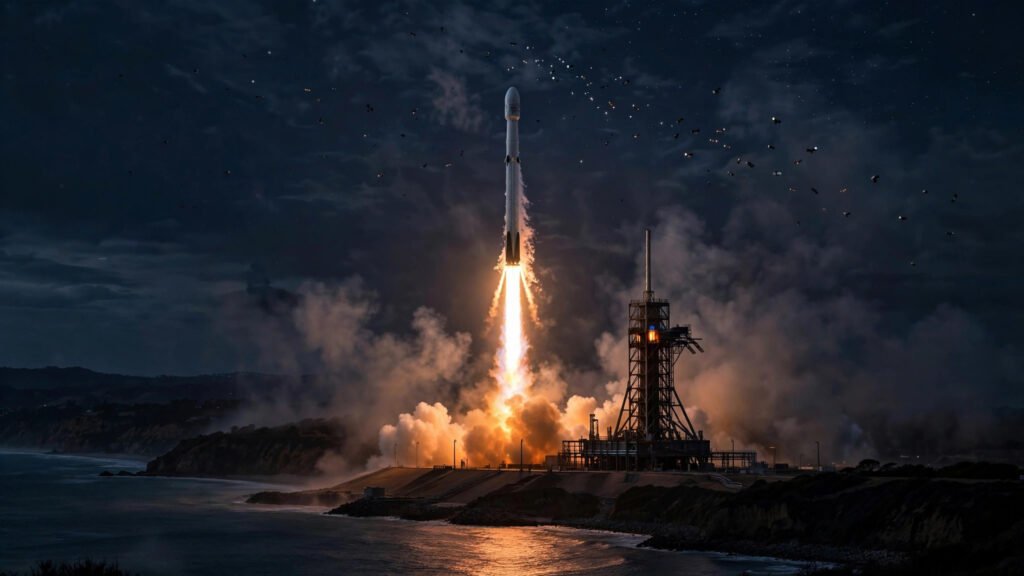
SpaceX closed out October with a milestone flight, launching its Falcon 9 rocket for the 700th time from Vandenberg Space Force Base in California.
The mission, Starlink 15-18, lifted off from Space Launch Complex 4 East at 9:04 p.m. PDT on October 30, which was 0404 UTC on October 31. It carried 27 Starlink satellites toward low Earth orbit on a southeasterly trajectory, with deployment about an hour after liftoff. The flight was the 700th launch of a Falcon 9 rocket to date — and the 11th and final orbital flight of October for SpaceX.
Key Takeaways
- SpaceX flew its Falcon 9 rocket for the 700th time with the Starlink 15-18 mission from Vandenberg.
- The mission carried 27 Starlink satellites to low Earth orbit and was SpaceX’s 11th and final orbital launch of October.
- Booster B1093 flew for the 18th time and landed on the droneship Of Course I Still Love You, the 675th Falcon booster landing overall.
A Halloween Eve Liftoff From Vandenberg
The Halloween eve timing gave the mission its nickname in launch coverage, but the flight itself was a routine Starlink delivery with an unroutine number attached. Seven hundred Falcon 9 launches is a tally no other orbital rocket family has reached, and it was built flight by flight through booster reuse.
The 27 satellites on board were Starlink V2 Mini Optimized spacecraft, the latest version of the broadband satellites SpaceX has been deploying in batches. Once released, they join a constellation that has become central to SpaceX’s business — and to its plans for what comes after Falcon 9.
The flight was the 700th launch of a Falcon 9 rocket to date — and the 11th and final orbital flight of October for SpaceX.
Booster B1093 Lands Again
The first stage, booster B1093, was flying for the 18th time. Its earlier flights included the Transporter-16 rideshare mission, two missions for the Space Development Agency and 14 previous Starlink batches, a record that shows how thoroughly reuse has become the norm for Falcon 9 operations.
Nearly eight and a half minutes after liftoff, B1093 landed on the droneship Of Course I Still Love You, stationed in the Pacific Ocean. It was the 231st landing on that droneship and the 675th Falcon booster landing overall, extending a recovery record that underpins the rocket’s high flight rate.
- Mission: Starlink 15-18, from Vandenberg Space Launch Complex 4 East
- Milestone: the 700th Falcon 9 launch to date
- Payload: 27 Starlink V2 Mini Optimized satellites to low Earth orbit
- Booster: B1093 on its 18th flight, landing on Of Course I Still Love You
- Recovery tally: 231st landing on that droneship, 675th Falcon booster landing overall
- October total: SpaceX’s 11th and final orbital launch of the month
Falcon Winds Down as Starship Ramps Up
The milestone arrives as SpaceX is deliberately winding down the Falcon program and turning its focus to Starship. Launch coverage notes that the company’s rolling 365-day total dropped below 150 orbital launches for the first time since July 2025, after peaking at 171 in December 2025, and that Falcon 9 Starlink flights from Florida ended in August.
The shift has been acknowledged by NASA and others, who have noted that SpaceX plans to stop offering Falcon 9 for commercial and government missions in the next few years. The company’s attention is moving to Starship, the much larger rocket it is developing at Starbase in Texas, and to the Starlink and AI infrastructure businesses that now drive much of its planning.
The milestone came in a busy stretch for launches worldwide: India’s GSLV also placed its NVS-03 navigation satellite in orbit this week, restoring its NavIC system to its minimum configuration. Closer to home, SpaceX’s shift toward AI infrastructure has shaped its financing, while Starlink’s network has also been in focus in Ukraine, where connection limits have been under scrutiny.
What to Watch Next
Attention now turns to Starship Flight 15, expected in mid-November from Starbase, which SpaceX says will attempt to catch the rocket’s upper stage. On the company’s third-quarter earnings call, Elon Musk said Starship could fly weekly at some point in the first half of next year and twice weekly or more by the end of next year — expectations, not outcomes, that will be tested against the actual flight rate. Until then, the 700th Falcon 9 flight stands as the closing mark of October and a measure of how far reuse has carried the rocket that built SpaceX’s launch business.