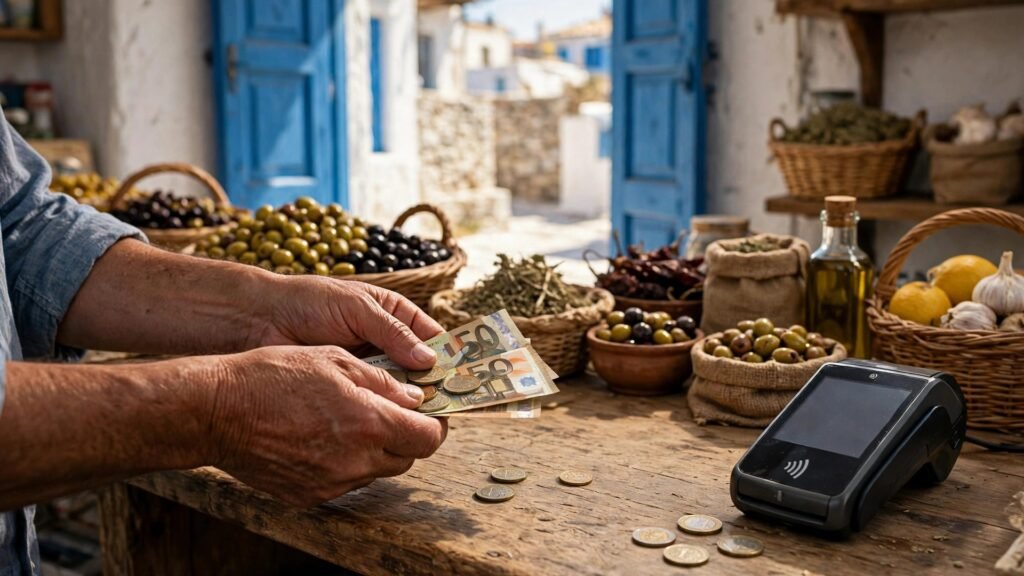
Walk into a small shop in Greece — a bakery in Athens, a grocery on a Cycladic island, a kafenio in a mountain village — and there is a good chance the payment will still be made in cash. Notes and coins change hands, the change is counted out on the counter, and the card terminal sits quietly to one side, used but not always first.
This surprises visitors from countries where the card or the phone has almost replaced cash. Greece has modern banks, contactless cards and phone payments too. So why does cash hold on so firmly in so many small Greek shops? The answer is not one single reason. It is a mix of habit, small-business economics, island life, and a deep cultural comfort with paying in person, face to face.
Key Takeaways
- Cash survives in Greek small shops because of habit, small margins, island logistics and trust in paying face to face.
- Cards and phone payments are growing, especially in cities and tourist areas, but they have not replaced cash everywhere.
- For many small shopkeepers, cash is simple, immediate and free of the fees and waiting times that come with card payments.
A Habit Built Over Generations
For many Greeks, cash is simply how shopping has always worked. Older customers in particular grew up in a time when every purchase was paid for with notes and coins, and they have kept the habit even as cards became common. Paying in cash feels concrete: you see exactly what leaves your wallet, and you know exactly what is left.
This matters most for everyday spending. A coffee, a loaf of bread, a few vegetables from the market — these are small, routine purchases, and for routine purchases people tend to stick with whatever feels easiest. In a small shop where the owner knows your name, handing over cash is part of the rhythm of the visit, not a separate transaction to think about.
Younger Greeks in big cities use cards and phones far more, and the gap between generations is real. But small shops serve everyone, including customers who still prefer cash, so the till has to work for both worlds.
Small Margins and the Cost of Card Payments
Running a small shop in Greece is often a tight-margin business. A family bakery, a mini-market or a souvenir shop on an island may sell many small items at low prices, and every cost counts. Card payments come with processing fees for the shopkeeper, and the money usually arrives in the shop’s account later, not instantly.
Cash avoids both problems. The money is in the till straight away, it can be used to pay a supplier or top up stock the same day, and there is no fee taken from each sale. For a shop selling low-priced goods, that simplicity is a genuine business advantage, even if the owner also accepts cards for customers who want them.
There is also the practical side. A card terminal needs a working connection, power and a charged device. In a busy shop, cash never runs out of battery and never loses signal. That reliability counts, especially where the internet connection is not always stable.
Islands, Villages and Everyday Reality
Greece is a country of islands and scattered villages as much as cities. On a small island, the nearest bank branch may be a ferry ride away, and the local shop may be the only place to buy essentials for days at a time. In that setting, cash is not old-fashioned — it is practical.
Tourist areas tell a different story. Hotels, larger restaurants and shops in busy resorts take cards readily, because visitors expect to pay that way. But step off the main street into a neighbourhood shop, a village taverna or a weekly market, and cash comes back to the front. The same country holds both payment cultures at once, and the small shop sits at the cash end of that range.
Seasonal life plays a part too. Island shops that trade intensely for a few summer months and quietly the rest of the year need payment methods that work without fuss in both seasons. Cash works the same in August and in February.
Trust, Privacy and Paying Face to Face
Another reason is trust — not distrust of banks, but trust in a payment you can see. When you pay cash, the deal is finished on the spot. There is no statement to check later, no pending charge, no worry about a double tap on the terminal. For people who keep a careful eye on household spending, that immediate certainty is reassuring.
Privacy matters to some shoppers as well. A cash purchase leaves no digital trail, and for small everyday buys many people simply prefer it that way. This is not unique to Greece — in Morocco, cash on delivery still rules online shopping for similar reasons of trust and control — but in Greek small shops the preference shows up at the counter every day.
The social side should not be underestimated either. Shopping in a small Greek shop is often a conversation, not just a transaction. Paying cash, receiving change, exchanging a few words — it all fits a style of commerce built on personal relationships rather than speed alone.
In a small Greek shop, handing over cash is part of the rhythm of the visit, not a separate transaction to think about.
Cards and Phones Are Growing — Just Not Everywhere at Once
None of this means Greece is standing still. Card use has grown steadily, contactless payment is now familiar in cities, and phone-based payments are spreading, including instant payment options that let people send money using a phone number. Younger shoppers, city workers and tourists drive much of this change, and many small shops now accept cards even if cash remains common.
The contrast with other countries shows how local habits shape the pace of change. In Sweden, cash has almost disappeared from everyday life, while in New Zealand, the EFTPOS habit shows how one local payment method can define a whole country’s checkout culture. Greece is on its own path: cards growing, cash enduring, and small shops adapting at their own speed.
- Cash feels concrete and immediate — you see exactly what you spend.
- Small shops avoid card fees and waiting times when customers pay cash.
- Island and village shops rely on cash when connections and banking are less convenient.
- Cards and phone payments are growing fast in cities and tourist areas.
- The future is likely a mix: cash staying strong in small shops while digital payments keep spreading.
What Cash Means for Visitors
For visitors, the practical lesson is simple: carry some cash in Greece, especially outside big cities and resort centres. Cards will work in most hotels, larger restaurants and chain stores, but the small bakery, the village shop and the market stall may prefer cash, and some may take cards only above a certain amount or not at all.
It is worth asking politely rather than assuming. Most shopkeepers will happily explain what they accept, and having notes and coins ready keeps a small purchase smooth for everyone in the queue behind you.
What to Watch Next
Cash is likely to stay part of Greek small-shop life for some time, even as cards and phone payments keep growing. The interesting question is not whether cash disappears, but how the balance settles: whether small shops gradually take more card payments as fees fall and connections improve, or whether cash keeps its strong place in villages, islands and neighbourhood shops. What is clear already is that habit, small margins, island logistics and face-to-face trust give cash a staying power that technology alone has not yet overcome — and that the small Greek shop will keep working for both kinds of customer, cash in hand or card in hand.