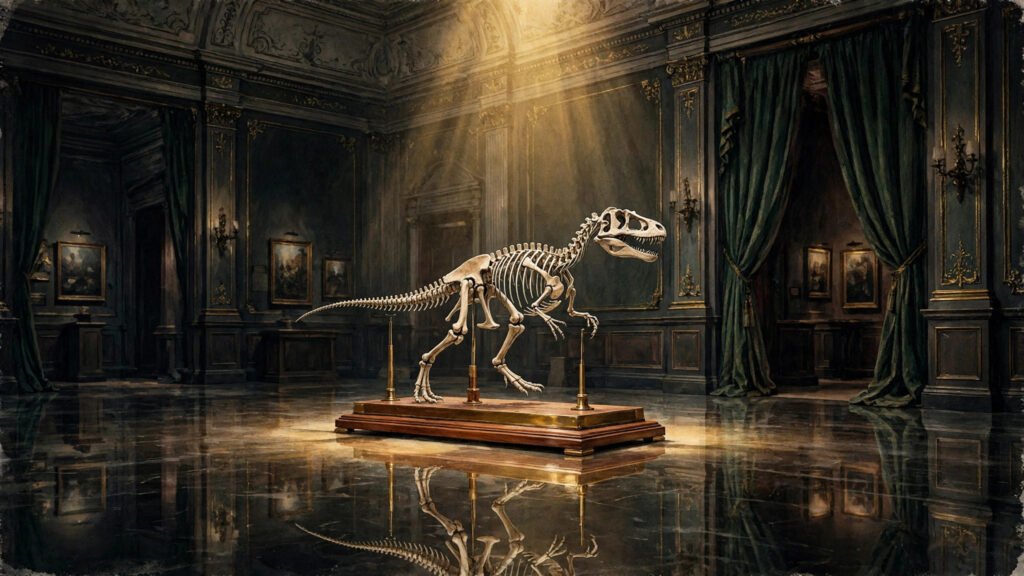
A rare dinosaur skeleton nicknamed Jodi has sold for $47.3 million at Sotheby’s in New York, becoming the second-most valuable dinosaur fossil ever sold at auction. The Nanotyrannus skeleton, a smaller relative of Tyrannosaurus rex, drew six bidders into a 12-minute contest on Tuesday, October 27, 2026, and finished far above its pre-sale estimate of $6 million to $9 million.
The result puts Jodi behind only Gus, a Tyrannosaurus rex skeleton that sold for $50.1 million in July 2026, and ahead of Apex, a Stegosaurus that fetched $44.6 million at Sotheby’s in July 2024. The winning bidder has not been identified, and where the skeleton will go next has not been disclosed.
Key Takeaways
- Jodi, a Nanotyrannus skeleton, sold for $47.3 million at Sotheby’s in New York after 12 minutes of bidding among six contenders.
- The price far exceeded the $6 million to $9 million estimate, making it the second-most expensive dinosaur fossil ever auctioned.
- The skeleton is one of only three relatively complete Nanotyrannus specimens known to science, and the first offered since the genus was confirmed as distinct from T. rex.
A Small Tyrannosaur With a Big Price Tag
Jodi stands about 9.6 feet tall and measures 19.6 feet long from nose to tail, roughly half the length of Gus. Sotheby’s described the specimen as exceptionally preserved, made up of around 191 bone elements, with what the auction house called a virtually complete skull. Reports on the sale also noted roughly 50 teeth preserved at different stages of emerging, a level of detail that gives researchers an unusually clear record of a predator that lived about 67 million years ago, in the Late Cretaceous period.
The skeleton was discovered in 2019 by Montana rancher Jodi Pierson, whose first name the specimen carries, on land in the Hell Creek Formation near Jordan, Montana. It was excavated by commercial palaeontologist Clayton Phipps. Hell Creek, which stretches across Montana, Wyoming and the Dakotas, is one of the most famous fossil grounds in the world, and one of the first T. rex skeletons was found there in 1902.
The price far exceeded the $6 million to $9 million estimate, making it the second-most expensive dinosaur fossil ever auctioned.
Settled Science, Open Debate
For decades, palaeontologists argued over a deceptively simple question: was Nanotyrannus a real dinosaur, or merely a young Tyrannosaurus rex that had not yet grown into its adult form? That dispute was settled only in October 2025, when researchers in the United States confirmed Nanotyrannus as a distinct genus. Jodi is the first specimen of the genus to reach the market since that confirmation, which helps explain why collectors pursued it so fiercely.
The animal itself was a fast, specialised carnivore that lived alongside Tyrannosaurus rex at the end of the Cretaceous period. It was smaller and more slender than its famous cousin, with blade-like teeth for slicing meat, and Sotheby’s noted more than 150 morphological differences separating it from T. rex. Some debate continues among palaeontologists about the genus, but researchers have increasingly come to favour the view that Nanotyrannus was a separate species rather than a juvenile T. rex.
- Jodi sold for $47.3 million including fees at Sotheby’s in New York on October 27, 2026.
- Six bidders competed for about 12 minutes, online and by telephone.
- The skeleton is about 9.6 feet tall, 19.6 feet long, and made up of around 191 bone elements.
- It is one of only three relatively complete Nanotyrannus skeletons known to science.
- It was discovered in 2019 in Montana’s Hell Creek Formation and excavated by Clayton Phipps.
- It ranks behind only the T. rex Gus ($50.1 million) among dinosaur fossils sold at auction.
Why the Sale Worries Scientists
The headline price is only half the story. Like several other important fossils sold at auction, Jodi’s sale has renewed concerns about whether scientifically important specimens will remain accessible to researchers and the public, or disappear into a private collection. The buyer’s identity has not been revealed, and nothing has been disclosed about whether researchers will be able to examine the skeleton or whether the public will see it again.
That tension is now a familiar feature of the high-end fossil market. When a specimen is one of only three of its kind known to science, its value to research is difficult to separate from its value to a collector, and a record price does not answer the question of access. Palaeontologists quoted in coverage of the sale expressed sadness at the prospect that Jodi might vanish from public view, while the auction house presented the skeleton as exhibition-ready, a description that keeps open the possibility of a future public display.
The sale also underlines how much the fossil market has changed. A decade ago, a $44.6 million Stegosaurus seemed extraordinary; now three dinosaur skeletons have passed $44 million, and two have passed $47 million within months of each other. The trend raises the stakes for museums, which rarely command auction-house budgets, and for the researchers who depend on access to specimens like Jodi.
What to Watch Next
What to watch next is whether the buyer is identified and whether Jodi goes on public display or into a private collection, since that decision will determine how much science can still learn from one of only three known specimens. The other question is whether the record prices for Gus and Jodi draw more rare fossils to auction, and whether museums and research institutions find new ways to keep pace. For readers following the week’s science news, the auction sits alongside other major research milestones, from new milestones in space research to the latest gatherings on science and technology. Until the buyer steps forward, Jodi remains both a scientific treasure and a mystery: a 67-million-year-old predator, sold in 12 minutes, whose next chapter is unwritten.