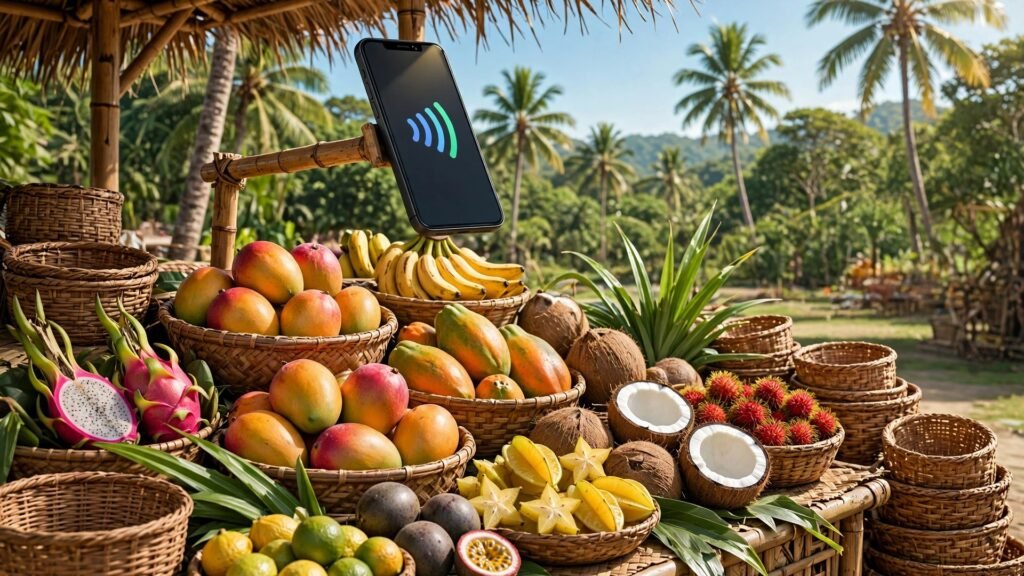
Ask a visitor what Fiji looks like and they will probably picture beaches, palm trees and small towns linked by winding coastal roads. Ask a local how they pay for everyday things, and a different picture appears: a phone, a few taps, and money moving without a single banknote changing hands. For many Fijians, that phone is a wallet, and the wallet is called M-PAiSA.
M-PAiSA is a mobile money service in Fiji. In simple terms, it turns a mobile phone into an account that can hold money, send money to another person, pay for goods and services, and handle everyday bills. The person on the other end does not need to be standing nearby, and neither side needs to visit a bank branch to complete the payment.
That simplicity is the whole point. Cash works well when everyone is in the same place at the same time. Mobile money works when they are not, and in a country made up of many islands, people often are not.
Key Takeaways
- M-PAiSA turns a mobile phone into a wallet for sending money, paying bills and shopping.
- It suits Fiji’s island geography, where bank branches and cash machines are not always close by.
- Its real strength is everyday convenience: money moves quickly, safely and without carrying cash.
What M-PAiSA Actually Does
At its core, M-PAiSA is a digital wallet linked to a mobile phone. A user loads money into the wallet, and from there can send money to family or friends, pay a merchant, top up a phone, or settle a bill. The recipient gets the money in their own wallet and can then spend it, send it on, or withdraw it as cash where that service is available.
For the person paying, the process feels much like sending a message. They choose the recipient, enter the amount, and confirm. For the person receiving, there is no need to wait for a bank transfer to clear over several days or to travel to collect cash in person. The money arrives on the phone they already carry.
That speed matters for everyday life. A parent can send money to a child studying in another town. A worker can send part of a wage home to family on a different island. A small shopkeeper can accept payment from a customer without keeping large amounts of cash in the till.
For many Fijians, the phone they already carry has quietly become the wallet they rely on most.
Why It Fits Island Life So Well
Fiji’s geography shapes almost everything about daily life, including money. The country is spread across many islands, and while larger towns have banks and cash machines, smaller communities and outer islands do not always have the same access. A trip to the nearest bank can take real time and real effort, and carrying cash on that journey is not always comfortable or practical.
A phone wallet changes that calculation. If the mobile network reaches a village, the wallet can reach it too. Money can move between islands without anyone boarding a boat or a bus to deliver it. Bills can be paid from home instead of in a queue. A family emergency does not have to wait for the next trip to town.
The same logic applies to small businesses. A market seller, a taxi driver or a roadside stall owner can accept a payment on a phone instead of handling notes and coins and worrying about change. For a small business, that is not just convenience; it is a simpler way to keep track of what came in and what went out.
Cash Still Has Its Place
None of this means cash has disappeared from Fiji. Cash is still used in markets, in small shops and in places where a phone signal is weak or a phone battery is flat. Older residents may still prefer notes and coins, and some transactions simply feel more natural in cash.
M-PAiSA works best when it is understood as an addition, not a replacement. People use cash where cash is easiest and a phone wallet where a phone wallet is easiest. Over time, the balance shifts as more shops accept mobile payments and more people grow comfortable with the wallet on their phone.
Trust is also part of the story. People adopt a new way of paying only when it works reliably and when help is available if something goes wrong. A service that becomes part of daily routines, from topping up a phone to paying a bill, earns that trust one successful payment at a time.
How It Compares With Mobile Money Elsewhere
Fiji is not alone in this shift. Across the Pacific and far beyond it, people are using phone wallets where banks are distant and cash is awkward to move. In Mozambique, for example, many people pay with M-Pesa instead of bank cards, for much the same reason: the phone is already in their pocket, and the wallet travels with them. You can read how that works in our guide to why Mozambicans pay with M-Pesa instead of bank cards.
The pattern is similar in West Africa, where Ghanaians pay with mobile money known as MoMo, and in Senegal, where Senegalese pay with Wave instead of cash or cards. The names and the providers differ from country to country, but the underlying idea is the same: a phone number becomes a way to pay, and distance stops being a barrier to moving money.
What makes Fiji’s version distinct is the setting. Island geography, a tourism economy, and communities spread across the sea make a phone wallet especially useful. Visitors may notice the beaches first, but for residents, the quiet revolution is the money that now travels by phone signal instead of by boat.
- A phone wallet means money can move between islands without a trip to a bank.
- Small sellers can accept payments without keeping large amounts of cash on hand.
- Families can support each other across distances quickly and simply.
- Cash still matters, especially where signals are weak or habits run deep.
What to Watch Next
The future of M-PAiSA in Fiji will likely be decided by everyday use rather than by any single announcement. If more shops, services and billers accept phone payments, the wallet becomes useful in more moments of daily life. If coverage and reliability keep improving in smaller communities, more people will be able to rely on it.
At the same time, cash will remain part of the picture for a long time, and that is fine. The real change is not that one way of paying has replaced another, but that Fijians now have a genuine choice. For many of them, the phone in their pocket has quietly become the simplest wallet they own, and island life is a little easier because of it.