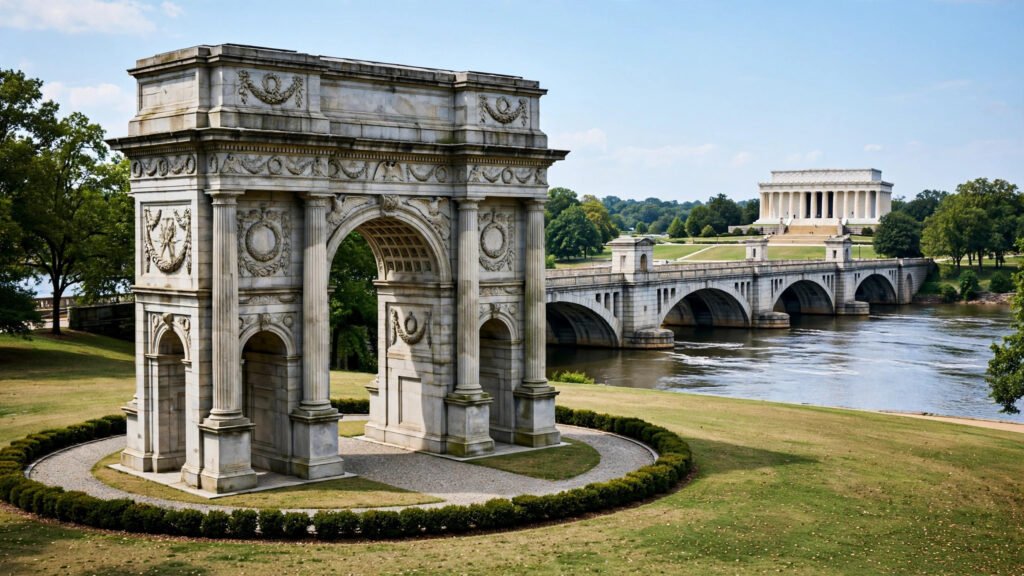
Washington, D.C. and Virginia have filed a federal lawsuit seeking to block construction of President Donald Trump’s proposed 250-foot triumphal arch, in the latest legal challenge to a monument planned for the monumental core of the United States capital. The lawsuit was filed on Saturday, October 31, 2026, as the administration has said work could begin as early as next week.
The planned arch would stand at Memorial Circle, on a patch of grass where Arlington Memorial Bridge meets the George Washington Memorial Parkway, in front of the entrance to Arlington National Cemetery and across the Potomac River from the Lincoln Memorial. At 250 feet, or about 76 metres, it would tower over much of the surrounding landscape and, according to court coverage, would be far taller than the Arc de Triomphe in Paris.
The District of Columbia and Virginia argue that the project is unlawful because it lacks the congressional authorisation they say is required for a new memorial on federal land. Their attorneys general, Brian Schwalb of Washington and Jay Jones of Virginia, described the project in the filing as flagrantly unlawful, according to reports of the lawsuit.
Key Takeaways
- Washington, D.C. and Virginia sued on October 31, 2026, to block President Donald Trump’s planned 250-foot triumphal arch at Memorial Circle.
- The lawsuit argues the project lacks congressional authorisation and would cause irreparable harm through traffic disruption, pollution and emergency-service problems.
- A federal judge has consolidated the case with two earlier lawsuits and is considering whether to halt work before construction begins.
The lawsuit and what it asks for
The new lawsuit asks a federal court for a temporary restraining order that would slow or halt the administration’s plans to move ahead imminently with construction. The plaintiffs argue that once ground is broken, the harm to both jurisdictions will already have begun, because the site sits at the centre of a major traffic artery between the District and Virginia.
According to reports of the filing, the lawsuit also argues that the arch would nearly double the legally permissible height of buildings in the nation’s capital, put at 130 feet in coverage of the case. The administration has previously said the arch will commemorate the country’s 250th anniversary, an argument that sits alongside a newer national-security justification discussed in court.
The case has been consolidated by United States District Judge Tanya Chutkan with two earlier lawsuits challenging the arch. The first was filed in February 2026 by three Vietnam War veterans and a retired architectural historian, who argued that the project would disrupt one of the capital’s most symbolic sightlines, between the Lincoln Memorial and Arlington House. Arlington County, Virginia, has filed a separate lawsuit of its own.
The case now turns on whether a court halts work before the first foundations are laid.
Why the location matters
Memorial Circle is not an ordinary building plot. It forms the Virginia-side gateway to Arlington National Cemetery, the resting place of hundreds of thousands of United States military personnel, and it anchors the western end of the bridge axis that runs from the Lincoln Memorial across the Potomac. Opponents of the arch say that setting is precisely why the project needs the full authorisation and review process that applies to memorials on federal land.
The District and Virginia also point to practical consequences during construction. Their filing argues, as reported, that building the arch would snarl traffic on a route used daily by commuters and visitors, produce pollution and stormwater runoff, and complicate emergency response in the area. Construction, according to a separate court filing cited in coverage, could take two to three years of near round-the-clock work.
Separately, the legal challenges facing the Trump administration have continued on other fronts, including a separate court ruling involving the president reported this weekend. The arch case, however, is distinct because it concerns a physical structure that, once built, cannot easily be undone.
- Planned height: 250 feet, or about 76 metres, at Memorial Circle
- Location: between the Lincoln Memorial and Arlington National Cemetery, across the Potomac River
- Plaintiffs: the District of Columbia and Virginia, plus earlier suits from veterans and Arlington County
- What the plaintiffs seek: a temporary restraining order halting construction
- Next decision point: a National Capital Planning Commission meeting expected on November 5
The administration’s case and the judge’s questions
The Trump administration has advanced a national-security justification for moving quickly, with sworn declarations from defence and homeland security officials arguing, as reported, that the arch could aid counter-drone and defensive operations. That rationale was questioned at a hearing on Friday, October 30, when Judge Chutkan asked the government’s lawyer why the project could not be delayed by three or four months.
The judge did not immediately issue an order at that hearing, but said she would move expeditiously. She has since ordered the parties to agree a joint briefing schedule on the request for a temporary restraining order, bringing all three lawsuits together under one timetable.
Reports on Saturday said the White House and the Interior Department had not responded to requests for comment on the new lawsuit. The Interior Department and the National Park Service are named among the defendants, and final approvals from the National Capital Planning Commission and the Interior Department could be completed on or about November 5, according to a Justice Department statement to the court cited in coverage.
The dispute also sits within a wider pattern of contested decisions by the Trump administration, from foreign-policy moves such as the denial that the United States helped a former Brazilian leader leave Brazil to defence decisions such as the approval of a major Patriot missile sale to Ukraine. In the arch case, though, the question is narrower and more concrete: whether the government followed the law before breaking ground.
What to Watch Next
What to watch next is whether Judge Chutkan grants a temporary restraining order before the November 5 commission meeting and the possible start of foundational work, and how the consolidated briefing schedule frames the central question of congressional authorisation. If the court halts work, the arch will remain a plan on paper while the lawsuits are resolved. If it does not, construction could begin within days, and the harm the District and Virginia warn about would, in their argument, already be under way.