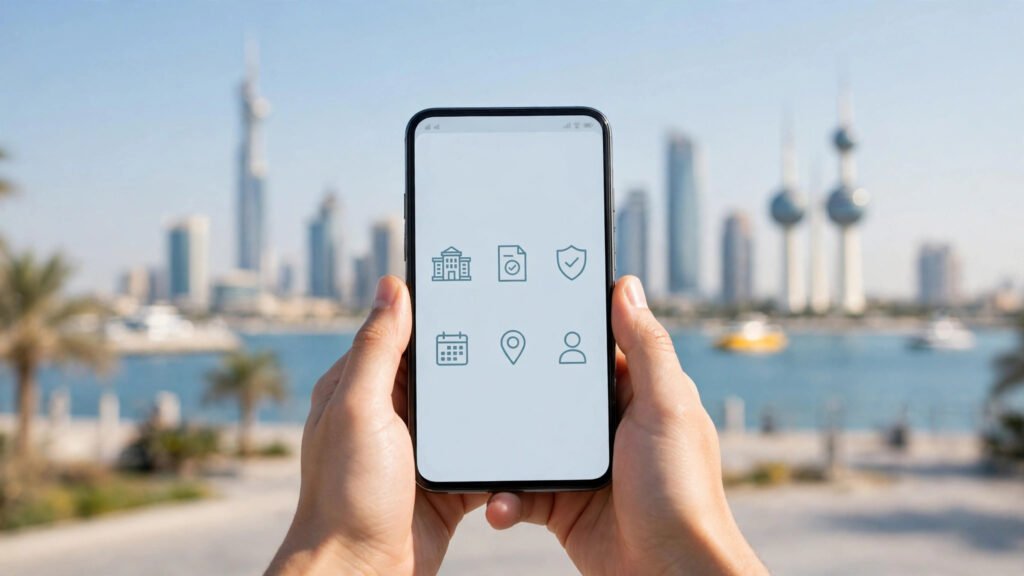
In Kuwait, a growing number of everyday dealings with the state no longer start at a government office counter. They start on a phone. The Sahel app, Kuwait’s official government-services app, brings many public services together in one place, and for many residents it has become the first place to check when a document, appointment, or official record is needed.
The idea behind Sahel is simple: instead of visiting a different office for every task, or keeping track of several separate websites and phone numbers, a resident opens one app and finds a range of services there. That convenience is the main reason the app is talked about so often, and why it fits naturally into a country where smartphones are part of daily life for work, family, and errands alike.
Key Takeaways
- Sahel gathers many Kuwaiti government services in one official phone app, so residents can handle routine tasks without visiting an office for every step.
- Its appeal comes from convenience: appointments, documents, and official records are easier to reach when they sit alongside each other in one place.
- Not everything can be finished on a phone, and some tasks still need an in-person visit, a physical document, or a check that only an office can complete.
What the Sahel App Actually Does
At its core, Sahel is a doorway to government services rather than a single service on its own. Through the app, residents can reach services from different government bodies, check the status of requests, book appointments, and view official information linked to their civil identity. Rather than remembering which ministry handles which form, the user starts from one familiar screen and follows the service they need.
That matters most for the small, recurring tasks of adult life: renewing something before it expires, confirming that a request has moved forward, or finding the right office hours and requirements before setting out. When those steps can be checked from home, people save the journey, the queue, and the uncertainty of arriving without the right paper. The app does not remove the rules behind a service, but it makes the route to that service easier to see.
The same pattern can be seen in other countries that have built a single digital doorway to the state. In Ukraine, for example, many residents reach official documents and services through the Diia app, which gathers government services on a phone, while Singapore’s residents use Singpass to reach government services with one digital identity. Kuwait’s Sahel belongs to the same idea: one trusted entry point, many services behind it.
Why One App Appeals to Kuwaitis
The first reason is practical. Kuwaiti households, like households everywhere, juggle renewals, school and work paperwork, vehicle matters, and family documents, and each one used to mean a separate trip or a separate phone call. Putting many of those services in one app reduces the mental load: there is one place to check, one login habit to keep, and one history of requests to look back on.
The second reason is timing. Government offices keep working hours, but life does not always fit inside them. An app that can be opened in the evening, during a break, or while travelling lets people prepare a task — checking what is needed, booking a slot, or confirming a status — at a moment that suits them, even if the final step still happens in person. That flexibility is worth a great deal to working parents, shift workers, and anyone who lives far from the relevant office.
The third reason is trust. Because Sahel is an official app, residents can be reasonably confident that the service list, the requirements shown, and the appointment booked are the genuine ones. In a world full of lookalike pages and forwarded links, an official doorway reduces the risk of following a wrong address or an outdated form. People still need to stay alert to scams, but starting from the official app is a safer habit than searching for a service from scratch every time.
- One official app for many government services, instead of a separate trip for every task
- Appointments, request status, and official records reachable from a phone
- Evening and weekend preparation for tasks that once needed office hours
- A trusted starting point that cuts down on outdated forms and wrong addresses
- Less queuing for routine checks, with in-person visits kept for steps that truly need them
What Sahel Does Not Replace
An app can simplify access, but it cannot finish every official process on its own, and Kuwaitis who use Sahel still run into that limit. Some services need a physical document to be seen, a signature to be given in person, or a check that can only be completed face to face. In those cases the app’s job is to prepare the visit well — the right appointment, the right papers, the right office — rather than to remove the visit entirely.
There are also everyday limits that have nothing to do with the app itself. A phone with a flat battery, a weak connection, or an expired login can turn a quick check into a delay, and not everyone is equally comfortable doing official business on a small screen. Older residents, people with limited eyesight, and anyone less confident with apps may still prefer a counter, a phone call, or help from a family member. A good digital service therefore has to sit alongside the old routes, not pretend they have vanished.
The app does not remove the rules behind a service, but it makes the route to that service easier to see.
That doorway idea is also why digital government keeps spreading. Estonia, for instance, built much of its public life around online access, as explained in why Estonians do almost everything on their phones. The lesson is the same in Kuwait: the technology is only useful when it fits the way people already live, and when the human help behind it stays within reach.
How to Get the Most Out of Sahel
For a first-time user, the sensible approach is to start small. Open the app for a simple check — an appointment, a status, or a service requirement — before relying on it for something urgent. Keep the phone’s official app store as the only download source, keep login details private, and double-check any message that claims to come from a government body before acting on it.
It also helps to prepare for the visit that an app cannot replace. Note down the appointment details, keep the physical documents the service asks for, and allow time for the in-person step. Used that way, Sahel does what it was built to do: it takes the searching, waiting, and guessing out of routine government tasks, and leaves people’s time for the parts of life that no app can handle.
What to Watch Next
Sahel’s story in Kuwait is, at heart, a story about convenience, trust, and limits. Its convenience comes from gathering many government services in one official app; its trust comes from being the genuine doorway to those services; and its limits are the in-person steps, physical documents, and human help that a phone cannot replace. What to watch next is how far that doorway widens — which services become fully doable from a phone, which ones keep their in-person step, and how well the app keeps serving residents who still prefer a counter, a call, or a helping hand.