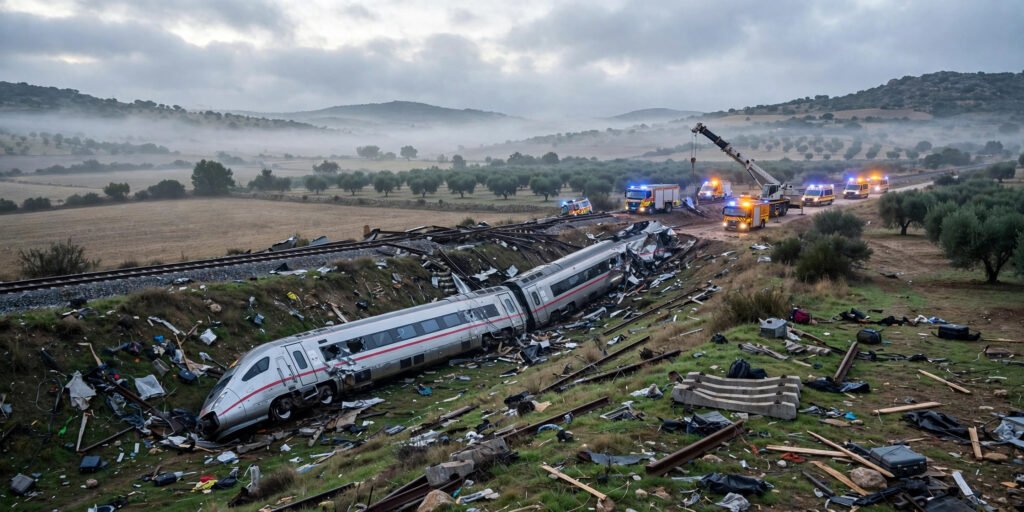
The death toll from Spain’s high-speed train collision near Urda has risen to 69, regional officials said on Thursday, as rescuers picked through mangled carriages for a second day and cranes worked through the night to lift wreckage from the crash site. The search continued even as hopes of finding further survivors faded, and train drivers went ahead with a previously planned strike to press for more investment in railway safety.
Key Takeaways
- The death toll from the Urda train collision rose to 69 on Thursday, up from 68, after human remains were found during overnight rescue efforts.
- Rescue teams said they still could not say with certainty that no more victims remained trapped in the twisted wreckage, and a canine unit was sent back in to check.
- Train drivers went ahead with a previously planned strike over railway safety investment, while the leaders of Spain’s two main parties suspended campaign events ahead of the November 29 snap election.
Regional leader Emiliano García-Page said the toll had risen to 69 people and that human remains had been found during overnight rescue efforts. Work at the site now involved crane operations, particularly on a carriage that was still overturned. Our previous report put the toll at 68, with officials warning even then that it could still rise as search teams worked through the wreckage.
Rescue work continues into a second day
Emergency workers were seen carrying what appeared to be a body wrapped in a blanket from one of the trains in a rural area in the central province of Toledo, after cranes worked through the night to lift parts of the wreckage of Wednesday’s crash. Esther Padilla, a spokeswoman for the regional government of Castilla-La Mancha, told TVE that rescue teams were still working very carefully.
“Rescue teams are still working very carefully, because we still cannot say with certainty that there are no more victims trapped in the twisted wreckage,” Padilla said. She added that a canine unit deployed on Wednesday would go back in on Thursday to make sure nobody else remained there.
García-Page said of the overturned carriage: “We do not believe there could be any more fatalities beneath that one, but I say this with caution.” More than 100 people were injured in the crash, according to reports on Thursday, in what is now Spain’s deadliest rail disaster since the 2013 derailment in Santiago de Compostela.
Rescue teams are still working very carefully, because we still cannot say with certainty that there are no more victims trapped in the twisted wreckage.
What happened on Wednesday
The crash happened at around 8:53 a.m. local time on Wednesday on a straight stretch of track near the village of Urda, around 130 kilometres south of Madrid. A service by state operator Renfe with nearly 400 passengers ploughed into the back of a stationary train belonging to private Spanish company Iryo, which had 152 people on board. Both trains had departed Madrid’s Atocha station bound for the southern city of Seville.
At around 8:30 a.m., an automatic signalling system known as LZB failed. The system is supposed to monitor train speeds and movements to help prevent collisions by maintaining safe distances between them. The failure forced six trains on a 69-kilometre stretch of track to stop, including the two involved in the collision, and control of rail traffic was transferred to the Madrid control centre.
Transport Minister Óscar Puente has said the control centre authorised the Renfe train to resume its journey despite the signalling failure, and called the decision “inexplicable”, saying a red signal should have kept the train stationary because the Iryo service was still on the same track. Our explainer on the investigation set out how the LZB system works and why the red-signal question is central to the inquiry.
New revelations in the Spanish press
On Thursday, Spanish newspapers had room for only one story. El Mundo headlined its coverage “A triple safety failure causes another rail massacre”, while El País called it the “second disaster on the high-speed network in less than a year”. The crash followed another fatal accident in January involving the same rail companies on the same line, and it is Spain’s second fatal high-speed train crash this year.
The online daily elDiario.es reported on communications between the train drivers and the Adif railway control centre at Atocha station in Madrid, which had taken over traffic management after the LZB failure. According to the recordings cited by elDiario, at 8:48 a.m. the Iryo driver reported being unable to verify the safety system and found himself at a standstill. Twelve minutes earlier, the AVE driver had been instructed to “disconnect and then reconnect the LZB” and to “resume normal speed”, operating under emergency traffic procedures. Six minutes later, at 8:54 a.m., the Renfe train struck the Iryo train.
Prime Minister Pedro Sánchez said “all of Spain” was in mourning after the collision, and vowed to address any failures that came to light, adding that the causes of the two crashes this year appeared to be unrelated. He declared three days of official mourning from October 29 to 31. “If we need to further strengthen safety in order to rebuild confidence in our high-speed rail system, we will do so, because what is unacceptable for a country like Spain is to suffer two high-speed rail accidents in the same year,” Sánchez said.
- The death toll rose to 69 on Thursday, after human remains were found during overnight rescue efforts at Urda.
- Rescue teams and a canine unit were still checking the wreckage, unable to say with certainty that no more victims remained trapped.
- More than 100 people were injured in Wednesday’s collision, Spain’s deadliest rail disaster since 2013.
- Train drivers went ahead with a previously planned strike pressing for more investment in railway safety.
- The leaders of Spain’s two main parties suspended campaign events ahead of the November 29 snap election.
- Three days of official mourning were declared from October 29 to 31.
Strike and suspended campaigning
Train drivers in Spain went ahead with a previously planned strike to press for more investment in railway safety, a day after the crash. The disaster has also upended campaigning for the November 29 snap election, with the leaders of Spain’s two main parties suspending campaign events. Spain’s opposition People’s Party said it had cancelled all campaign events for the day.
The crash shut the Madrid–Andalusia high-speed corridor, one of Spain’s busiest rail routes, while rescue teams worked at the site and investigators began their work. The formal investigation has not yet reached a final conclusion on the cause, and officials have stressed that the control-centre authorisation described by the transport minister is a possible cause under examination, not yet a final finding.
What to Watch Next
What to watch next is only what this article has already set out: whether the death toll rises further as crane work and the canine-unit check of the overturned carriage are completed, whether investigators confirm the account of the control-centre instructions and the signalling failure reported in the Spanish press, what the drivers’ strike and the safety-investment demands mean for services on the Madrid–Andalusia corridor, and how the suspended election campaigning resumes. Until those confirmations arrive, the verified picture remains the one in Thursday’s reports: 69 people killed, more than 100 injured, rescue work still under way at Urda, and a cause that remains under formal investigation.