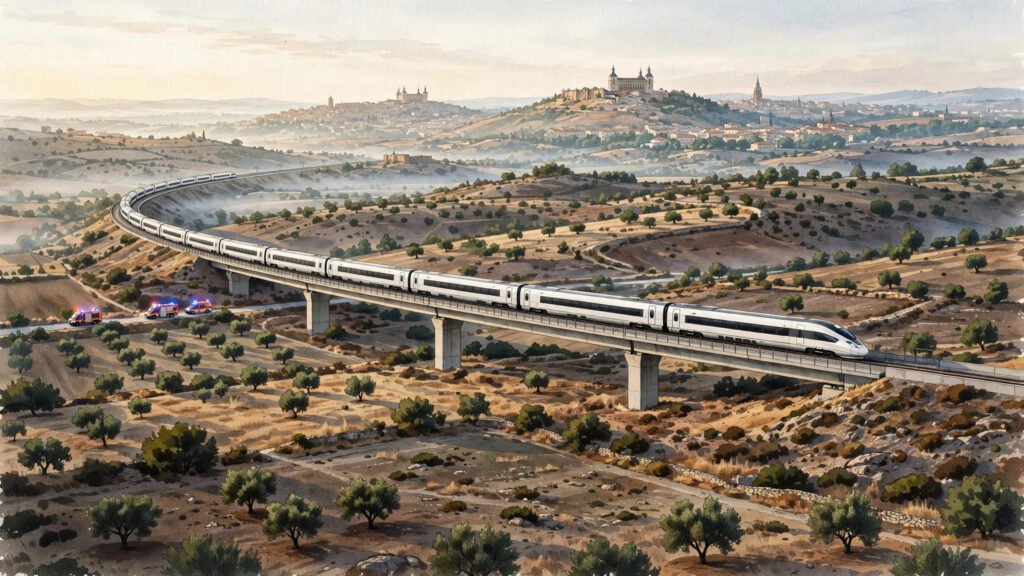
Two high-speed trains collided in central Spain on Wednesday morning, October 28, 2026, killing at least 39 people, according to reports citing Spanish government sources and broadcasters. Later reports put the death toll at 46, and the figure was still being confirmed as rescue work continued, so the toll reported here should be read as developing, not final.
Key Takeaways
- Two high-speed trains collided between Los Yébenes and Urda in Toledo province shortly after 9 a.m. local time on October 28, 2026.
- At least 39 people were reported killed, with later reports putting the toll at 46, and many more injured; the exact number was still being confirmed.
- Services on the Madrid–Andalusia high-speed line were suspended, and the cause of the crash remained under investigation.
The crash happened between the towns of Los Yébenes and Urda in Toledo province, on the Madrid–Andalusia high-speed line, one of Spain’s busiest rail corridors. Spain’s rail infrastructure manager, Adif, said traffic on the line had been suspended following what it described as a rear-end collision between two trains.
Spanish newspaper El País reported that the accident involved a Renfe AVE train travelling from Madrid to Seville and an Iryo train travelling in the opposite direction. Witnesses described numerous injuries and said emergency medical teams had reached the scene quickly. El País also reported that two carriages derailed and fell down an embankment.
What happened between Los Yébenes and Urda
Reports of the exact sequence of events differed in the first hours, and officials had not confirmed a single account. Adif described the incident as a rear-end collision, while other reports described one train derailing and then coming into contact with a train travelling in the opposite direction. What was consistent across reports was the location, the time — shortly after 9 a.m. local time, or 0800 GMT — and the scale of the emergency response.
Television footage from regional Castilla-La Mancha Television showed a derailed train with at least one carriage still on an elevated section of track, while twisted metal, broken panels and wreckage could be seen strewn across an embankment beneath the line. Reports put the number of passengers on the two trains at around 500.
Services on the Madrid–Andalusia high-speed line were suspended, and the cause of the crash remained under investigation.
The mayor of Urda, Manuel Galán, told Spanish state broadcaster TVE that passengers had been injured and that civil protection authorities had asked his town hall to prepare a sports pavilion to attend to passengers. The mayor of Los Yébenes, Jesús Pérez, told TVE that the accident appeared to be serious.
Emiliano García-Page, the regional president of Castilla-La Mancha, wrote on X that he was on his way to the crash site. Transport Minister Óscar Puente left an event in Madrid after learning of the crash, according to El País. A government spokesperson for the Castilla-La Mancha region said the cause and the number of injuries were still being determined.
Services suspended across a key corridor
The suspension hit services between Madrid, Ciudad Real and Andalusia, cutting one of the main high-speed routes linking the capital with destinations in the south of Spain. Adif’s announcement did not give a timeline for resuming services, and other services were left stationary along their routes as the line was closed.
For passengers, the disruption extended beyond the two trains involved. High-speed services on the corridor were halted while rescue teams worked at the site and investigators began their work, and travellers faced cancellations and delays while the line remained closed.
- The crash happened shortly after 9 a.m. local time between Los Yébenes and Urda, in Toledo province.
- A Renfe AVE service from Madrid to Seville and an Iryo service were the two trains involved, according to El País.
- Two carriages were reported to have derailed and fallen down an embankment.
- Urda’s town hall was asked to prepare a sports pavilion to help attend to passengers.
- Madrid–Andalusia high-speed services were suspended, with no reopening time given.
A second deadly crash in less than a year
The Toledo crash is Spain’s second major deadly rail accident in less than a year, and it comes amid renewed attention to railway safety in the country. In January 2026, a train accident in the south of Spain killed 45 people after a train derailed and struck an oncoming train. That crash was the deadliest in Spain since a 2013 crash that killed 80 people.
The January accident shook confidence in Spain’s extensive high-speed rail network, which is one of the largest in the world. Wednesday’s crash will now put that network under fresh scrutiny, even though officials have stressed that the cause of the Toledo collision has not yet been established.
As with other major travel disruption across Europe in recent days, the immediate focus for authorities was on rescue, medical care and helping stranded passengers, rather than on assigning blame. Investigators will examine the signalling, the condition of the track and trains, and the sequence of events that led to the collision.
Spain’s high-speed network carries millions of passengers a year, and the Madrid–Andalusia line is a central part of it. Questions about how two trains came to collide on a modern high-speed line — and whether the initial rear-end description or the derailment account proves correct — are likely to dominate the investigation in the days ahead, alongside the official confirmation of the final casualty figures.
The crash also lands at a moment when Europe is already watching several fast-moving stories, from European Union action over foreign interference to Nordic leaders’ talks with Russia’s president — but the human toll in Toledo, and the families waiting for news of passengers on the two trains, is the story that will define the day in Spain.
What to Watch Next
Officials are expected to confirm a final casualty figure as rescue and identification work continues, and to clarify the sequence of events that led to the collision. Adif and Renfe are expected to say when Madrid–Andalusia services can resume, and investigators are expected to begin setting out what caused two high-speed trains to collide on the line between Los Yébenes and Urda.