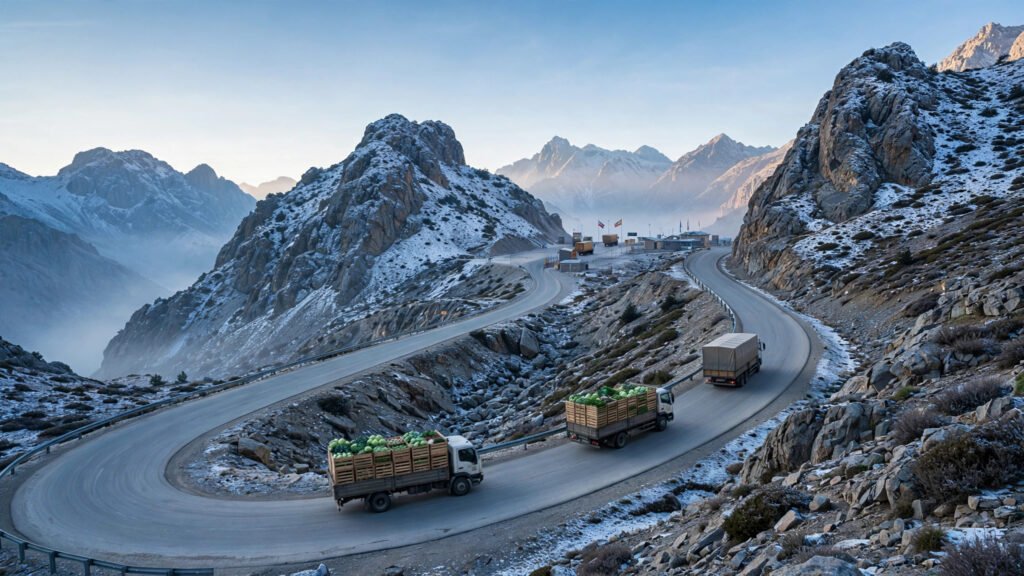
Pakistan and China have signed an agreement to operationalise a Green Channel at the Sost-Khunjerab border for agricultural and allied products, in a move aimed at making farm trade between the two countries faster and more predictable. The agreement was signed online on Thursday, October 29, between the customs administrations of the two countries at the Federal Board of Revenue (FBR) headquarters in Islamabad.
The Pakistani delegation was led by Syed Shakeel Shah, Member Customs (Operations), and included the Chief Collector of Customs, Peshawar, the Collector of Customs, Gilgit-Baltistan, and representatives of the Department of Plant Protection, the National Agri-Trade and Food Safety Authority, Pakistan Single Window and the Ministry of Commerce, along with the Commercial Counsellor at the Embassy of Pakistan in China. The Chinese delegation was headed by Li Qinghua, Deputy Head of Urumqi Customs and Director of Tashkurgan Customs.
Key Takeaways
- Pakistan and China have agreed a Green Channel at the Sost-Khunjerab border for an agreed list of agricultural and allied products.
- Eligible consignments will receive priority processing and examination, while risk-based customs controls remain in place.
- Perishable goods will get priority handling, and the two customs administrations will share information and exchange risk alerts.
What the Green Channel Will Do
Under the arrangement, consignments of agricultural products on a mutually agreed list will go through priority processing and examination at the border. Customs controls will be risk-based rather than removed, so checks continue but eligible shipments are handled first. The two sides will also share information and exchange risk alerts, giving customs officers on both sides a clearer picture of what is crossing and what needs closer attention.
For fresh produce, time at a border is not just a delay — it is the difference between a shipment that arrives in good condition and one that does not. That is why perishable consignments are given special attention under the agreement: faster handling is meant to cut waiting time and help fruit, vegetables and similar goods reach their destinations before quality suffers. The arrangement is also expected to give traders a more coordinated framework, with both customs administrations working to the same understanding of which products qualify and how they should be processed.
Why the Crossing Matters
The Sost-Khunjerab crossing links Gilgit-Baltistan with China’s Xinjiang region through the Khunjerab Pass, which stands at about 15,500 feet above sea level and is described as the highest paved international border crossing in the world. Under a border protocol signed by the two countries in 1985, the pass generally remains open for trade and travel between April and November, which makes the months it is open especially important for traders who rely on the route.
The crossing already carries significant trade. In the fiscal year 2025-26, Pakistan Customs collected a record Rs14.93 billion in revenue from imports arriving from China through the Sost Dry Port, while goods worth Rs2.8 billion were exported to China and Central Asian countries through the crossing, according to reporting on the agreement. A dedicated channel for farm goods builds on that existing flow rather than creating a new route from scratch, and it sits alongside wider regional dialogue on trade and cooperation in South Asia.
The deal also matters for Pakistan’s economy at a time when the cost of moving goods and the speed of getting them to market both affect farm incomes. Shorter border delays can mean lower spoilage, more reliable delivery schedules and steadier returns for producers whose goods depend on reaching buyers quickly. On the other side of the border, smoother farm imports fit into China’s wider export trade picture, where cross-border logistics increasingly shape how goods move between markets.
For fresh produce, time at a border is not just a delay — it is the difference between a shipment that arrives in good condition and one that does not.
What Traders Should Expect
The practical test of the Green Channel will be in how it works day to day at Sost and Khunjerab. Priority processing should mean shorter queues for qualifying shipments, but traders will still need to meet documentation and inspection requirements, and only products on the agreed list will qualify. The information-sharing and risk-alert arrangements are designed to keep that system working smoothly, so that a shipment cleared on one side is not held up unexpectedly on the other.
- Priority processing and examination for an agreed list of agricultural and allied products
- Risk-based customs controls remain in place, with information sharing and risk alerts between the two administrations
- Special priority handling for perishable goods to cut delays and protect quality
- A crossing at 15,500 feet, generally open for trade and travel from April to November
- Record Rs14.93 billion in customs revenue from China imports via Sost Dry Port in fiscal year 2025-26, as reported
What to Watch Next
What to watch next is how the agreed list of products takes shape in practice, and whether priority processing shortens waiting times for perishable shipments at Sost-Khunjerab in the months the pass remains open. Traders will also be watching how the information-sharing and risk-alert arrangements work between the two customs administrations, and whether the faster handling promised under the agreement is reflected in smoother crossings for the farm goods it covers.