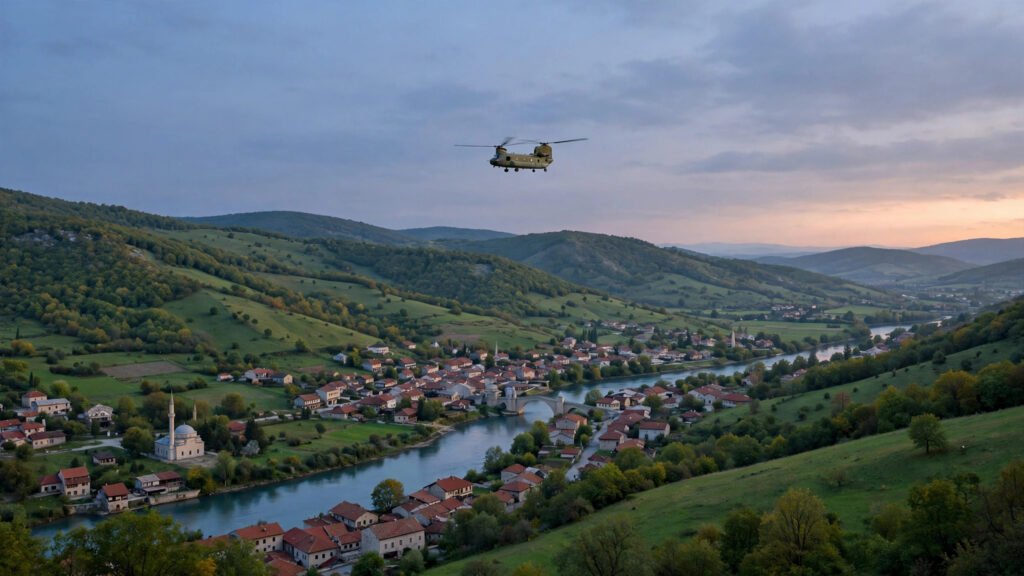
An Italian military helicopter serving with the European Union peacekeeping force in Bosnia and Herzegovina crashed during routine training in the country’s north on Thursday, killing four people on board and injuring 11 others, the force said. The aircraft, a CH-47 Chinook, came down in the Brcko region, about 180 kilometres north of the capital, Sarajevo, near the village of Gorice.
The European Union Force in Bosnia and Herzegovina, known as EUFOR, said all 15 people on board were Italian nationals. The Italian defence ministry said the four people killed were two soldiers and two volunteers from the Italian Red Cross’s Volunteer Military Corps. EUFOR said the 11 injured personnel were receiving medical treatment and were in stable condition, and that none of the injuries was described as life-threatening in the Italian account.
Key Takeaways
- An Italian CH-47 Chinook helicopter serving with EUFOR crashed during routine training near Brcko, Bosnia and Herzegovina.
- Four people on board were killed — two soldiers and two Italian Red Cross volunteers — and 11 others were injured.
- EUFOR said no civilians were injured and no civilian infrastructure, property or vehicles were damaged, and a full investigation is under way.
What Happened Near Brcko
EUFOR described the flight as a routine mission and, in later statements, as routine training. The helicopter crashed in the Brcko district, a northern region of Bosnia and Herzegovina. ANSA, Italy’s news agency, reported that the aircraft came down in the village of Gorice, and photographs published from the scene showed the helicopter largely destroyed on open ground.
A spokesman for Brcko hospital told the AFP news agency that three people died in the crash itself, and that a fourth person later died in hospital after being brought in with other casualties. That account matches the overall toll reported by EUFOR and the Italian defence ministry: 15 people on board, four dead and 11 injured. EUFOR said the injured were in stable condition and receiving treatment.
EUFOR also said that no civilians were injured and that no civilian infrastructure, property or vehicles were damaged. That detail matters in a district where the crash site sits close to inhabited areas, and it was repeated in the force’s statements as investigators began their work.
EUFOR said a thorough and complete investigation was under way and that further information would be released as it was verified.
The Victims and the Response
Italy said all those on board were Italian nationals serving with the EUFOR contingent. The Italian defence ministry identified the dead as two members of the Italian army and two members of the Italian Red Cross’s Volunteer Military Corps, a body whose volunteers serve alongside the armed forces in support roles. Italian Prime Minister Giorgia Meloni expressed grief over the deaths and solidarity with the victims’ families, according to reports of her statement.
Italian Defence Minister Guido Crosetto also spoke about the loss, and Italian officials said inquiries were under way to establish the circumstances of the accident. At the time of the first official statements, no cause had been confirmed, and authorities had not released a detailed account of what caused the aircraft to go down.
The response followed the pattern seen after other fatal accidents in Europe this week, where rescue teams, hospitals and investigators have had to work in parallel — first treating the injured, then securing the site, and only later establishing what went wrong. After Spain’s deadly train crash, for example, the questions that followed were also about rescue, recovery and the investigation that comes next, rather than immediate conclusions about cause. The same sequence — treatment first, then securing the scene, then a formal inquiry — follows sudden disasters elsewhere, including the magnitude 5.5 earthquake in Chiba, Japan, where the first official accounts also focused on casualties and response before any wider assessment.
- Aircraft: Italian CH-47 Chinook serving with EUFOR’s Operation Althea
- Location: Gorice, in the Brcko region of northern Bosnia and Herzegovina
- On board: 15 people, all Italian nationals, according to Italy’s government
- Casualties: 4 dead — two soldiers and two Red Cross volunteers — and 11 injured, in stable condition
- Civilians: no civilian injuries and no damage to civilian infrastructure, property or vehicles, EUFOR said
- Status: cause under investigation; no cause confirmed in the first official statements
What EUFOR Does in Bosnia
EUFOR is the European Union’s peacekeeping force in Bosnia and Herzegovina. It took over from a NATO peacekeeping force in 2004 and oversees the military provisions of the Dayton Peace Agreement, the deal that ended the Bosnian War of 1992 to 1995. The mission, known as Operation Althea, is currently under Italian command, and EUFOR has about 1,200 personnel deployed in the country, according to the force’s recent accounts.
The mission’s work is largely about maintaining a safe and secure environment and supporting Bosnia and Herzegovina’s authorities. Routine training flights, like the one involved in this crash, are part of keeping a multinational force ready across a country where the force operates from bases and training areas far from the capital.
That long-running presence is why a crash involving a peacekeeping aircraft draws attention beyond the immediate casualties. EUFOR is not a combat force in Bosnia today, but its helicopters, vehicles and troops are a visible part of the international presence that has been in place for more than two decades since the war ended.
What the Investigation Will Look At
EUFOR said a full and thorough investigation of the incident was under way and that more information would be released as it was verified and when appropriate. In practice, that means investigators will examine the wreckage, the flight’s records and the conditions at the time of the crash before reaching any conclusion about cause.
Until that work is complete, the confirmed facts remain limited to what EUFOR and the Italian authorities have stated: the type of aircraft, the location, the number of people on board, the casualty toll, and the fact that the flight was a routine training mission. The cause has not been confirmed, and early reports that differed on the number of injured — some put the figure at 12 — were superseded by the EUFOR and Italian figures of 11 injured, consistent with 15 people on board and four deaths.
That caution is normal after an aviation accident. Initial casualty counts can change as hospitals confirm admissions, and the distinction between people killed at the scene and people who later die in hospital can make early reports look inconsistent even when they are describing the same event. The hospital spokesman’s account — three dead at the scene and a fourth dying in hospital — explains how the toll of four was reached.
What to Watch Next
What to watch next is only what the article has already set out: whether EUFOR and the Italian authorities release the names of the victims, whether the investigation confirms a cause for the crash, and whether any further update changes the condition of the 11 injured personnel, who were reported to be stable. The other question is whether the investigation produces any safety findings for the rest of the EUFOR fleet in Bosnia, and whether the force issues further statements as verified information becomes available. Until then, the verified picture remains the one stated by EUFOR and Italy: a routine training flight near Brcko, four dead, 11 injured, no civilian casualties, and a cause still under investigation.