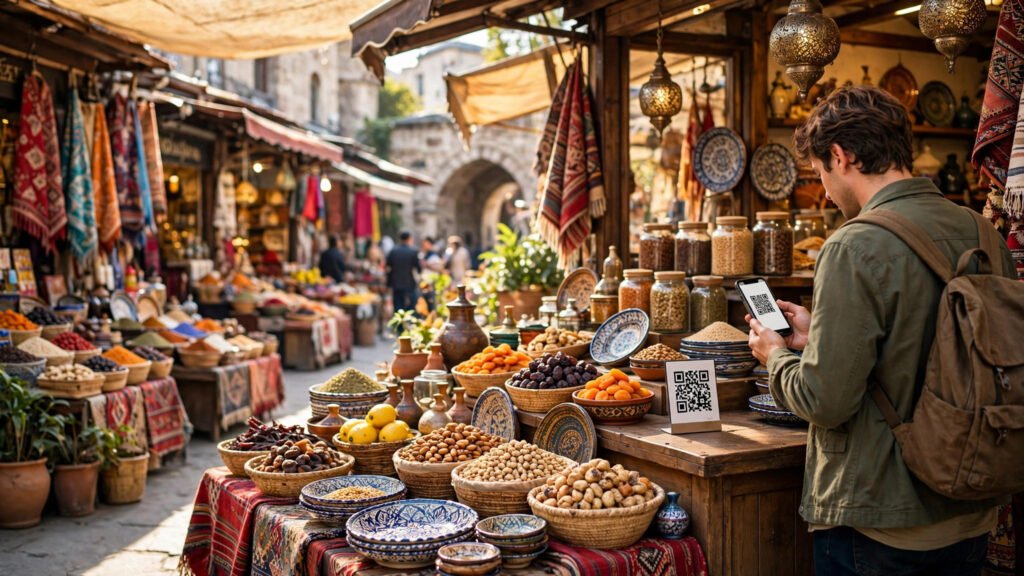
At a market stall in Istanbul, the payment often happens without a wallet coming out at all. A shopper points a phone at a printed QR code on the counter, confirms the amount, and the money moves from one bank account to another in seconds. There is no card terminal, no change to count, and no waiting for a transfer to clear later in the day. For a growing number of people in Turkey, this is simply how paying works now.
The system behind much of this is called FAST, short for Fonların Anlık ve Sürekli Transferi, which means instant and continuous transfer of funds. It is Turkey’s national instant payment system, operated through the country’s central bank infrastructure, and it lets people send money between accounts at different banks at any hour, including weekends and public holidays. That always-on character is the point: a transfer made on a Sunday evening does not sit in a queue until Monday morning.
FAST did not arrive in a country that was short of ways to pay. Turkey already had widespread bank cards, a large banking sector, and a strong habit of using mobile banking apps. What FAST changed was the speed and simplicity of moving money directly between people and businesses, without needing a card network in the middle of every transaction.
Key Takeaways
- FAST is Turkey’s instant payment system, letting money move between different banks in seconds, day or night.
- With Kolay Adres, people can send money using a phone number or email address instead of typing out a long IBAN.
- QR codes have made FAST practical for small shops and market stalls, where a printed code can replace a card terminal.
What FAST Actually Is
At its simplest, FAST is a way to move Turkish lira from one bank account to another almost immediately. A person opens their bank’s mobile app, enters the recipient and the amount, and the transfer is completed in seconds rather than hours. The recipient can use the money straight away, which matters most for the everyday payments that used to involve waiting: splitting a restaurant bill, paying a tradesperson, or settling up with a friend.
The system works across banks, so the sender and the recipient do not need to use the same bank. That matters in a country where people hold accounts at several different banks and where small businesses may bank somewhere different from their customers. An instant system that only worked inside one bank would be far less useful, and FAST was designed to avoid that problem.
FAST also works around the clock. Traditional bank transfers in many countries still follow business hours, with evening or weekend payments clearing on the next working day. FAST removes that delay, which is why it feels less like a bank transfer and more like handing over cash — except that the money leaves a digital trail both sides can check.
Why a Phone Number Instead of an IBAN Matters
One reason FAST caught on quickly is that it removed one of the most annoying parts of bank transfers: the IBAN. A Turkish IBAN is a long string of letters and numbers, and typing it on a phone screen is exactly the kind of task where a single wrong digit causes a failed or misdirected payment. Many people simply avoided bank transfers for small amounts because the effort did not feel worth it.
Turkey’s answer is called Kolay Adres, meaning easy address. It lets a person link their bank account to something they already remember, such as a mobile phone number or an email address. Once that link is set up, someone sending money only needs that phone number or email address, and the system finds the right account behind it. The sender never has to ask for an IBAN, and the recipient never has to read one out over the phone.
This small change has a large effect on everyday behaviour. Paying a neighbour, a colleague, or a small business becomes as simple as sending a message, because the identifier people use is one they already know. It also lowers the barrier for people who are less confident with banking details, since there is far less to type and far less to get wrong. Similar ideas exist in other countries, and people in neighbouring Georgia have also moved towards bank apps and QR codes for the same reason: the payment method that asks for the least typing tends to win.
FAST removes that delay, which is why it feels less like a bank transfer and more like handing over cash — except that the money leaves a digital trail both sides can check.
Why QR Codes Fit Turkish Shops So Well
For shops, the most visible part of the change is the QR code. Turkey has a national QR standard, known as TR QR, which means a code printed by one bank or payment provider can generally be read by another provider’s app. A small business does not need to print a different code for every bank its customers use, and a customer does not need to worry whether their own bank’s app will recognise the code.
That standard is what makes QR payment realistic for the smallest sellers. A market stall, a neighbourhood bakery, or a taxi driver can display a single printed code and accept instant payments without renting a card terminal or paying for extra hardware. The customer scans, checks the amount, and confirms. For the seller, the payment arrives in the account quickly, without handling notes and coins or waiting for a card settlement.
QR codes also suit how Turkish shoppers already use their phones. Mobile banking is deeply established, and many people already open a bank app several times a day to check balances, pay bills, or send money. Adding a scan-and-pay step inside that same app feels natural, rather than asking people to download and trust something entirely new. The same phone-first habit explains why people in nearby Azerbaijan handle so much official business through their phones, and why travellers in Greece now book ferries on their phones instead of at the port.
- FAST transfers settle in seconds, at any hour, between different banks.
- Kolay Adres replaces the long IBAN with a phone number or email address.
- TR QR codes let small shops accept instant payments with just a printed code.
- Payments stay inside familiar bank apps, so shoppers need nothing new to learn.
Where Cash Still Wins
None of this means cash has disappeared from Turkey. Cash is still common at the smallest stalls, in rural markets, and among older shoppers who prefer notes and coins. Some sellers still prefer cash because it is immediate in a different way: there is no app to open, no phone signal to worry about, and no screen to check. Visitors to Turkey will still find places where cash is expected, and carrying some lira remains sensible.
There are also practical limits to phone payments. A dead battery, a weak mobile signal in a basement shop, or a customer whose bank app is not set up for instant transfers can all send a shopper back to cash. And some people simply like the control of physical money, especially for small daily spending where they can see exactly what is left in their pocket. FAST has not removed those preferences; it has given people a fast alternative for the many payments where a phone is already in hand.
What Visitors Should Know
For a visitor, the most useful thing to understand is that a QR code on a Turkish counter is usually a payment code, not just an advertisement or a menu link. Scanning it with a bank app is how a local would pay, but a foreign bank app will not normally connect to the Turkish system. Visitors should therefore not expect their own home banking app to pay a Turkish QR code, and should instead use a card or cash unless a local payment method is available to them.
It is also worth knowing that asking a seller whether they accept a card or a transfer is perfectly normal. Many larger shops and restaurants take cards without any difficulty, while smaller stalls may take cash only or a QR payment through a local app. A short, polite question before ordering avoids an awkward moment at the till, and it reflects a payment landscape that is now genuinely mixed: cards, cash, and instant transfers all sit side by side.
What to Watch Next
Turkey’s payment habits are still shifting, and the direction so far is clear: instant transfers are becoming the default for person-to-person payments, QR codes are spreading among small sellers, and cash remains a practical fallback rather than the only option. The interesting question is how far the QR habit spreads into the smallest and most rural sellers, and whether visitors will eventually find a simple way to join the same system. For now, the change is best summed up by the market stall itself: the phone has become the wallet, the QR code has become the till, and the money moves in seconds.