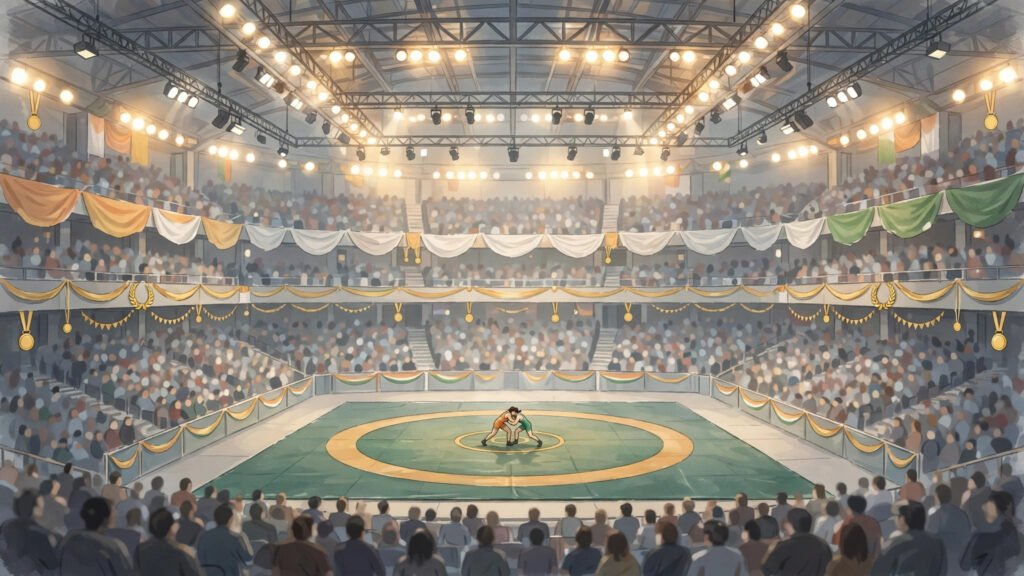
Indian wrestling has its first woman world champion. Manisha Bhanwala created history in Astana, Kazakhstan, on Friday, October 30, 2026, staging a remarkable comeback from a six-point deficit to defeat American Abigail Nette 8-6 in the women’s 59kg final at the World Championships.
Key Takeaways
- Manisha Bhanwala beat Abigail Nette 8-6 in the women’s 59kg final in Astana, after trailing 0-6.
- She is the first Indian woman to win a World Championships gold medal, and only the second Indian wrestler overall to do so.
- Her gold capped a historic Indian campaign in which three women reached gold-medal bouts at the same edition for the first time, and India finished with four medals.
The 29-year-old’s triumph ended India’s long wait for a wrestling world champion. She is only the second Indian wrestler to win a senior World Championships gold medal, following Sushil Kumar, who claimed the men’s 66kg title in 2010 in Moscow. For Indian women’s wrestling, however, this was a first — a barrier that had stood through years of near misses finally fell in Astana’s Barys Arena.
The Final: From 0-6 Down to 8-6
The final began in the worst possible way for Bhanwala. Nette, the Pan American champion from the United States, opened up a 6-0 lead, and the contest looked to be slipping away before it had truly begun. Manisha was trailing 0-6, but she refused to let the final slip away.
Manisha was trailing 0-6, but she refused to let the final slip away.
Slowly, she worked her way back into the bout, finding scoring opportunities where none had seemed available in the opening exchanges. She followed it up with another scoring move, executing a two-pointer to take an 8-6 lead. When the final whistle sounded, Bhanwala had secured a historic victory. Overcome with joy, she jumped in celebration, bowed down and kissed the mat — a moment that marked the culmination of a landmark achievement in Indian wrestling.
The comeback was not a lucky escape. It was the product of composure under pressure, the quality that separates a finalist from a champion. At 0-6 down, many wrestlers would have chased the bout recklessly and left themselves open to further scores. Bhanwala instead stayed in the contest, took her chances when they came, and turned a six-point deficit into a two-point win.
A Late Starter Who Kept Changing Weight
Bhanwala’s path to the top was far from conventional. She took up wrestling at 17 to get fit, a late start in a sport where many champions begin as children. She comes from Siwaha village in Haryana’s Jind district, with Rohtak also associated with her early life and wrestling journey, and she has battled height and weight-category challenges throughout her career.
Ahead of the World Championships in Astana, her sixth appearance at the event, she took another bold decision: switching weight categories yet again, this time to 59kg. She had previously competed in the 62kg and 65kg categories. The move paid off spectacularly, and the gold medal is a vindication of a career built on adaptation rather than on following a single fixed route to the top.
Her route to the final underlined that form. She stormed into the title bout with a dominant semifinal performance against Kazakhstan’s Altyn Shagayeva, setting up a final against Nette that would become one of the most memorable in recent Indian wrestling history.
A Historic Campaign for Indian Women’s Wrestling
Bhanwala’s gold capped an exceptional campaign for the Indian women’s team. For the first time in the country’s history, three Indian women reached the gold-medal bouts at the same edition of the World Championships. Neelam Sirohi (50kg) and Kajal Dhochak (76kg) had settled for silver on Thursday after losing their respective finals, while Tanmu Sharma also contributed to India’s medal tally with a bronze.
Together, those results gave India four medals at the 2026 World Championships, a record haul that shows the depth now present in the women’s programme. The story is no longer about one breakthrough wrestler carrying the hopes of a team. It is about a group reaching finals together, and about Bhanwala ensuring that the campaign would not end without a gold.
That wider progress matters for what comes next. Indian sport has seen individual pioneers before — Indian sportswomen reaching finals on the biggest stages — but a world title changes the conversation. It gives younger wrestlers a champion from their own programme to follow, and it gives the sport a new reference point: the first Indian woman to stand on top of the world podium.
What the Gold Means Beyond One Night in Astana
The significance of the win goes beyond the medal itself. Sushil Kumar’s 2010 gold had stood alone for 16 years as India’s only wrestling world title. Bhanwala’s victory ends that wait and joins him in a very small group, while also opening a new chapter: the first time the name on the list is a woman’s.
It also arrives in a week of Indian team success elsewhere, including India’s hockey triumph over China, and it reinforces a broader point about Indian sport in 2026 — that success is coming from more than one discipline, and from women’s events as much as men’s.
- Manisha Bhanwala, 29, won the women’s 59kg gold at the World Championships in Astana on October 30, 2026.
- She beat Abigail Nette of the United States 8-6 in the final, after trailing 0-6.
- She is India’s first woman wrestling world champion and only the second Indian overall, after Sushil Kumar in 2010.
- She reached the final with a dominant semifinal win over Kazakhstan’s Altyn Shagayeva.
- Neelam Sirohi and Kajal Dhochak won silver, and Tanmu Sharma won bronze, as India finished with four medals.
- Bhanwala took up wrestling at 17 and switched to 59kg ahead of Astana, her sixth World Championships appearance.
What to Watch Next
What to watch next is how Bhanwala builds on this title, whether the depth shown by three women reaching finals in Astana becomes a regular feature of Indian teams, and whether this gold lifts the next generation of wrestlers from Haryana and beyond toward the same podium. The immediate legacy is already clear: India no longer waits for its first woman wrestling world champion, because Manisha Bhanwala has become one.