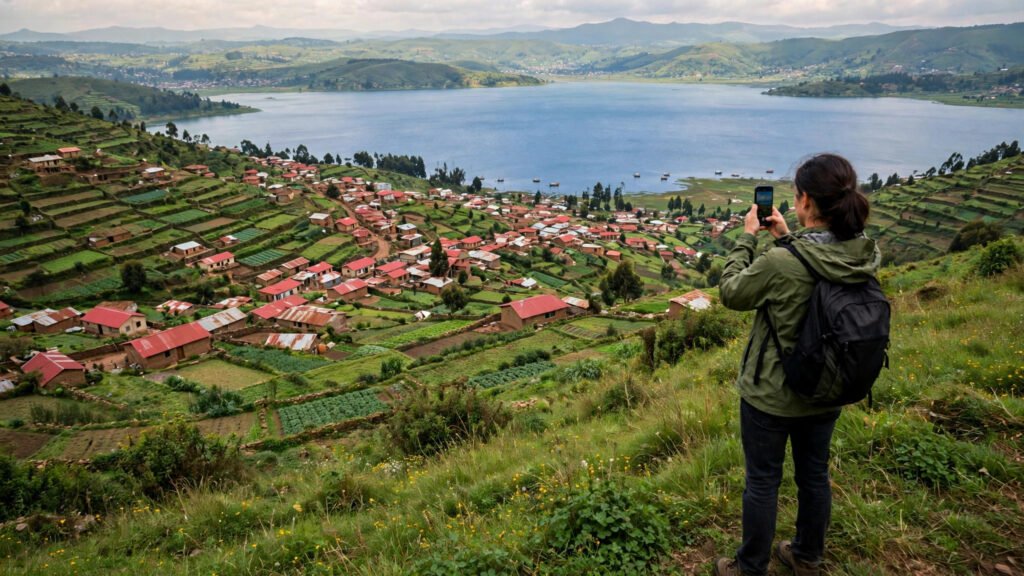
Burundi is a country of hills. Villages sit on ridges, fields run down the slopes, and the road to the nearest town can be long, especially when the rains come. For many Burundians, the phone has quietly become the shortcut: it carries money, news, music and family voices across distances that are still hard to travel every day.
This is not a story about one app or one gadget. It is about how an everyday device fits into daily life in a landlocked East African country where bank branches are concentrated in towns, where many people farm, trade and study far from a city, and where family members often live in different provinces, or in another country altogether.
Key Takeaways
- For many Burundians, the phone works as a wallet, a radio and a family link in one device.
- Mobile money lets people send and receive money without travelling to a distant bank branch.
- Phones also carry news, schoolwork, farming advice and music across Burundi’s hills.
A Wallet That Fits in a Pocket
For a farmer selling beans or bananas at a local market, or a trader moving goods between towns, carrying large amounts of cash on a long journey is a worry. A mobile money wallet changes the shape of that problem. Money can arrive as a message, sit in the wallet until it is needed, and then move on to a supplier, a school fee or a relative, all without a trip to town.
That matters most for people who live far from a bank. In Burundi’s hills, a journey to a branch can eat up most of a day. A phone transfer takes a few minutes instead, and the time saved goes back into work, family or rest. Small traders use the same tool to pay for stock, and parents use it to send money to children studying in another town.
Neighbours across the region have followed a similar path. In Rwanda, many people now pay with mobile money instead of cash or bank cards, and in Tanzania, M-Pesa and Tigo Pesa play a similar everyday role. Burundi’s version of the habit fits the same pattern: where branches are few and distances are long, the phone becomes the nearest bank.
News, Radio and Music on the Move
The phone is also Burundi’s portable radio. Kirundi-language programmes, music and news travel easily on a handset, and a phone can keep a household connected to what is happening in Bujumbura or Gitega even when the television is off and the newspaper never arrives in the village.
For students, the phone is a study aid and a library of sorts. Lessons, notes and messages from classmates move through it, and a quick search can answer a question that no book at home can. For young people in towns, it is also where music, football talk and jokes circulate, the same way they do for young people everywhere.
For many Burundians, the phone has quietly become the shortcut: it carries money, news, music and family voices across distances that are still hard to travel every day.
Staying Close Across Distance
Burundian families are often spread out. Some members work in the capital, others farm in the hills, and still others live abroad. The phone is what keeps those threads tied together: a voice call on a birthday, a message with a photo of a new baby, a short video from a wedding that a relative could not attend.
Money follows the same threads. Relatives abroad send support home through mobile channels, and that support often pays for food, school costs or medicine. Ugandans rely on mobile money in a similar way, and the logic is the same in Burundi: the phone lets family help family, even from far away.
For traders and small business owners, the phone is also a shop window and a telephone exchange. A customer can ask about prices, place an order or confirm a delivery without either side travelling. In a country of hills and long roads, that simple exchange saves real time and real money.
Charging and Signal in the Hills
None of this works without power and signal, and both can be uneven in rural Burundi. Charging a phone may mean a visit to a neighbour with electricity, a small shop with a charging point, or a solar charger at home. People plan around it: charging in the evening, keeping the phone switched off during the day, or sharing one charger between several handsets.
Signal, too, can fade in valleys and on remote ridges. People learn where the signal is strongest, sometimes a particular spot on a hill or near a trading centre, and they make their important calls from there. These small workarounds are part of daily life, and they show how much the phone is valued: people go out of their way to keep it working.
- Mobile money replaces long trips to distant bank branches for many rural households.
- Phones carry Kirundi radio, news, music and schoolwork into villages.
- Calls and messages keep scattered families in touch, including relatives abroad.
- Charging points and solar chargers help keep phones running where power is uneven.
What Phones Still Cannot Fix
A phone cannot build a road, bring electricity to a village or replace a bank branch entirely. Cash is still essential in many markets, and not everyone owns a smartphone or can read a long message with ease. Older Burundians in particular may rely on children or neighbours to help with menus and codes, and that help is itself a form of family closeness.
Costs also matter. Airtime, data and handset repairs all cost money, and a broken screen can put a household’s wallet, radio and family link out of action at once. That is why repair stalls and second-hand handsets are part of the same story: keeping the phone alive is worth real effort.
What to Watch Next
The phone’s role in Burundi is likely to keep growing as networks reach further into the hills and more services move onto handsets. The questions worth watching are practical ones: whether charging and signal improve in rural areas, whether more traders and schools use phones for everyday business, and whether the wallet in the pocket keeps making long journeys unnecessary. For now, the answer to why Burundians rely on their phones is simple enough. The hills are not getting flatter, but the phone makes them feel closer.