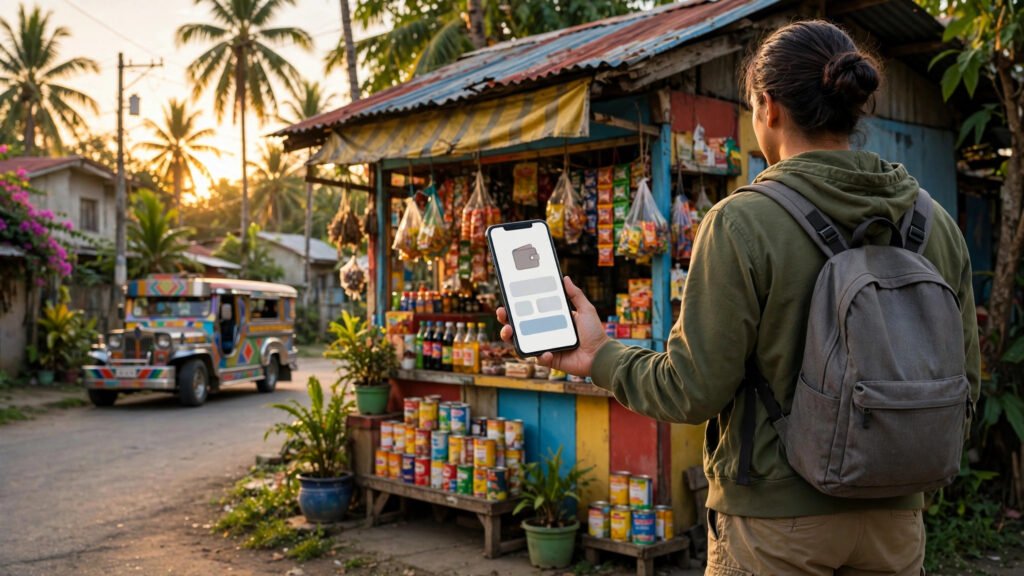
In the Philippines, the phone in your pocket often works harder than the bank branch down the road. For millions of Filipinos, paying a bill, sending money to family, topping up mobile load, or buying from a neighbourhood sari-sari store now happens inside an app — most often GCash or Maya — rather than at a bank counter. It is a shift shaped by geography, work, and everyday convenience, and it says a lot about how a country of thousands of islands organises its money.
This is not simply a story about new technology replacing old habits. It is about what happens when banking has to reach people spread across islands, cities, and provinces, many of whom work far from home — sometimes in another country altogether. Mobile wallets fit that reality in a way that a branch network, however large, struggles to match.
Key Takeaways
- Filipinos use GCash and Maya for everyday money tasks — bills, transfers, shopping, and mobile load — because the phone is always at hand.
- An archipelago of thousands of islands makes branch banking hard to reach for many people, while a phone wallet travels everywhere.
- Money sent home by Filipinos working elsewhere is a major reason wallets became a daily habit, not just a payment tool.
An Archipelago Needs Banking That Travels
The Philippines is made up of thousands of islands, and distance is a daily fact of life. A bank branch may be a short walk away in Metro Manila, but in a provincial town or a smaller island community, reaching one can mean a long trip, a boat ride, or a day set aside for a single transaction. A phone wallet removes that journey. If there is a mobile signal, the wallet is open.
That matters most for the small, frequent transactions that fill daily life. Paying an electricity or water bill, sending a few hundred pesos to a relative, or topping up prepaid load are not occasions for a formal bank visit. They are errands, and people want them done in seconds, between other tasks. Wallets turn those errands into something that can be finished while waiting for a jeepney or standing in a market queue.
Small shops have adapted to the same logic. Many sari-sari stores — the tiny neighbourhood shops that sell everything from soap to snacks in small quantities — now accept wallet payments and QR codes. For a shopkeeper, that means less cash to handle and change to find. For a customer, it means paying with the same phone already used to chat with family and check the news.
Money From Far Away, Delivered Close to Home
One of the strongest forces behind wallet use in the Philippines is the money sent home by Filipinos working abroad. Overseas Filipino workers support families across the country, and those remittances pay for school fees, groceries, medicine, and home repairs. Traditionally, collecting that money meant a trip to a remittance centre or a bank, with queues and opening hours to work around.
Mobile wallets changed the last step of that journey. Money sent from abroad can land in a wallet that a family member already carries, and it can then be spent directly — on bills, groceries, or a transfer onward to another relative — without an extra trip to collect cash. That convenience is why wallets are often described in the Philippines not as a banking alternative, but as the family wallet itself.
The same pattern repeats inside the country. Filipinos working in Manila or Cebu send money to parents or children in their home provinces, and students away from home receive allowances on their phones. When the people you support live on another island, a wallet that moves money instantly feels less like a financial product and more like a practical necessity.
When the people you support live on another island, a wallet that moves money instantly feels less like a financial product and more like a practical necessity.
Why Two Wallets, and Why Both Stick Around
Visitors often ask why the Philippines has two dominant wallets rather than one. The answer is the same as in many fast-growing mobile money markets: competition kept both improving, and different people adopted each for different reasons. One wallet might be the one a person’s employer, school, or local shop uses; the other might be the one their family already has. Many Filipinos simply keep both, using whichever one fits the payment in front of them.
Both wallets grew beyond simple payments. Bills, savings features, insurance options, and small investment products have gradually been added inside the same apps, so a user who started by topping up load can end up managing a surprising amount of household finance in one place. That breadth is part of the appeal: instead of learning a separate system for each task, people learn one app and keep using it.
QR codes helped this spread further. A printed QR code at a market stall, a food cart, or a transport terminal costs almost nothing to display, and paying means pointing a phone camera rather than counting notes. For small merchants who could never afford a card terminal, QR payments opened the door to cashless trade — a pattern seen across Southeast Asia, where Indonesians pay with QR codes instead of cash and cards for similar reasons.
What Makes Wallets Win Over Bank Branches
Bank branches still matter in the Philippines, especially for larger transactions, loans, and formal business banking. But for everyday money, wallets have several advantages that are hard for branches to match. They are open whenever the phone is on, they require no travel, and they speak the language of the phone itself — notifications, contacts, and chat-like transaction histories rather than forms and queues.
There is also a lower barrier to starting. Opening a traditional bank account has historically involved documents, minimum balances, and a branch visit. A wallet account, by contrast, can be set up on a phone with the identity checks done digitally, which makes it far easier for young people, informal workers, and people in rural areas to join the formal financial system for the first time.
- Distance: wallets reach island and provincial communities where branches are scarce.
- Remittances: money from abroad and from other cities lands directly in the family wallet.
- Small trade: sari-sari stores and market stalls accept QR payments with no card terminal needed.
- Everyday ease: bills, load, and transfers are finished in seconds on a phone people already carry.
That ease has a social side too. In a country where extended families support each other across great distances, sending money is an act of care, not just a transaction. A wallet makes that act immediate — a parent can help with a school fee the same day it is needed, and a child working in the city can respond to a family emergency without waiting for a branch to open. Similar family-first logic drives wallet use elsewhere in the region, as Bangladeshis pay with bKash and Nagad instead of bank cards for much the same reasons.
The Limits Still in Plain Sight
Wallets have not solved everything. Mobile signal and internet access are still uneven in remote areas, and a phone with a dead battery or no load is a wallet that cannot pay. Cash remains essential for many transactions, especially in markets and rural communities, and not everyone is comfortable trusting a phone with their savings.
Trust is built slowly, and scams targeting wallet users are a real concern, as they are wherever money moves by phone. That is why wallet providers and regulators alike put so much emphasis on verification, transaction alerts, and customer support — and why many Filipinos still keep cash alongside their wallets rather than abandoning it entirely. The wallet has not replaced cash so much as joined it, taking over the tasks where speed and distance matter most.
There is also the question of what happens when a phone is lost or stolen. Because the wallet holds real money, losing the device feels more serious than losing a phone used only for calls. Recovery processes, account security, and the ability to block a wallet quickly all matter more as wallets hold a larger share of household money — a concern shared by phone-first societies across the region, including Sri Lankans who run daily life from their phones.
What to Watch Next
The story of GCash and Maya in the Philippines is, at its core, a story about distance and family. An archipelago needed banking that travels, workers far from home needed a fast way to support their families, and small shops needed a cashless option that cost almost nothing to accept. Wallets answered all three needs at once, which is why they became a daily habit rather than a novelty.
What to watch next is whether wallets keep expanding into more of household finance — savings, credit, and insurance — or whether their growth settles around payments and transfers. Either way, the habit they created is unlikely to reverse: for millions of Filipinos, the phone is now the first place money lives, and the bank branch is the place visited only when the phone cannot do the job.