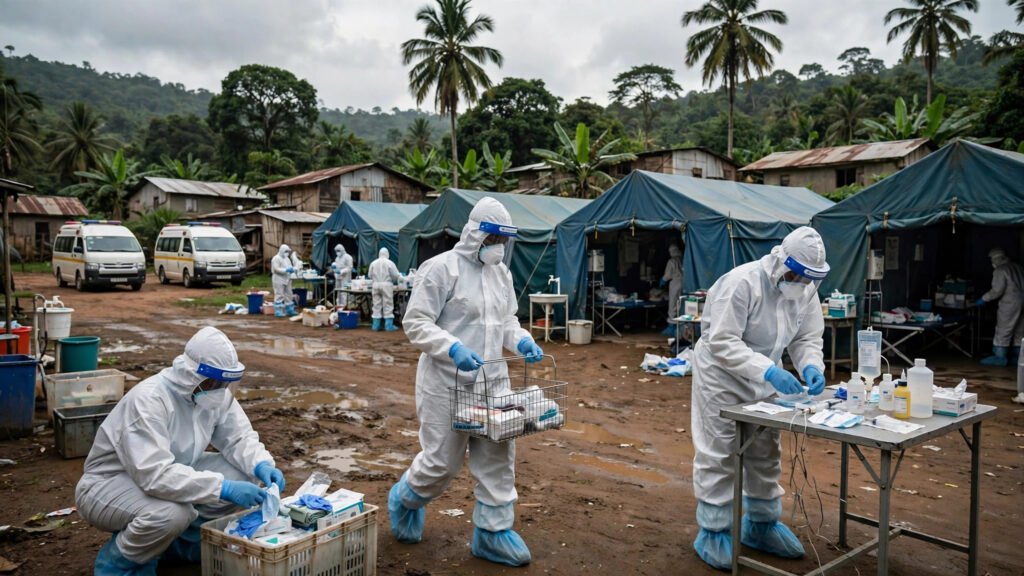
The death toll from the Ebola outbreak in the Democratic Republic of the Congo has passed 5,000, government data show, making it the deadliest Ebola outbreak ever recorded in the country and the second-largest in the world.
Data from the Congolese Ministry of Health, reported by the Associated Press on October 31, 2026, showed 5,026 deaths among 10,351 people infected. The outbreak, caused by the rare Bundibugyo species of the Ebola virus, was declared in May 2026 and has now spread to eight of the country’s 26 provinces.
Health officials say the outbreak remains uncontrolled. Many deaths are occurring outside treatment centres, and the strain behind this outbreak has no approved vaccine and no approved specific treatment, leaving health workers to rely on supportive care, isolation and contact tracing.
Key Takeaways
- Government data show 5,026 deaths among 10,351 infections in DR Congo’s Bundibugyo Ebola outbreak.
- The outbreak, declared in May 2026, has reached eight of the country’s 26 provinces and is the deadliest on record in DR Congo.
- There is no approved vaccine or specific treatment for the Bundibugyo strain, and cases have also been reported in neighbouring countries.
The latest numbers
The latest figures underline the scale of the emergency. With 5,026 deaths out of 10,351 infections, the case fatality rate stands at close to 50 percent. The World Health Organization has said that about one-third of recorded deaths were people who died outside treatment centres, before being tested for Ebola.
At the same time, 2,788 people have recovered, according to the health ministry data cited in the reports. That recovery figure matters: it shows that early care and isolation can save lives, even without a strain-specific drug or vaccine.
The heaviest concentration of cases is in the east of the country, in Ituri and North Kivu provinces. Ituri alone accounts for a large share of confirmed cases, and the province’s long-running armed conflict has made the response harder, limiting safe access for health teams and disrupting surveillance in some areas.
With 5,026 deaths out of 10,351 infections, the case fatality rate stands at close to 50 percent.
Why Bundibugyo is so hard to fight
Bundibugyo is a different species from the Ebola strain behind earlier outbreaks, and that difference is central to this crisis. Africa CDC has said there are no approved vaccines or specific treatments for the Bundibugyo virus, although research is ongoing.
That gap changes the whole response. Without a vaccine to ring-fence contacts, health workers must find cases quickly, isolate patients safely, trace every contact and support families through safe burials. Delayed detection has allowed the virus to spread faster than in past outbreaks, and overstretched health services in remote areas have struggled to keep up.
Attacks on health workers have also continued during the response, according to reporting on the outbreak, adding risk to teams already working in conflict-affected areas. Safe access, community trust and steady supplies remain as important as medical care itself.
- 5,026 deaths and 10,351 infections reported in DR Congo, a fatality rate of close to 50 percent.
- Eight of DR Congo’s 26 provinces affected, with Ituri and North Kivu hit hardest.
- No approved vaccine or specific treatment exists for the Bundibugyo strain.
- About one-third of recorded deaths happened outside treatment centres.
- 2,788 people have recovered, showing early care saves lives.
Spread beyond Congo’s borders
The outbreak is no longer confined to one country. Kenya has confirmed eight cases and two deaths, and Nigeria confirmed a case in October, extending the outbreak to West Africa. Uganda had earlier recorded cases, and Nigeria said on October 31 that it had identified two suspected cases in its northeast, which were isolated while laboratory testing was carried out. Those suspected cases were not yet confirmed.
Governments are tightening travel rules in response. Saudi Arabia on October 31 suspended travel to and entry from Kenya, halting visas for Kenyan travellers and barring anyone who has been in Kenya or another affected country in the previous 21 days, including those in transit, according to the Saudi Press Agency.
The pattern echoes the wider challenge of emergency evacuations and rapid response: when a health emergency crosses borders, neighbouring countries must move quickly on screening, isolation and public information, even while the details are still emerging. For communities across Central Africa, clear, trusted information about symptoms and where to seek care is one of the most effective tools available.
A record no country wanted
This year’s outbreak is the second-largest Ebola outbreak ever recorded, behind only the 2014-2016 epidemic in Guinea, Liberia and Sierra Leone, which infected more than 28,600 people and killed more than 11,000. Within DR Congo itself, it is now the deadliest on record, surpassing every previous outbreak in the country, which has recorded 17 Ebola outbreaks in its history.
In September, an independent scientific review convened by the Africa Centres for Disease Control and Prevention reported progress in some areas, including declining cases and deaths in parts of Ituri province. That progress shows the outbreak can be slowed where teams can reach people early and safely. The overall toll, however, shows how far the response still has to go.
What to Watch Next
What happens next depends on the same factors already shaping this outbreak: whether cases are found early, whether patients reach treatment centres in time, and whether health teams can work safely in conflict-affected areas. The suspected cases in Nigeria will be watched for laboratory results, and travel measures announced by neighbouring governments will show whether the regional spread is contained or widening.
The search for a Bundibugyo vaccine and treatment continues, but for now the response rests on isolation, contact tracing, supportive care and community trust. Until the numbers fall steadily across all eight affected provinces, this outbreak will remain DR Congo’s deadliest, and one of the world’s largest, public-health emergencies.