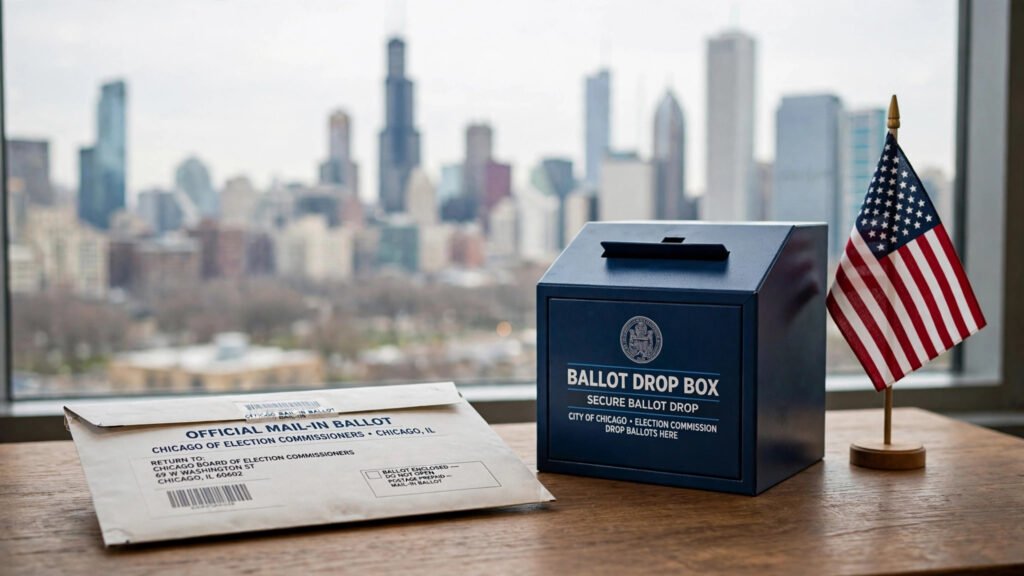
Pope Leo XIV has submitted a mail-in ballot for the 2026 United States midterm elections, and the Vatican confirmed on October 30 that he has done so in Chicago, his home city. The confirmation makes him the first sitting pope known to vote in an American election, a milestone that has drawn attention far beyond the Illinois ballot itself.
The Holy See Press Office said the pope has voted as a United States citizen whenever he was eligible to do so, and that he kept up that practice during his years living in Peru. In its statement, the Vatican said that, in keeping with this long-standing practice of civic participation, he has submitted his mail-in ballot in Chicago.
Key Takeaways
- The Vatican confirmed on October 30 that Pope Leo XIV submitted a mail-in ballot in Chicago for the 2026 US midterm elections.
- Leo XIV is the first American-born pope and the first sitting pope known to vote in a US election.
- His vote does not reveal his choices: Illinois lists him as undeclared, and the Vatican has not said which candidates he chose.
A First in the History of the Papacy
Leo XIV, born in Chicago as Robert Francis Prevost, became the first American-born pope when he was elected in May 2025. He remains a United States citizen, and he also holds Peruvian citizenship, acquired in 2015 after years spent there as a missionary. That dual background is part of why the story has travelled so widely: the head of the Catholic Church, who leads the Holy See, a state that holds no elections of its own, is also a registered voter in Illinois.
Historians cited in coverage of the announcement described the moment as unprecedented. No earlier pope, whatever his nationality, is known to have voted in a democratic election, and Leo XIV may be the first pope to vote in any democratic election at all. The Vatican’s decision to confirm the ballot publicly also broke with a long tradition of silence about the private civic lives of reigning pontiffs.
Pope Leo XIV has exercised his right to vote as a United States citizen whenever he was eligible to do so.
How the Chicago Ballot Came About
According to the Chicago Sun-Times, which first reported the ballot, the pope is registered in Will County, Illinois, at an address in New Lenox, the suburban Chicago town where his elder brother John lives. The county clerk’s office said Robert Francis Prevost, the pope’s name before his election, requested a mail ballot on October 3. The Vatican confirmed the submission on October 30, days before Election Day on November 3.
Illinois voters in this midterm cycle are choosing a United States senator and a governor, alongside members of the House of Representatives and a range of state and county contests. The ballot in Will County includes those races, although reports noted that it was not clear whether the pope’s ballot, cast from overseas, covered state and local contests or only federal contests. The Vatican has not said how the ballot was sent, whether by post from the Vatican or through an intermediary.
The wider midterm picture is one of heavy early participation. A record number of Americans have already voted early ahead of November 3, with nearly 48 million early votes recorded by October 30. That surge in early voting is the backdrop against which even this single ballot has become news.
What His Voting Record Shows, and What It Does Not
Illinois does not register voters by party, so state records list Prevost as undeclared. That means his party affiliation cannot be read from his registration. Voting records cited in coverage show that, before becoming pope, he voted in multiple American elections while living outside the country, including general elections in 2012, 2016 and 2024, and that he took part in both Republican and Democratic primaries in past years.
Those records do not reveal which candidates he chose in any election, and the Vatican has not said whom he voted for this time. Final pre-election polls and campaign coverage have therefore treated the story as one about participation rather than endorsement. The pope’s own statement framed voting as a matter of civic duty: citizens, in the Vatican’s account, have both the right and the duty to take part in democratic processes.
- First sitting pope known to vote in a US election
- Ballot requested October 3 in Will County, Illinois, and confirmed submitted October 30
- Registered as undeclared in a state that does not register voters by party
- Past voting record spans both parties’ primaries, with no candidate choices disclosed
Why the Announcement Matters
The announcement landed in the final days of a midterm campaign in which the rules of voting themselves have been contested. Courts have intervened in disputes over election administration, including a ruling barring pressure on election officials in the run-up to the vote. Against that background, a statement from the Vatican confirming that its head of state voted by mail carried a symbolism that went beyond one envelope from Chicago.
It also fits a pattern in Leo XIV’s papacy. Earlier in October, he personally disclosed a lung nodule, breaking with the Vatican’s centuries-old tradition of secrecy about a pope’s health. The voting confirmation, like the health disclosure, showed a pontiff willing to make public details that his predecessors kept private. Observers quoted in coverage called the vote a quiet revolution in how the papacy relates to the civic life of a pope’s home country.
For Catholics in the United States, the story also underlined a simple fact: the first American pope is still, in the eyes of Illinois election law, an ordinary registered voter in Will County, subject to the same mail-ballot process as any other voter living abroad. His ballot will be counted like any other valid mail ballot, and its contents will remain private, as the law requires.
What to Watch Next
What to watch next is limited to what is already known: the midterm results on November 3 will show who won the Illinois Senate and governor’s races and control of Congress, while the pope’s own choices will stay private. The Vatican has said nothing more about the ballot, and no further statement is expected before Election Day. The historical first, however, is already recorded: a sitting pope has voted in an American election, and the confirmation came from the Vatican itself.