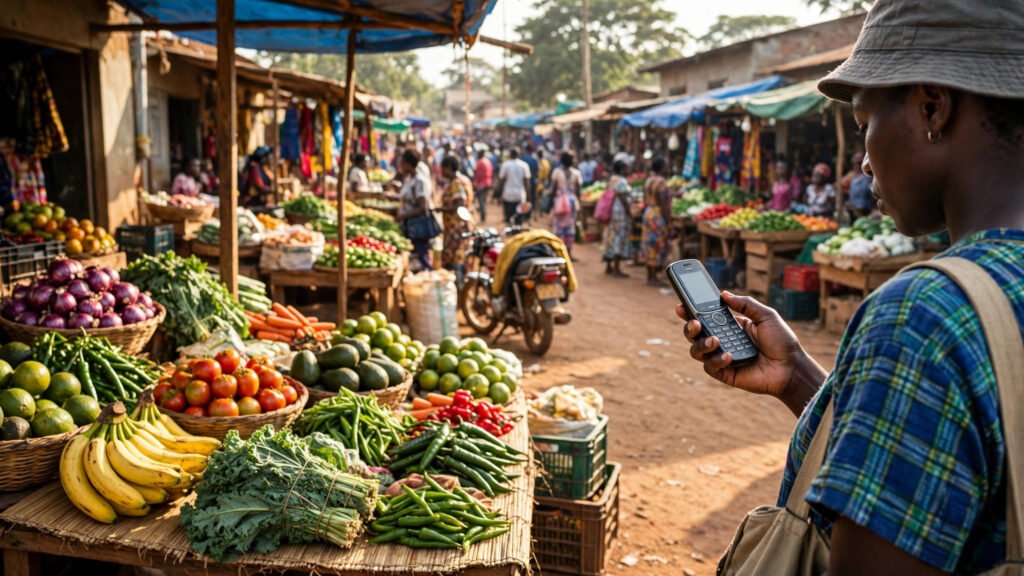
In Uganda, the phone in your pocket often works as a bank, a shop till, a bus ticket window and a way to send help to family — all without ever visiting a bank branch. For millions of Ugandans, mobile money is not a novelty or a backup. It is the everyday way money moves, from a market stall in Kampala to a farm in a village hours from the nearest town.
The question many visitors ask is simple: why did mobile money take hold so strongly here, when banks have existed for far longer? The answer lies in distance, cost and habit. Uganda is a country where many people live outside big cities, where formal bank branches are thin on the ground, and where a basic phone reaches places a branch never will.
Key Takeaways
- Mobile money reaches Ugandans where bank branches do not, using basic phones and local agents.
- It fits daily life: paying traders, sending money to family, and settling small bills quickly.
- Its strength comes from convenience and trust built over years of everyday use, not from replacing cash overnight.
Bank branches are far away, but agents are close
For a farmer or a small trader, a trip to a bank can mean transport costs, lost working hours and paperwork. A mobile money agent, by contrast, is often a familiar shopkeeper down the road. People can deposit cash, withdraw it, or send it onward with a few steps on a phone, and the agent handles the cash side of the transaction.
This agent network matters more than any single app feature. It turns thousands of small shops and kiosks into points where digital money meets real cash. That is why mobile money works even for people who do not own a smartphone: a basic handset, a SIM and a PIN are enough to take part.
It matches how Ugandans actually earn and spend
Much of Uganda’s daily economy runs on small, frequent payments. A market trader sells in small amounts through the day. A boda boda rider is paid ride by ride. A family member working in town sends support home in instalments, not in one large transfer. Mobile money fits that rhythm because it handles small sums quickly and cheaply, without waiting for a bank’s opening hours.
Paying a supplier, settling a school-related cost, or splitting a bill with friends can all happen from the same phone. When money can move in minutes rather than days, people plan around it — and that planning becomes a habit that is hard to break.
A basic handset, a SIM and a PIN are enough to take part.
Family support travels faster than a bus
One of the strongest reasons mobile money stuck is family. Uganda has large numbers of people working away from home, in cities or abroad, supporting relatives in other districts. Sending cash by hand meant waiting for someone to travel. Sending it by phone means the money can arrive the same day, and the recipient can collect it from a nearby agent.
That speed changes real decisions. A medical cost can be covered quickly. A school fee can be paid before a deadline. A farming input can be bought when the rain arrives, not a week later. Similar patterns appear elsewhere in Africa, including in Kenya, where M-Pesa became the everyday way to pay, and in Ethiopia, where Telebirr serves people with limited banking access.
Trust was earned one transaction at a time
No payment system survives on technology alone. People use mobile money in Uganda because it has worked for them repeatedly: the transfer arrives, the balance is visible, and the agent is someone they know. Problems still happen — wrong numbers, network delays, and fees that add up — but the system is familiar enough that most users know how to check, confirm and correct a payment.
That familiarity also helps small businesses. A trader who accepts mobile money does not need to keep large amounts of cash on site, and a customer does not need exact change. Over time, the phone becomes the record book as well as the wallet.
- Agents bring banking-style services to streets and villages without a branch building.
- Small, frequent payments suit traders, riders and families better than large, rare transfers.
- Speed matters most when money is family support, not just shopping.
- Trust grows from repeated, successful everyday transactions.
Cash has not disappeared — and that is fine
Mobile money has not ended cash in Uganda, and it does not need to. Cash still matters in markets, for small roadside purchases, and where networks are weak. The real change is choice: people can hold value on a phone, move it instantly, and turn it back into cash at an agent when they need notes in hand.
This mix is also visible in neighbouring economies, such as Zimbabwe, where people rely on mobile money even when cash is scarce. The lesson is the same: the winning system is the one that works where people already live and trade.
What to Watch Next
Watch how mobile money in Uganda keeps spreading into more parts of daily life: more traders accepting it, more bills settled by phone, and more families depending on instant transfers. The key question is not whether phones replace banks, but how far a simple, agent-backed phone wallet can go in a country where distance once decided who could use financial services at all. For now, the answer is already in millions of pockets: the bank that fits in your hand is the one you use every day.