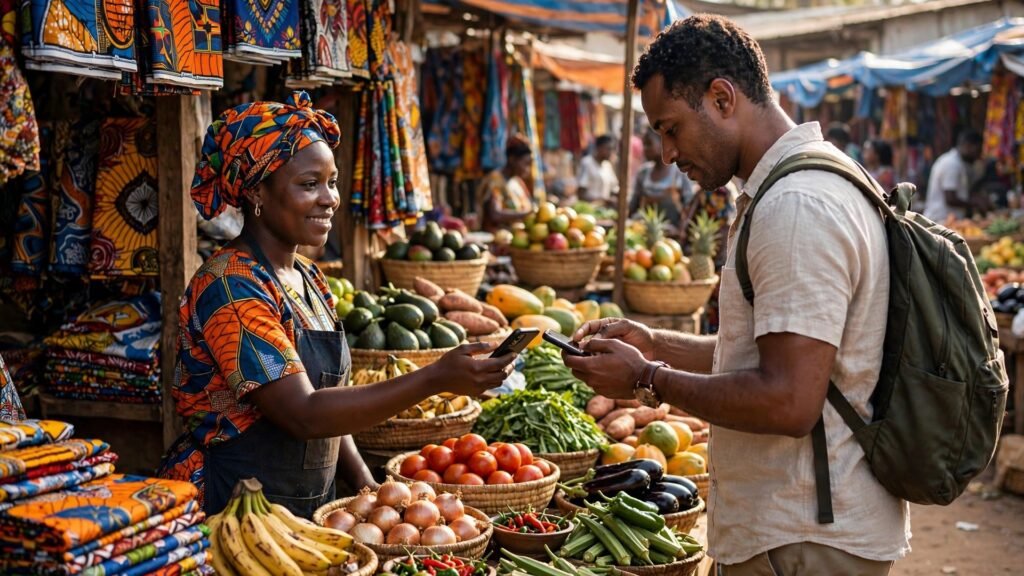
In markets across Ghana, from busy stalls in Accra to small shops in farming towns, a familiar scene plays out every day: a buyer picks up tomatoes, yams or cloth, and instead of counting out banknotes, both buyer and seller reach for their phones. A few taps later, the payment is done. For many Ghanaians, the phone has become the wallet — and mobile money is the reason why.
Mobile money lets people store value on a mobile phone account and send it to another person, pay a trader, or settle a bill, without needing a traditional bank account or a bank card. The service runs through mobile network operators, and agents — small shops and kiosks found in towns and villages — help people deposit cash into their accounts or withdraw it when they need notes in hand.
Key Takeaways
- Mobile money turns an ordinary phone into a wallet, so payments, transfers and bill payments do not require a bank branch visit.
- It suits daily life in Ghana because agents are close by, transfers reach family quickly, and market traders can accept payment on the spot.
- Cash and bank cards still have a place, but for many everyday payments the phone is simply faster and more convenient.
Why the Phone Beat the Trip to the Bank
For a long time, paying someone far away meant a journey: travelling to a bank branch, queuing, and hoping the branch was open and the system was working. For people living outside the big cities, that journey could eat up most of the day. Mobile money removed the journey. Money can be sent from a phone wherever there is a mobile signal, and the recipient gets a confirmation message within moments.
That speed matters most for family support. Many Ghanaians work in cities while their relatives live in other towns or villages, and sending money home used to mean handing cash to a traveller or waiting for a bus driver to deliver it. A phone transfer is direct, traceable, and arrives without anyone having to travel. Parents can receive school fees support, traders can pay suppliers, and friends can share costs — all from the phone in their pocket.
For many Ghanaians, the phone has become the wallet — and mobile money is the reason why.
How Market Traders and Small Businesses Use It
Mobile money fits the way Ghana’s markets already work. A trader selling vegetables, cloth or cooked food does not need a card machine, a power socket or a fixed shop to accept payment. A phone is enough. Buyers who arrive without enough cash can still pay, and sellers avoid keeping large amounts of cash at a stall, which is safer at the end of a long market day.
Small businesses use the same tool for more than sales. They pay suppliers, settle delivery costs, and keep a record of transactions through the confirmation messages on their phones. That simple record helps a trader remember who paid, when, and how much — something a pocket full of notes never offered. Similar habits have grown in other countries too, where phone-based payments have become the everyday way to move money; Kenya’s phone-based money transfers show how the same idea took root across East Africa.
Why Not Just Use Cash or a Bank Card?
Cash is still widely used in Ghana, and it is not disappearing. But cash has limits: it can be lost, it is hard to send over distance, and exact change is not always available. Bank cards solve some of that, but they require a bank account, a card, and a merchant with a card terminal — three things that are not always present in a small shop or an open-air market.
Mobile money sits in between. It works on ordinary feature phones as well as smartphones, using simple menu steps, so people do not need an expensive handset or a fast internet connection to use it. Agents bridge the gap between cash and digital money: someone with paper notes can hand them to an agent and have the same value added to their phone, and someone with phone balance can withdraw notes when a cash payment is needed. In neighbouring West Africa, Nigerian phone payment apps grew for similar reasons, while in South Asia Bangladesh’s mobile wallets filled the same gap between cash and cards.
- Payments work from almost any phone, not just a smartphone.
- Agents in towns and villages turn cash into phone balance and back again.
- Transfers reach family in other towns without anyone travelling.
- Traders accept payment without a card machine or a fixed shop.
- Confirmation messages give buyers and sellers a simple transaction record.
What Still Needs Care
Mobile money is not free of problems. Users must guard their personal identification number, watch out for scam messages pretending to be from the operator, and double-check the recipient’s number before confirming a transfer, because a payment sent to the wrong number can be hard to recover. Network outages can also pause transactions, and agents sometimes run out of cash for withdrawals. These are habits people learn over time: verify the number, keep the PIN private, and keep the confirmation message until the deal is done.
None of that has stopped the shift. For everyday amounts — market shopping, transport fares, airtime, utility bills, school support — the phone now comes first for many people, with cash kept for the moments when digital payment is not possible.
What to Watch Next
Mobile money in Ghana is now part of daily routine rather than a novelty: it moves family support across distance, lets traders sell without card machines, and gives people without a bank branch nearby a practical way to pay and be paid. As more services — from bills to small business payments — accept phone balance, the wallet in the pocket is likely to keep replacing the trip to the bank, while cash remains the backup for the days when the network or the agent is out of reach.