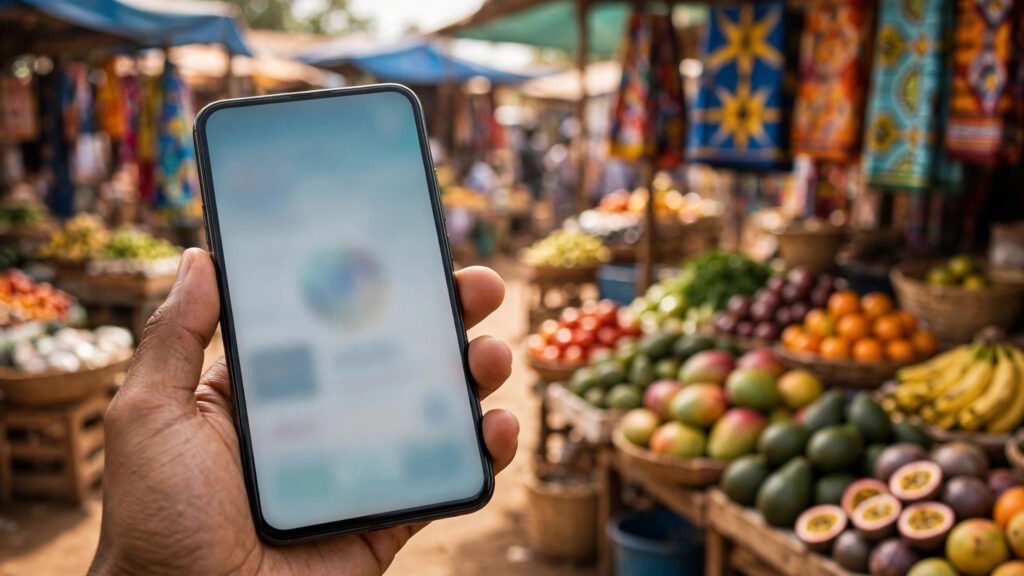
In Kenya, sending money to family, paying a supplier, or settling a small bill often starts with a phone, not a trip to a bank. For many people, the phone in their pocket already works as a wallet, a payment counter, and a way to reach someone hundreds of kilometres away in seconds.
This habit did not appear overnight. It grew out of a practical problem: bank branches were few and far away for many communities, while mobile phones were already spreading fast. When a simple way to move money by phone arrived, it fitted the way people already lived, worked, and helped each other.
Key Takeaways
- Many Kenyans send money by phone because the phone is already in hand, while a bank branch may be a long journey away.
- Mobile money works through a phone wallet topped up and cashed out at local agents, so no bank account visit is needed for everyday transfers.
- The habit stuck because it fits family support, market trade, and bill payments in daily life, not just one kind of transaction.
A bank branch was far away, a phone was already in hand
For a long time, formal banking in Kenya was concentrated in towns and cities. Opening an account often meant paperwork, minimum balances, and a journey to a branch during working hours. For farmers, traders, and workers living outside major towns, that journey cost time and transport money, and it had to be repeated for every deposit or withdrawal.
Mobile phones changed the calculation. Even a basic feature phone could carry a mobile money wallet, and the network of local agents grew around it. An agent could be a small shopkeeper in the neighbourhood, someone who already sold airtime or groceries. That meant topping up a wallet or collecting cash could happen close to home, on the way to work, or while shopping at the market.
The result was a shift in what felt normal. Instead of planning a day around a bank visit, people could send money in the moment it was needed — when a relative asked for help, when a delivery arrived, or when a bill fell due.
Instead of planning a day around a bank visit, people could send money in the moment it was needed.
How sending money by phone actually works
The basic idea is simple. A person keeps a balance in a mobile money wallet linked to their phone number. To add money, they hand cash to an agent, who credits the wallet. To send money, they enter the recipient’s phone number and the amount, confirm with a personal PIN, and the transfer goes through. The recipient can then keep the balance in their own wallet, spend it, or withdraw cash from another agent.
Because the system was built to work on ordinary phones, it does not depend on a fast internet connection or a new smartphone. Menus on the phone guide the user step by step, and confirmation messages arrive as texts, so both sides have a record of the transfer. That simplicity mattered: it meant parents, grandparents, and first-time phone users could learn the process and trust it.
Over time, the same wallet has been used for more than person-to-person transfers. People pay for goods at market stalls, settle utility bills, and receive payments for work, all from the same balance. Each new use made the phone wallet more central to daily spending.
Why it fits daily life in Kenya
Family support is one of the strongest reasons. Many Kenyans work in cities while their families live elsewhere, and regular support is part of household life. A phone transfer lets a worker send money home the same day wages arrive, without waiting for a weekend trip or asking someone travelling in that direction to carry cash.
Trade is another reason. Market traders buy stock, pay suppliers, and take payment from customers, often in small amounts spread across the day. Handling those amounts by phone keeps the money moving without repeated trips to deposit cash, and it leaves a trail that helps a trader keep track of what came in and what went out.
The same pattern shows up across the region, though each country has its own story. In Uganda, for example, mobile money has become a everyday alternative to bank cards, while in Zimbabwe cash shortages pushed people toward phone-based payments. Ethiopia’s experience with Telebirr shows a similar response to limited banking reach. Kenya’s version stands out because the agent network and everyday uses grew together, reinforcing each other.
- Agents in local shops made cash-in and cash-out possible close to home.
- Basic phones could run the wallet, so no expensive device was required.
- Family support, market trade, and bill payments all moved onto the same wallet.
- Text confirmations gave both sender and receiver a simple record of each transfer.
What banks and phones do differently
This does not mean banks disappeared. Banks still matter for larger savings, loans, business accounts, and services that a phone wallet is not designed to handle. The difference is about the everyday job: for small, frequent transfers, the phone is faster, closer, and easier to use.
Phones also changed expectations. Once people could send money in seconds, waiting days for a transfer or travelling far to collect cash started to feel unnecessary. Banks and other services have responded by connecting to mobile money and offering their own phone-based services, so the two systems now overlap more than they compete for every task.
Trust remains the foundation. People use the wallet because the money arrives, the confirmation comes through, and the agent nearby can turn the balance back into cash. If any part of that chain broke down, the habit would fade. Keeping agents stocked with cash, keeping the menus simple, and keeping fees understandable are what protect that trust.
What to Watch Next
Kenya’s phone-based money habit is likely to keep spreading into more everyday payments, from market stalls to bills and small business trade. The question now is how smoothly phone wallets and banks work together, and whether the agent network stays strong in smaller towns and rural areas. What made the system work in the first place — closeness, simplicity, and a confirmation for every transfer — is also what will decide how far it goes next.