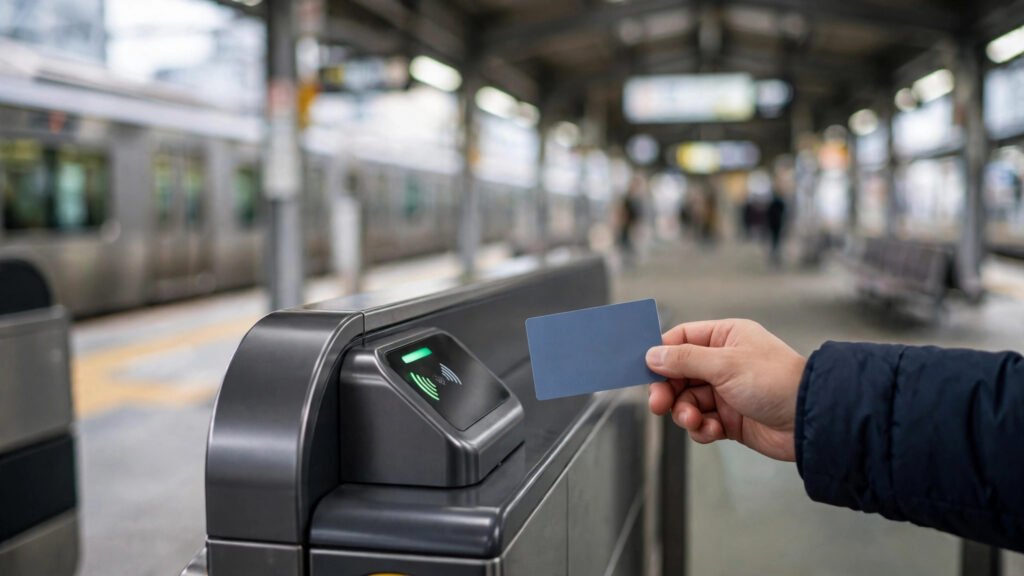
Walk through a busy station in Tokyo or Osaka at rush hour and you will notice something quickly: most commuters do not stop at a ticket machine. They tap a small card — or a phone — on the gate reader and keep walking. Paper tickets still exist, but for daily travel in Japan, the IC card has become the default.
The habit looks simple, yet it answers a real question for anyone visiting Japan or wondering how its transport system stays so smooth: why did commuters switch from paper tickets to a tap?
Key Takeaways
- IC cards let commuters tap in and out at gates instead of buying a paper ticket for every journey.
- One card works across trains and buses in many areas, so changing lines does not mean buying again.
- The same balance can also pay for small everyday purchases, which keeps the card in daily use.
What Is an IC Card?
An IC card is a rechargeable smart card for public transport. The best-known names are Suica, issued in the Tokyo area, Pasmo, used on many private railways and buses around Tokyo, and ICOCA in the Kansai region around Osaka and Kyoto. Each card holds a balance, and the fare for a journey is deducted when the card is tapped at the gate on entry and again on exit.
The cards are designed to work together across much of the country, so a traveller can often use a card from one region on trains and buses in another. That mutual use is one reason the system feels effortless: commuters do not need a new card every time they change city.
Why Tapping Beats a Paper Ticket
The biggest advantage is speed. Buying a paper ticket means checking the fare, using a machine, and keeping a small slip of paper safe until the end of the journey. Tapping removes all of that. For a daily commuter, the difference is not the technology itself — it is the seconds saved at every gate, twice a day, every working day.
Tapping also removes fare mistakes. With a paper ticket, a traveller must buy the right fare for the exact destination. With an IC card, the system calculates the fare from the entry and exit stations and deducts it from the balance. If the balance runs low, it can be topped up at station machines, and in many cases at convenience stores too.
For a daily commuter, the difference is not the technology itself — it is the seconds saved at every gate, twice a day, every working day.
One Card for Trains, Buses and Small Purchases
IC cards are not limited to trains. In many areas the same card pays for buses, and the balance can also be used at vending machines, convenience stores and some shops and restaurants. That everyday usefulness matters: the card stays in a wallet or phone case because it is used for more than the morning commute.
This pattern is not unique to Japan. Tap-to-pay transit is spreading in other cities too, including tap-to-pay travel in Hong Kong and phone-based transit payments in Slovakia. What stands out in Japan is how early and how widely the card habit took hold, across both trains and buses.
- Tap in and out — no ticket machine queue for each journey.
- One balance for trains and buses in many regions.
- Easy top-ups at stations and convenience stores.
- The same card can pay for small purchases like drinks and snacks.
What About Tourists and Phones?
Visitors can buy IC cards at major stations and airports, and short-stay versions are also available for tourists. Many commuters now keep their card on a phone instead of carrying a physical card, tapping the phone on the reader in the same way. The phone version works on the same principle: a balance, a tap in, and a tap out.
For a first-time visitor, the advice is straightforward. Get a card on arrival, top it up, and tap it like everyone else. It will not answer every transport question — some long-distance and reserved-seat trains still need separate tickets — but for city trains, subways and buses it removes the most common source of confusion at the station.
Why Paper Tickets Still Exist
Paper tickets have not disappeared, and that is part of the point. Japan’s transport system kept the old option while the new one spread, so occasional travellers, children and anyone without a card can still travel. At the same time, cash is still common in Japan in other parts of daily life, which shows that new payment habits can grow alongside old ones rather than replacing them overnight.
The IC card won over commuters because it fits the rhythm of Japanese city life: crowded stations, tight connections and journeys made every single day. It did not ask people to change how they travel. It simply removed the slowest step.
What to Watch Next
Expect the tap to keep spreading rather than fading. More travellers are moving their cards onto phones, and the same balance keeps finding new everyday uses beyond the station gate. Paper tickets will likely stay for occasional trips, but for the daily commute, the tap has already become the normal way to travel in Japan.