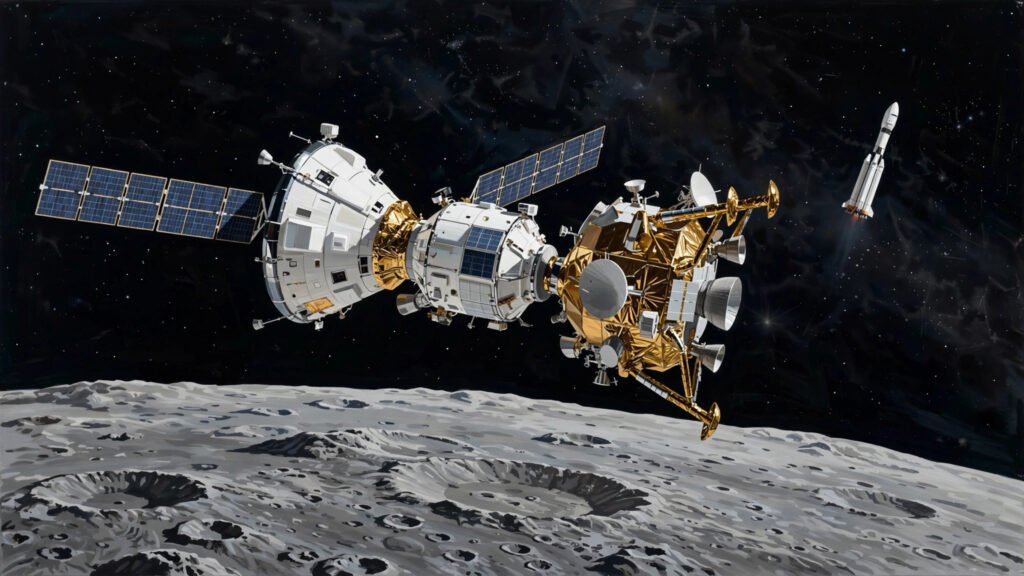
China has set out how it plans to put astronauts on the Moon: not with a single giant launch, but with two launches that meet in lunar orbit. Senior engineer Wang Xiang outlined the approach on October 31 at the 7th Manned Space Symposium in Beijing, describing a “two launches, lunar orbit rendezvous” architecture for the country’s manned lunar exploration programme.
Under the scheme, separate rockets will launch the Mengzhou crewed spaceship and the Lanyue lunar lander into Earth-Moon transfer orbit. The two spacecraft will then dock in lunar orbit, allowing astronauts to transfer to Lanyue for the descent to the surface and for scientific work there. It is a plan built around joining two spacecraft far from Earth, rather than carrying everything needed for the landing on one vehicle from the start.
Key Takeaways
- China will use two launches for its crewed Moon landing, with the Mengzhou spaceship and Lanyue lander docking in lunar orbit.
- Astronauts will transfer to Lanyue in lunar orbit for the descent to the surface and scientific work.
- Key tests are already complete: Mengzhou’s zero-height abort and escape tests, Lanyue’s landing-takeoff test, and Long March-10’s low-altitude validation.
How the Two-Launch Plan Works
The sequence described by Wang is straightforward in outline, even though each step is demanding in practice. First, one Long March-10 rocket launches Mengzhou, the crewed spaceship, toward the Moon. A second launch sends Lanyue, the lunar lander, on the same kind of trajectory. Both spacecraft travel through Earth-Moon transfer orbit, the route that carries a mission from Earth toward the Moon’s neighbourhood.
Once both vehicles reach lunar orbit, they dock. That docking is the hinge of the whole plan. It is the moment when the crew’s journey changes from a transit in Mengzhou to a landing mission in Lanyue. After the transfer, Lanyue carries the astronauts down to the lunar surface, where they will conduct scientific work before returning to the orbiting spaceship for the journey home. The plan therefore treats lunar orbit not just as a destination, but as a meeting point where the mission is assembled in space.
Under the plan, two separate launches will carry the crew ship and the lander to lunar orbit, where they will meet before the descent to the surface.
The Three Vehicles at the Centre of the Plan
Three names define the programme: the Long March-10 rocket, the Mengzhou spaceship and the Lanyue lander. The Long March-10 is the launcher that will send both spacecraft toward the Moon. Mengzhou is the crewed vehicle that carries astronauts on the Earth-to-Moon journey. Lanyue is the specialised lander that takes them from lunar orbit down to the surface and back up again.
Wang said development of all three is progressing smoothly. That assessment matters because a two-launch plan only works if both launches, both spacecraft and the docking between them all perform as designed. A delay or failure in any one element would leave the other waiting in lunar orbit, so the programme’s progress is measured across the whole set of vehicles, not on a single rocket or capsule alone. The same logic applies to other ambitious space efforts: launch reliability and repetition are what turn a single flight into a dependable programme.
- Architecture: two launches, with rendezvous and docking in lunar orbit.
- Crew vehicle: Mengzhou, the crewed spaceship for the Earth-Moon journey.
- Lander: Lanyue, which carries astronauts from lunar orbit to the surface.
- Launcher: Long March-10, which will launch both spacecraft toward the Moon.
- Completed tests: Mengzhou zero-height abort and escape, Lanyue landing-takeoff, and Long March-10 low-altitude validation.
- Announced: October 31, at the 7th Manned Space Symposium in Beijing, by Wang Xiang, deputy chief designer of China’s manned space programme.
Why Rendezvous in Lunar Orbit
Wang said the approach aligns with existing capabilities, standardises production and supports a long-term vehicle family. In plain terms, splitting the mission across two launches avoids the need for a single vehicle large enough to carry the crew, the lander, the fuel for landing and the fuel for return all at once. Each launch carries a more manageable load, and the two spacecraft are designed to work together once they meet.
The standardisation point is also significant. If the same rocket family and shared systems can serve more than one mission, later flights become easier to build, test and repeat. Wang linked that idea to a long-term vehicle family, suggesting that the hardware developed for the first crewed landing is intended to support further missions, not to be used once and retired. That kind of thinking is familiar across space exploration: a telescope such as NASA’s Swift Observatory served for more than two decades because its design and operations were built to last, while new discoveries such as the possible dwarf planet spotted by the Rubin Observatory show how each generation of hardware opens new questions for the next.
Tests Already Completed and Challenges Ahead
The update included a concrete checklist of tests already passed. Mengzhou has completed zero-height abort and escape tests, which check that the crew can escape safely even before launch, at ground level. Lanyue has completed a landing-takeoff test, which exercises the critical manoeuvre of touching down and lifting off again. The Long March-10 has completed low-altitude validation, a step in proving the rocket’s performance in the early phase of flight.
Wang also pointed to how development challenges are being addressed: through nationwide resource mobilisation, unified standards and integrated subsystem verification. The first of those means bringing resources from across the country behind the programme. The second means making sure different teams build to the same standards, so parts fit and systems work together. The third means testing subsystems not only on their own, but as an integrated whole, which is essential when two spacecraft must dock precisely in lunar orbit.
He emphasised building knowledge before resource utilisation through step-by-step surveys, noting that shared technology, personnel and achievements from the Chang’e programme will support the manned landing effort. The Chang’e programme, China’s robotic lunar exploration effort, has already sent orbiters, landers and rovers to the Moon, and the experience, people and technology from those missions feed directly into the crewed plan. The message is one of sequence: survey first, learn from robotic missions, and only then commit crews and resources to the surface.
What to Watch Next
What to watch next is what the article has already set out: further progress on the Long March-10, Mengzhou and Lanyue, the next stages of integrated testing for the two spacecraft, and any further detail on how the lunar-orbit rendezvous will be practised before a crew flies it. The other questions to follow are whether the development pace described as progressing smoothly continues through those tests, and how the shared technology, personnel and Chang’e achievements continue to support the manned landing effort as it moves from planning and testing toward flight.