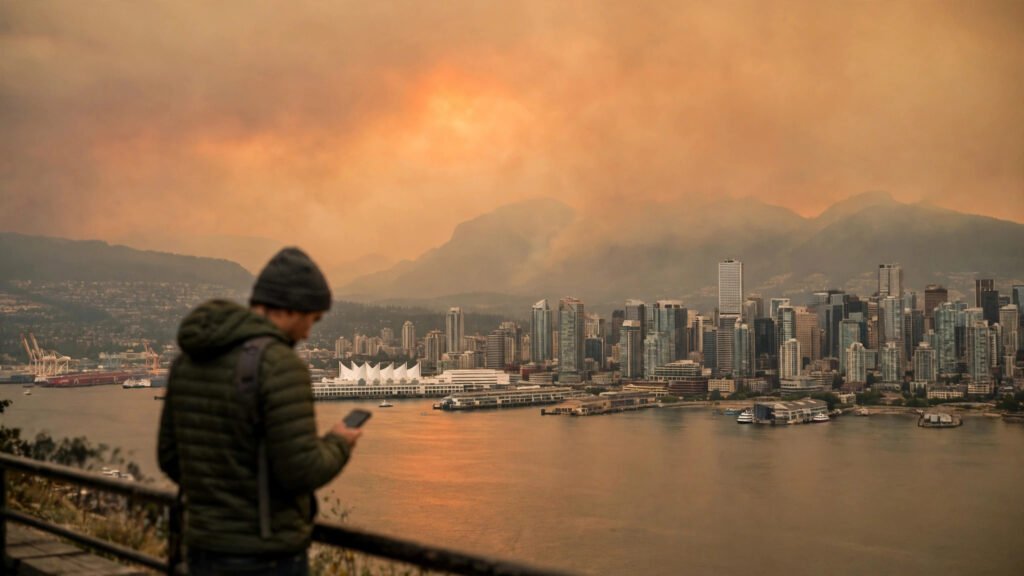
On a smoky summer morning in Canada, many people do not look out of the window first. They look at their phones. A wildfire smoke alert can change the whole plan for the day: whether children play outside, whether a run goes ahead, whether windows stay shut, and whether a trip to another town is still sensible. For Canadians, the phone has become the first place to check the air before stepping into it.
That habit makes sense in a country where wildfire smoke can travel far from the fire itself. Smoke does not respect municipal boundaries, and a sky that looks only slightly hazy can still carry fine particles that irritate eyes, throats and lungs. People with asthma, heart conditions, older adults and young children are often the most affected, which is why a quick check has become part of the daily routine during fire season.
Key Takeaways
- Canadians check phones for wildfire smoke alerts before outdoor plans, because smoke can travel far from the fire.
- Official alerts, air-quality readings and forecasts each answer a different question, so checking more than one source helps.
- Simple steps — staying indoors, closing windows and postponing strenuous activity — reduce exposure on smoky days.
Why Smoke Alerts Matter in Canada
Canada has vast forests, and wildfire seasons can affect large regions at once. When fires burn in one province, smoke can drift across several others, and even across the border. That is why a person living nowhere near a fire can still wake up to an orange sky and a warning on their phone. The alert is not only about the fire; it is about the air in the place where you actually are.
Air quality is usually described with an index or scale that rates how clean or polluted the air is at a given time. A low reading generally means ordinary outdoor activity is fine, while a high reading suggests limiting time outside, especially for strenuous exercise. Checking the number matters more than judging by colour alone, because smoke can be present even when the sky does not look dramatic.
Where Canadians Get Their Alerts
Most people start with the weather app already on their phone, which often shows an air-quality reading beside the temperature. Others turn to official sources: Environment and Climate Change Canada issues special air quality statements when smoke is expected to affect an area, and provincial or territorial authorities publish their own fire and smoke information. Local news outlets and municipal channels also relay warnings when conditions change quickly.
Emergency alert systems add another layer. When smoke poses a more immediate risk, an alert can arrive as a push notification or a broadcast message, even if the user has not opened any app. That speed matters, because smoke conditions can shift during the day as wind direction changes. A morning that starts clear can turn hazy by afternoon, and a forecast checked once may already be out of date.
A morning that starts clear can turn hazy by afternoon, and a forecast checked once may already be out of date.
What the Numbers Actually Mean
Air-quality readings combine measurements of fine particles and other pollutants into a single figure. Fine particles are the main concern in wildfire smoke, because they are small enough to be breathed deep into the lungs. Higher readings therefore mean a greater concentration of those particles in the air you are breathing.
Forecasts add the time dimension. They estimate how smoke will move over the coming hours, which helps people decide not just whether to go out now, but whether to delay a hike, a sports practice or a drive until conditions improve. A forecast is a prediction, not a guarantee, and it works best when checked again later in the day, especially if the wind picks up or dies down.
- Check the air-quality reading for your exact location, not just your province.
- Recheck later in the day — smoke moves with the wind and conditions change.
- Combine an official alert with a forecast to plan the whole day, not just the next hour.
- Keep windows closed and limit outdoor exertion when readings are high.
How Phones Changed the Routine
Before smartphones, smoke information arrived mainly through television, radio or the next day’s newspaper. Now the information travels with the person. A parent can check the reading while children get ready for school, a worker can check before a shift outdoors, and a coach can check before deciding whether practice goes ahead. The phone has turned a general regional warning into a personal, location-specific decision.
This is part of a wider Canadian habit of managing daily life through the phone, from understanding why mobile plans are expensive in Canada to paying friends and bills with Interac e-Transfer. In each case, the phone is not a novelty but a practical tool shaped by the country’s size, distances and services. Smoke alerts fit the same pattern: a vast country, changeable conditions, and a device that can deliver local information quickly.
Other countries show the same logic in different weather. In Fiji, for example, people check their phones first when a cyclone warning arrives, because the warning can mean the difference between a normal day and a dangerous one. The hazard differs, but the behaviour is the same: when nature moves fast, the phone is the fastest way to know.
Practical Steps on a Smoky Day
Health guidance during smoky periods is usually straightforward. Stay indoors when readings are high, keep doors and windows closed, and avoid strenuous outdoor activity until the air improves. If you must go outside, keep the trip short. A well-fitting mask can reduce particle exposure for short outdoor tasks, though it is not a substitute for staying inside when the air is at its worst.
Indoors, a portable air cleaner can help if one is available, and running a ventilation system on recirculation can limit how much outdoor air enters. People who feel unwell — persistent coughing, difficulty breathing, chest discomfort or dizziness — should seek medical advice rather than waiting for the smoke to clear. Children, older adults and people with existing lung or heart conditions should take extra care even at moderate readings.
What to Watch Next
Wildfire smoke alerts will keep mattering as long as fire seasons bring hazy skies to Canadian towns and cities. The practical habit stays the same: check the reading for your exact location, recheck it as the wind changes, and let the forecast shape the day’s plans rather than guessing from the colour of the sky. The phone does not stop the smoke, but it gives Canadians the information they need to decide when to stay in, when to wait, and when it is safe to step outside again.