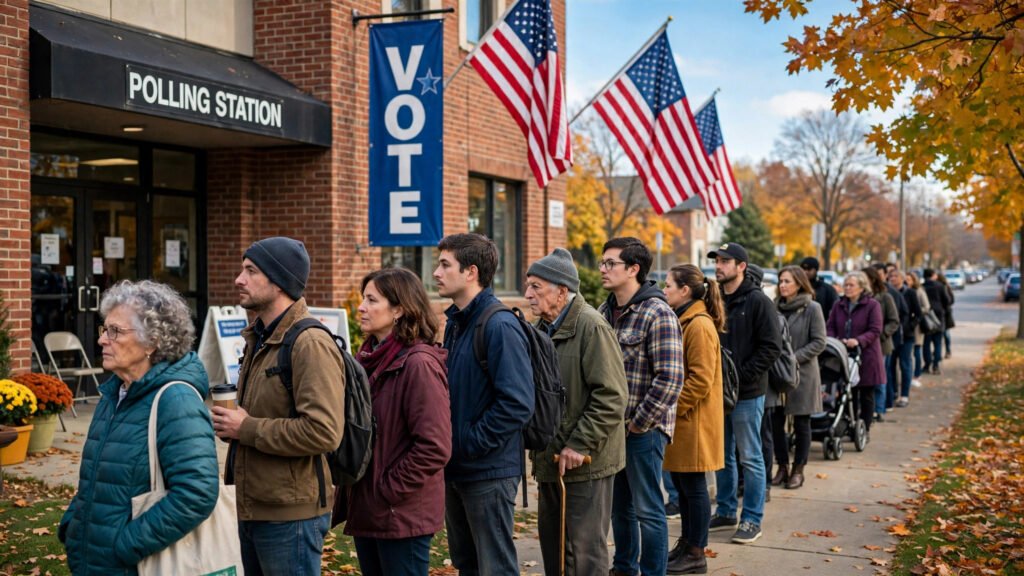
More than 51 million Americans had already cast a ballot by Saturday, October 31, ahead of Tuesday’s midterm elections, setting a new early-voting record for a midterm cycle. The total, tracked by the University of Florida’s Election Lab, passed the entire early vote from the 2022 midterms before Election Day had even arrived.
The Election Lab put the total at 51.31 million as of Saturday afternoon. In 2022, 45.9 million people voted early across the whole cycle. This year’s figure therefore cleared the previous record with voting still open in parts of the country, and with mail ballots still arriving.
Key Takeaways
- More than 51 million Americans had voted early by Saturday, October 31, according to the University of Florida’s Election Lab.
- The total passed the whole 2022 early vote of 45.9 million before Election Day on Tuesday, November 3.
- Early totals show participation, not results: party registration figures describe who is registered, not how anyone voted.
A Record Built on In-Person Voting
In-person early voting accounts for much of the increase. More than 28 million people had voted early in person by Saturday, compared with about 20.5 million across the whole early-voting period in the previous cycle. Mail ballots make up the rest of the early total, with the two routes together pushing the national count past 51 million.
Texas shows the surge most clearly. More than seven million people in the state had voted early, already above its full early total from the previous cycle. Long lines were also reported at polling stations in Virginia on Saturday, the last day of early in-person voting there, as voters used their final chance to cast a ballot before Tuesday.
More than 51 million Americans had already cast a ballot by Saturday, setting a new early-voting record for a midterm cycle.
What Is at Stake on Tuesday
Tuesday’s vote will decide control of Congress for the remaining years of President Donald Trump’s term. All 435 seats in the House of Representatives are on the ballot, along with 35 of the 100 Senate seats. Republicans currently hold a 53-47 majority in the Senate and a narrow edge in the House.
That arithmetic is why the final weekend has drawn so much attention. Campaigning has continued through the weekend, with candidates making closing arguments in the contests that will decide whether Republicans keep control of Congress or Democrats take one or both chambers. The stakes have also been visible in the wider election debate, from mail-ballot voting in the midterms to high-profile campaign stops such as the Georgia rally in the midterm campaign.
- 51.31 million early votes by Saturday afternoon, October 31, per the University of Florida’s Election Lab.
- 45.9 million early votes across the whole 2022 midterm cycle.
- More than 28 million early in-person votes, against about 20.5 million in all of 2022.
- More than seven million early votes in Texas alone.
- All 435 House seats and 35 Senate seats are contested on Tuesday, November 3.
- Republicans hold a 53-47 Senate majority going into the vote.
What the Early Numbers Do Not Show
Early totals describe participation, not results. Ballots are generally not counted by candidate before Election Day in most states, and the national total says nothing about which candidates the voters who have already cast ballots chose.
Party registration data offers only a partial picture. In the states that record the party registration of early voters, registered Democrats have cast more ballots so far: 10.7 million Democrats compared with 7.8 million Republicans, according to the Election Lab data. In the 27 states that track registration, Democrats accounted for about 43 percent of early votes and Republicans about 32 percent. Those shares describe registration, not vote choice, and they cover reporting states only.
The Election Day electorate is also missing from the figures. A ballot cast in October can replace a ballot that would otherwise have been cast on Election Day, so a larger early total does not by itself prove that final turnout will rise by the same margin. The early registration balance could narrow or widen once the remaining votes are cast on Tuesday.
Legal disputes have run alongside the voting. In California, a federal appeals court ruled this week that the Justice Department had failed to justify its emergency bid to force the state to set aside mail ballots from more than 20,000 registered voters it alleges are likely noncitizens. The administration has said it would likely take a dispute over thousands of California mail-in ballots to the Supreme Court, while claims about voter fraud have also featured in the campaign.
What to Watch Next
What to watch next is what the article has already set out: how the final Election Day vote on Tuesday, November 3, changes the picture, whether overall turnout passes the 2022 level once Election Day ballots are added, and which party emerges with control of the House and the Senate. Until the votes are counted, the verified story remains one of participation: a record early vote, a still-open Election Day, and a Congress whose control is yet to be decided.