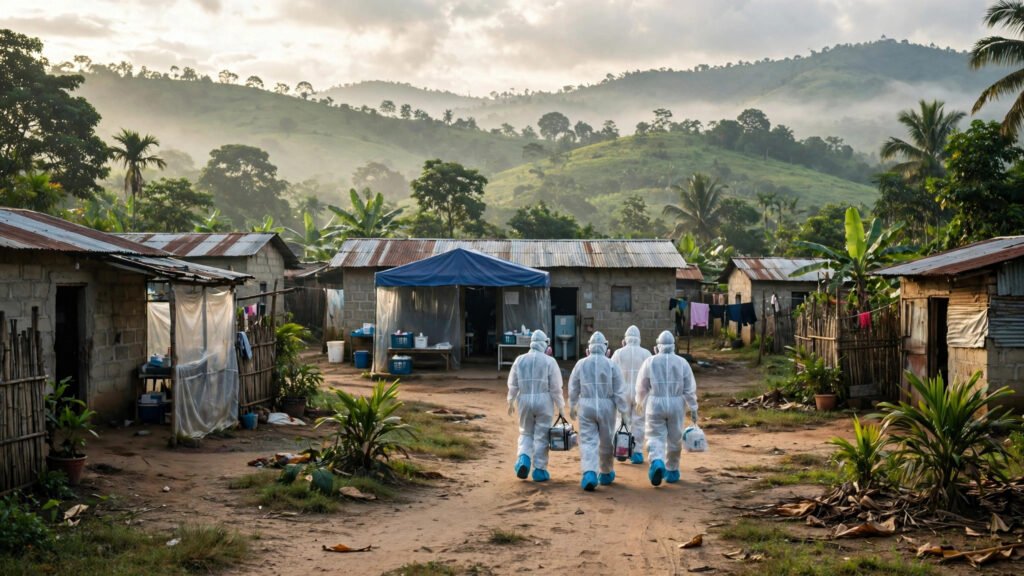
Healthcare workers at an Ebola treatment centre in Mongbwalu, in the Democratic Republic of the Congo’s Ituri province, broke into song and dance this week as the last patients walked out of the facility, a rare moment of celebration in an outbreak that has now passed 10,000 confirmed cases.
Footage circulating online showed a woman dancing as she left the Doctors Without Borders (MSF)-run centre, surrounded by celebrating staff. It is the first time since the outbreak was declared in May that the Mongbwalu clinic has had no confirmed Ebola cases under treatment.
But health officials are clear that an empty ward in one town is not the end of the outbreak. The virus is still spreading across eastern Congo, and the celebrations in Mongbwalu sit alongside grim national figures.
Key Takeaways
- The MSF-run centre in Mongbwalu has no confirmed Ebola cases under treatment for the first time since the outbreak was declared in May 2026.
- DR Congo’s outbreak has passed 10,060 confirmed cases, with nearly half of those infected having died, according to government figures cited by the Associated Press.
- The wider outbreak is still spreading, with 80 percent of new cases appearing outside monitored contacts.
A milestone in Mongbwalu
The Mongbwalu centre is run by the international medical charity Doctors Without Borders, known by its French initials MSF. The latest outbreak was first identified in Mongbwalu and the nearby Rwampara health zone, before it spread to other parts of the country.
The Congolese Ministry of Public Health declared the outbreak on May 15, 2026, making it the country’s 17th Ebola outbreak. The World Health Organization confirmed that it was caused by the Bundibugyo virus, a rare species of Ebola.
World Health Organization Director-General Tedros Adhanom Ghebreyesus said of the scenes in Mongbwalu, according to the Associated Press: “The outbreak is far from over, but every life saved is worth celebrating.”
The outbreak is far from over, but every life saved is worth celebrating.
For the teams who have worked at the centre for months, the discharge of the final patients marked a significant milestone. It was the first time the facility had been empty of confirmed cases since the outbreak began.
An outbreak still growing
The national picture remains severe. Government figures cited by the Associated Press put confirmed cases at 10,060, with nearly half of those infected having died. Around 2,600 people in DR Congo have recovered so far.
The US Centers for Disease Control and Prevention, in its October 29 update, called this the second-largest Ebola outbreak on record. The Associated Press has described it as the fastest-growing Ebola outbreak in history.
What began in three health zones when it was first declared in May has now spread to 66 health zones across eight provinces. Responders have told the Associated Press that 80 percent of new cases are outside monitored contacts, which makes tracing the virus much harder.
- 10,060 confirmed cases recorded, according to Congolese government figures
- Nearly half of those infected have died; around 2,600 people have recovered
- The outbreak has spread from 3 health zones to 66 across eight provinces
- 80 percent of new cases are outside monitored contacts
- No approved vaccine or treatment exists for the Bundibugyo strain
There is still no approved vaccine or treatment for the Bundibugyo strain, though research continues, including work on a single-dose Ebola vaccine. International funding for neglected diseases such as Ebola also remains part of the wider response.
The hard road for responders
The outbreak is unfolding in eastern Congo, where responders face dangers beyond the virus itself. Health workers are still being attacked by angry villagers, and treatment centres in some health zones are overwhelmed.
According to the Associated Press, a nurse was killed and another health worker severely injured while responding to an Ebola alert in Bafwasende, in Tshopo province. In the Nia Nia health zone in Ituri province, Ebola responders including surveillance and community engagement officers went on strike over unpaid bonuses owed since late August, a pattern reported across many affected areas.
Those pressures help explain why the milestone in Mongbwalu matters so much to the people working there, and why it does not, on its own, change the national picture.
What to Watch Next
The key question now is whether the Mongbwalu centre stays empty, and whether new cases continue to appear outside monitored contacts across the 66 affected health zones. The figures to watch are the confirmed case count, which has passed 10,060, and the recovery count, which stands at around 2,600. How responders are protected and paid will also shape what happens next, as will progress on research into a vaccine for the Bundibugyo strain. For now, the celebrations in Mongbwalu stand as a reminder that, even in the second-largest Ebola outbreak on record, every life saved is worth celebrating.